
Students and Fresh Graduates
Applying for your first jobs
Applying for your first jobs is a skill in itself. This topic helps fresh graduates and final-year students decide where to look, how many roles to apply for and how to tailor a resume quickly without sending the same document everywhere. It covers job boards, employer websites, recruitment agencies, referrals and speculative applications, with example emails and messages to recruiters. It also explains when and how to follow up, what to do when applications get no response, how to track everything, and how to handle phone screens, rejections and salary questions as a graduate.
Where should a fresh graduate look for their first job?
Use several channels at once rather than relying on one job site. Graduates find first jobs through many routes, and each reaches different employers.
Main channels:
- Your university careers service and job board, which list employers who want graduates from your institution.
- Employer careers pages, especially for graduate programmes and trainee roles.
- General and graduate-focused job sites, filtered for entry-level, junior and trainee roles.
- LinkedIn: job listings, plus following companies and alumni in your field.
- Recruitment agencies that place graduates, especially in sales, finance, IT and admin.
- Personal networks: lecturers, internship managers, family friends and former classmates.
- Career fairs and employer events on campus or online.
Set up alerts for your target job titles and locations so new roles reach you quickly. Then spend most of your time on roles that genuinely fit your degree, skills and location, and tailor each application. A smaller number of good applications usually works better than hundreds of rushed ones.
How many jobs should I apply for as a new graduate?
There is no magic number. Apply to as many roles as you can tailor properly and that you would genuinely accept. For many graduates, that means a handful of well-prepared applications each week rather than dozens of identical ones.
Think about:
- Fit: do you meet most of the essential requirements?
- Quality: can you adjust your resume and write a short cover letter if needed?
- Tracking: can you keep up with responses, tests and interviews?
If you are getting no responses after a few weeks, change your approach (resume, targeting or channels) rather than just sending more of the same.
Should I apply for jobs that ask for one or two years of experience?
Often yes, if you meet most of the other requirements and can show related experience from internships, projects or part-time work. "One to two years" is sometimes flexible, especially for junior roles.
How to give yourself a fair chance:
- Highlight internships, placements and relevant projects as experience.
- Match the advert's key skills clearly.
- In a cover letter, briefly show how your experience relates.
If an advert clearly needs specialist experience or a licence you do not have, focus your time elsewhere. Roles asking for five or more years are usually not realistic for graduates.
How can I tailor my resume quickly when applying to lots of jobs?
Create a strong master resume, then make a few targeted changes for each application. With practice, this becomes a quick routine for each job.
A quick workflow:
- Keep one master version with every project, job and skill you might use.
- Group the jobs you want into two or three types and keep a base version for each.
- For each advert, change the target role in your summary, reorder your skills and swap in the most relevant bullets.
- Use the advert's exact terms for skills you really have.
- Save the version with a clear name so you know what you sent.
A job-description comparison tool can show which of an advert's most frequent terms are missing from your resume, which speeds up the check. Never add skills you do not have just to match. Light, honest tailoring makes your resume look written for the role, which helps with both recruiters and applicant tracking systems.
Is it better to send many quick applications or fewer tailored ones?
Fewer tailored applications usually work better. Generic applications sent in bulk are easy for employers to spot and often do not match the skills they screen for.
A balanced approach:
- Spend most of your time on roles that fit well, with a tailored resume and a short note or cover letter.
- Use quick-apply options only for roles where your base resume already fits closely.
- Review your results every couple of weeks and adjust.
If quick applications are getting interviews, keep using them. If not, slow down and improve quality.
Are "Easy Apply" or one-click applications worth it for graduates?
They can be, for roles where your saved resume already fits well. But because they are easy, many people use them, so your application may get less attention than one that is tailored.
Make them work better:
- Keep your profile and uploaded resume complete and current.
- Use them for roles closely matching your base resume.
- For roles you really want, apply through the company's site with a tailored resume instead, if possible.
- Follow up with a short message to the recruiter when appropriate.
Track which channel gives you responses, and focus on what works.
Should I apply through the company website or a job board?
If the role is on both, applying through the company's own careers page is often a good choice because your application goes straight into their system. Job boards are useful for finding roles and for quick applications.
Consider:
- The advert may tell you where to apply; follow it.
- Some employers only accept applications through their own portal.
- Do not apply twice for the same role through different routes unless the employer allows it.
Use job boards to discover roles and set alerts, then check whether the company's site offers a direct route.
Should graduates use recruitment agencies?
Yes, agencies can help, especially for roles in sales, finance, admin, IT and hospitality. They find candidates for employers, so they want to place you in a role that suits the client.
How to use them well:
- Register with agencies that specialise in your field or in graduates.
- Send a clear, up-to-date resume and be specific about the roles and locations you want.
- Ask the recruiter for feedback on your resume.
- Keep track of which roles they submit you for.
Legitimate agencies are normally paid by employers. Be very careful with any agency that asks you to pay a fee for a job or interview, and check local rules if unsure.
How do I email a recruiter about a job as a fresh graduate?
Keep it short: who you are, which role you are interested in, why you fit in one or two lines, and your resume attached. Recruiters read many messages, so make yours easy to act on.
Example:
Subject: Application: Graduate Accountant role, Dubai - Priya Menon
"Dear Ms Al Hashimi,
I'm a 2025 BCom Accounting graduate with a three-month internship in accounts payable, and I'm interested in the Graduate Accountant role advertised on your website. My experience with bank reconciliations and Excel reporting matches the skills listed in the advert.
I've attached my resume and would welcome the chance to discuss the role.
Kind regards,
Priya Menon
+971 50 123 4567"
Use a professional email address, a clear file name like "Priya-Menon-Resume.pdf", and check the recruiter's name spelling. If the advert asks you to apply through a portal, do that as well; an email does not replace the official application.
How do I message a recruiter on LinkedIn as a graduate?
Send a short, polite message that names the role or area you are interested in and asks one clear question. Avoid long life stories or asking for a job outright.
Example:
"Hi Ahmed, I'm a recent mechanical engineering graduate interested in your company's graduate engineering roles in Abu Dhabi. I've applied for the Graduate HVAC Engineer position. Could you tell me whether the team is still reviewing applications? Thank you for your time."
Personalise each message, keep it under about 80 words, and make sure your profile matches your resume. If you do not get a reply, one polite follow-up after a week or two is enough.
Can I apply to a company that isn't advertising jobs?
Yes. A speculative application can work, especially with smaller companies, start-ups and firms that hire graduates informally. Target your message carefully.
How to do it:
- Research the company and find the right person, such as a team manager or HR contact.
- Explain what you can offer and what kind of role you are looking for.
- Attach a tailored resume.
- Keep it short and polite, and accept that many will not reply.
Example opening: "I'm a recent environmental science graduate and admire your work on water recycling projects. I'm writing to ask whether you expect any entry-level openings in your project team."
When should I follow up after applying for a graduate job?
Wait until after the closing date, or about one to two weeks after applying if there is no closing date, then send one short, polite follow-up. Many graduate roles have long processes, so patience is normal.
Tips:
- Check the advert for timelines first; if it says not to contact them, do not.
- Follow up by email or the portal's messaging option.
- Keep it brief and reconfirm your interest.
If there is still no reply after another week or two, move on and focus on other applications. Silence is common and usually not personal.
What should a follow-up email after applying say?
Say which role you applied for and when, restate your interest in one sentence and ask politely about the next steps.
Example:
Subject: Follow-up: Junior Data Analyst application - Daniel Okafor
"Dear Hiring Team,
I applied for the Junior Data Analyst role on 3 March and wanted to confirm that my application was received. I remain very interested in the position and the chance to apply my SQL and Power BI skills in your team. Please let me know if you need any further information.
Kind regards,
Daniel Okafor"
Do not attach your resume again unless asked, and do not send repeated follow-ups.
I've applied to many jobs and heard nothing back. What should I change?
Review your targeting, your resume and your channels one by one. No responses usually means something in the process is not working, not that you are unemployable.
Check these:
- Targeting: are you applying for roles that match your degree, skills and location? Are many asking for experience you do not have?
- Resume: is it tailored, specific and readable? Does it use the advert's key terms honestly? Is the PDF text selectable and the layout simple?
- Channels: are you only using one job site? Try careers services, agencies, referrals and direct applications.
- Volume and timing: are you applying soon after roles are posted?
Ask a careers adviser, a recruiter or someone working in your target field to review your resume. Run it through an ATS-readiness check to catch structural issues, keeping in mind that the score is an estimate, not a prediction. Then change one or two things at a time and track whether responses improve.
Can I apply for more than one role at the same company?
Yes, if you genuinely fit each role and they are reasonably related. Applying for many unrelated roles at one company can make you look unfocused.
Tips:
- Choose two or three roles that suit your skills.
- Tailor your resume for each one.
- Check whether the company limits applications per candidate or per graduate programme.
For graduate programmes with several streams, many employers ask you to choose one or rank your preferences, so read their instructions carefully.
When should I start applying for jobs if I'm in my final year?
Start early, especially for graduate programmes, which often recruit many months before the start date. For ordinary entry-level jobs, start a few months before you finish, because many employers hire for roles that start soon.
A rough plan:
- Early in your final year: research employers, update your resume and apply for graduate programmes.
- Mid-year: keep applying to programmes and start applying for entry-level roles with later start dates.
- Last few months: apply widely for roles starting after graduation.
On your resume, include your expected graduation date and when you can start.
Should I wait for my final results before applying?
No. Most employers accept applications from students before final results, using your predicted or current grades. Waiting can mean missing graduate programmes and early openings.
What to do:
- Show your expected graduation date and, where asked, predicted or current grades, clearly labelled.
- Update your resume and applications as soon as results come out.
- Be honest if an employer asks about your expected results; offers may depend on them.
If a job requires a completed degree on the start date, check that your graduation timing fits.
What job titles should a graduate search for?
Search for entry-level terms as well as your field, because graduate roles go by many names.
Common entry-level terms:
- "Graduate", "Graduate trainee", "Management trainee"
- "Junior", "Assistant", "Associate"
- "Entry level", "Fresher", "Trainee"
- "Analyst" or "Coordinator" in many business roles
Combine them with your field: "junior data analyst", "graduate civil engineer", "marketing assistant", "HR coordinator". Read the requirements rather than relying on the title, because "associate" and "analyst" can mean different levels at different employers.
Should I accept an unpaid role after graduating to get experience?
Think carefully. A short, structured, unpaid opportunity can sometimes help, but long unpaid work can be unfair and, in some places, may not be allowed. Rules on unpaid work differ by country, so check official guidance where you live.
Questions to ask:
- Is it short, with clear training and supervision?
- Will it lead to useful skills, a reference or a paid role?
- Are you doing real work that a paid employee would normally do?
- Can you afford it without hardship?
Never pay to work for an employer. Paid internships, graduate jobs and temporary work are usually better routes if available.
How do I answer a salary expectations question as a graduate?
Research typical pay for the role, level and location before applying, then give a sensible range or say you are flexible and open to discussion. Avoid naming a figure you have not researched.
How to research:
- Graduate pay information published by employers or your careers service.
- Salary tools on reputable job sites.
- Conversations with alumni or recruiters.
If the form allows, write something like "Negotiable" or "In line with the advertised range". If you must enter a number, use your research and be ready to explain it. Salary norms vary widely by country and sector.
How do I ask someone for an informational interview?
Send a short message asking for 15 to 20 minutes to learn about their job or company, not for a job. People are more willing to help when the request is small and specific.
Example:
"Hi Sara, I'm a recent business graduate interested in supply chain roles. I saw that you work as a logistics analyst at Gulf Freight and studied at my university. Would you be open to a 15-minute call in the next couple of weeks to share how you started your career? I'd really appreciate your advice."
Prepare a few questions, keep to time and thank them afterwards. If they offer to pass on your resume, send a tailored version.
Can I ask a friend to refer me for a job?
Yes, if they know you well enough to vouch for you and the company has a referral process. Referrals can help your resume get noticed, but they do not replace the normal selection steps.
How to ask:
- Send them the exact job link and your tailored resume.
- Explain briefly why you are interested and how you fit.
- Make it easy for them to say no.
Thank them whatever happens, and let them know the outcome. Never ask someone to refer you for a role you are not suitable for, as it affects their reputation too.
How do I look for first jobs in the UAE as a fresh graduate?
Combine Gulf job sites, LinkedIn, employer careers pages, recruitment agencies and university careers services, and tailor your CV to the local style.
Tips:
- Use a clear, Gulf-style CV with your location, phone number with country code, nationality if you wish, and languages.
- Follow companies in your field on LinkedIn and apply soon after roles are posted.
- Register with reputable agencies; legitimate ones do not charge you for placement.
- Network through alumni, university events and professional groups.
If you are applying from outside the country or are unsure about permission to work, use official UAE government sources for that information rather than job sites.
Should I apply for jobs abroad as a fresh graduate?
You can, but be realistic and do your research. Applying abroad is harder without local experience or permission to work, so target employers and roles that recruit internationally.
Before applying:
- Check official government sources for the country about working there.
- Learn the local resume format and adjust yours.
- Look for international graduate programmes, multinational companies and roles needing your languages.
- Keep applying at home too, so you are not relying on one route.
On your resume, state your location and when you could start, and add a work authorization line only if you are sure it is accurate.
Should I reply to a rejection email?
A short, polite reply is a good idea, especially if you got as far as an interview. It leaves a positive impression and can be a chance to ask for feedback.
Example:
"Thank you for letting me know, and for the opportunity to interview. I enjoyed learning about the team. If you have any feedback that could help me in future applications, I would be grateful. I hope to apply for future openings with you."
Do not argue with the decision. Many employers cannot give individual feedback, so accept a non-reply gracefully.
Templates to try
Free to edit and preview. Single-column layouts are the safest choice for applicant tracking systems.
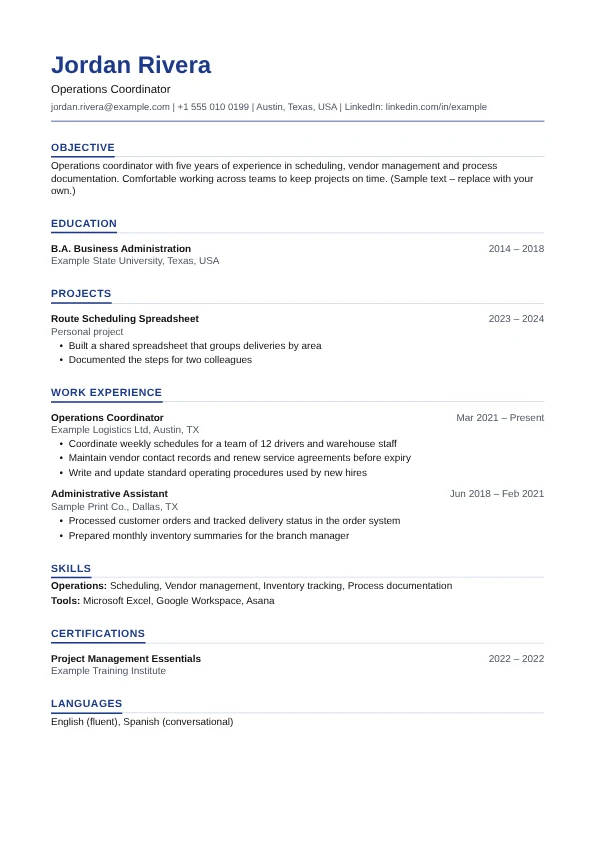
Graduate Resume
Single column

Student Resume
Single column

ATS Classic
Single column
General guidance for job seekers, not legal or immigration advice. Employers and applicant tracking systems differ, so always follow the instructions in the job advert. Spotted a mistake? Email support@jobb.ae.
Ready to build your resume?
Start with a sample or a blank page. No sign-up needed. Free to edit; US$1.00 only if you download a PDF.