
Students and Fresh Graduates
The education section for students
For students and new graduates, the education section often carries the most weight on the page. This guide explains how to write it well: where to place it, how to show an expected graduation date, which modules to list, and how to present honours, scholarships, a thesis or a final-year project. It also covers school results such as A-levels, Class 10 and 12, the IB and UAE Grade 12 certificates, and situations like transferring universities, pausing a degree or waiting for results, with sample entries you can adapt.
What should the education section of a student resume include?
Include your qualification, subject, institution, location and dates, and then add only the details that strengthen your application. For students and new graduates, the education section is often the most important part of the resume, so it deserves care.
Core details:
- Degree or qualification and major, such as "BSc Computer Science".
- Institution name and city or country.
- Start and end dates, or an expected graduation date.
Useful extras, if they help:
- Your grade, GPA, CGPA or classification, when it is good or requested.
- Three to six relevant modules.
- Honours, scholarships or awards.
- Thesis or final-year project title.
Example:
"BBA in Marketing | Gulfview University, Dubai, UAE | Sep 2022 – Expected Jun 2027
Relevant modules: Consumer Behaviour, Digital Marketing, Market Research
Dean's List: Fall 2023, Spring 2025"
Keep each extra line short, and leave out anything that does not relate to the jobs you want.
When should a graduate move education below work experience?
Move education below experience once your work history becomes your strongest evidence for the jobs you want. For most people this happens after their first full-time role, or after one or two substantial internships in the same field.
Ask yourself: what would the employer most want to see first? If it is your degree and academic projects, keep education at the top. If it is a relevant internship or job, put experience first.
You can also change the order for different applications. For example, a graduate applying for an engineering role might put education first, but put a sales internship first when applying for a sales job.
How do I write an expected graduation date on my resume?
Write "Expected" followed by the month and year you plan to finish. This tells employers you are still studying and when you will be available.
Examples:
- "BSc Civil Engineering | Expected May 2027"
- "Bachelor of Commerce, Westbay University, Mumbai | 2023 – Expected 2027"
Use the official expected completion date from your university. If you are not sure, check your study plan or ask your department. This date matters for graduate jobs and internships, because many employers plan start dates around it.
A few extra tips:
- Put the expected date in the same position where finished degrees show their end date, so the layout stays consistent.
- If you are applying for an internship, the expected date also tells the employer which year of study you are in.
- If you finish your final exams before the official graduation ceremony, use the month you complete your requirements, not the ceremony date.
- Once you graduate, remove "Expected" and keep only the completion date.
Should I write "Expected", "Anticipated" or "Candidate for" before my degree?
Any of these is acceptable, but "Expected" is the simplest and most widely understood. Choose one style and use it consistently.
- "Expected Jun 2027" is clear and common in many countries.
- "Anticipated Jun 2027" means the same, and is used more in the USA.
- "Candidate for BSc Physics" is more formal and less common outside academic settings.
Avoid writing only the end year without any marker, such as "2022 – 2026", if that might suggest you have already graduated. Clarity matters more than the exact word.
My graduation will be delayed. What date should I put on my resume?
Put the new realistic date, and update it whenever it changes. An employer may plan around your expected date, so it should be accurate.
If the delay is due to a repeated module, a placement year, a transfer or personal reasons, you do not need to explain it on the resume. Simply give the current expected date. If an interviewer asks, give a short, honest explanation.
Example: "BEng Mechanical Engineering | Expected Dec 2027" (updated from an earlier June date).
Never keep an old date you know is wrong; it can cause problems when the employer checks your availability or certificates.
I am in my first year of university. What should my education section show?
Show your degree, university and expected graduation date, plus your school results if they are strong. You have little university content yet, so school qualifications still carry weight.
Example:
"BSc Accounting and Finance | Coastline University, Sharjah | Expected Jun 2029
A-Levels: Mathematics, Economics, Business (2025)"
You can add one or two first-year modules if they relate to the job. As you complete more of your degree, replace school details with university achievements, projects and grades.
How do I show my major and specialisation in my education section?
Write the degree title, then the major or specialisation, in the order your university uses. Clarity is more important than following one exact format.
Examples:
- "BBA, Major in Finance"
- "B.Tech in Electronics and Communication Engineering"
- "BSc Psychology (Specialisation: Organisational Psychology)"
- "Bachelor of Arts in English, Concentration in Creative Writing"
Use the wording on your official transcript or degree certificate. If a specialisation is especially relevant to the job, make sure it is easy to see, for example by putting it on the first line rather than lower down.
How do I list a double major or dual degree?
List both clearly in one entry if they belong to one degree programme, or as two entries if they are two separate degrees. Follow how your university describes it.
Examples:
- Double major, one degree: "BA in Economics and Political Science (Double Major)"
- Dual degree, two awards: "BEng Mechanical Engineering" and "BSc Business Management" as separate entries, with the same dates.
If one subject is more relevant to the job, put it first. Make sure your transcript matches what you write, as some employers verify degrees.
Should I put my minor on my resume?
Yes, if it relates to the job or adds a useful skill. A minor can show breadth, such as a computer science student with a minor in business or an engineering student with a minor in Arabic.
Example: "BSc Computer Science, Minor in Business Administration".
If the minor is unrelated and space is tight, you can leave it out. It does not need its own line; adding it after the major is enough.
Which modules should I list in my education section?
List three to six modules that relate directly to the job, especially ones the advert mentions or that show advanced skills. Do not list every course you have taken.
How to choose:
- Match the job: for a finance role, choose accounting, corporate finance or financial modelling modules.
- Prefer higher-level or specialised modules over introductory ones.
- Use clear names; if a module has a vague title, add a few words of explanation.
Example: "Relevant modules: Data Structures, Database Systems, Machine Learning, Software Engineering Project".
Change the list for different job types, because different modules matter to different employers.
Should I write modules as a list or as bullet points?
A single line with modules separated by commas or vertical bars is usually best. It saves space and is easy to scan.
Example: "Relevant modules: Corporate Finance | Financial Reporting | Taxation | Audit and Assurance"
Use bullet points only if you add a short description to each, for example when a module included a substantial practical project. If you have that much to say, it may be better to move the work to a "Projects" section and keep the module line short.
Can I list modules I am taking right now?
Yes. Current modules are fine to list, especially if they are relevant and more advanced than the ones you have finished. You can mark them so the reader knows.
Example: "Relevant modules: Financial Accounting, Business Law, Corporate Finance (in progress)"
Make sure you can talk about the topics if asked. If you drop or fail a module later, update your resume.
How do I show Dean's List or academic honours on my resume?
Add them as a short line under your degree, with the terms or years you earned them. This keeps your academic achievements in one place.
Examples:
- "Dean's List: Fall 2023, Spring 2024, Fall 2024"
- "President's Honours List, 2025"
- "Academic Excellence Award, Faculty of Engineering, 2024"
If you received the same honour every term, you can write "Dean's List (all semesters)". If you have several awards, consider a separate "Awards" section, but keep the most important one with your degree so it is seen early.
What does "Hons" mean after a degree, and should I write it?
"Hons" means the degree was awarded with honours. In the UK and some other systems, most bachelor's degrees are honours degrees, written as "BSc (Hons)" or "BA (Hons)". Write it if it is part of your official degree title.
Example: "BSc (Hons) Biomedical Science, Northgate University, 2025"
It is different from a grade. In the UK, the honours degree is usually also given a classification, such as First Class or Upper Second Class, which you can add if it helps you. Use the exact title shown on your degree certificate or transcript.
How do I list Latin honours like cum laude on my resume?
Write the honour after your degree, in the form your university uses. Latin honours are used by some universities, mainly in the USA and parts of Europe, to recognise strong overall results.
Examples:
- "BA in Economics, magna cum laude"
- "BSc Biology, summa cum laude, 2025"
Use italics only if your template supports them cleanly; plain text is fine. If an international employer may not know the terms, the grade or GPA next to them can help, but do not translate the honour into a claim the university did not make.
Should I put scholarships in my education section?
Yes. Scholarships show that someone selected you, and they fit neatly under your degree. Include the name and, if helpful, what it was awarded for.
Examples:
- "Merit Scholarship, awarded for academic performance (2023 – 2026)"
- "Full tuition scholarship, University Excellence Programme"
Do not include the scholarship's monetary value. If you have several awards, you can group them under "Scholarships and Awards". If a scholarship involved selection through interviews or tests, a short note can show how competitive it was, but avoid unverifiable claims about acceptance rates.
I am on a government or company-sponsored scholarship. Should I mention it?
You can, and it is common in the UAE and wider Gulf to mention sponsorship. It shows you were selected, and some employers will want to know your situation.
Example: "BSc Petroleum Engineering, sponsored scholarship from a national energy company".
Be aware that some sponsorships include conditions, such as working for the sponsor after graduating. Check your agreement before applying elsewhere, and be ready to answer questions honestly. You do not need to give financial details on your resume.
Should academic awards go in education or in a separate awards section?
Put one or two academic awards under your degree, and use a separate "Awards" section if you have several or if some are non-academic. The aim is to keep your resume easy to scan.
- Few awards: "BSc Mathematics | First Year Excellence Award, 2023" under education.
- Many awards: a short "Awards" section with the most impressive first.
Non-academic awards, such as sports or competition prizes, usually belong in awards or activities rather than education. Avoid listing the same award in two places.
Should I include my thesis or dissertation title?
Yes, if it relates to the job or shows skills the employer values, such as research, data analysis or writing. A clear title can start a conversation in interviews.
Example: "Dissertation: The effect of remote work on employee engagement in UAE banks"
Add one line of description if the title is technical, for example: "Analysed survey responses from 120 employees using SPSS." If your dissertation is unrelated to the job, you can still include it in a single line, as it shows you completed an independent piece of work.
How do I describe my thesis in bullet points?
Describe the question, your method and your result in one to three bullets, using plain language. Write it for someone outside your field.
Example:
"Dissertation: Customer loyalty in UAE grocery delivery apps
- Designed and ran a survey of 200 app users; analysed data in Excel and SPSS.
- Found that delivery speed predicted repeat orders more than price.
- Presented findings to a faculty panel; awarded a distinction."
Choose the details that match the job. For a research role, describe methods in more depth; for a business role, focus on findings and practical use.
Should my final-year project go under education or projects?
Put a short mention under education and the full description under projects, or put it only in projects if it is substantial. Avoid describing it twice.
Option 1: Under education: "Final-year project: Smart irrigation controller (see Projects)." Then describe it under projects.
Option 2: A projects section alone, with title, dates, your role and results.
For technical, design and engineering roles, a separate project entry with bullets usually works best. For other roles, a one-line mention under education may be enough.
I am at university now. Should my school results still be on my resume?
Keep them during your first year or two if they are strong or the employer expects them, then remove or shorten them as your degree content grows. University results and projects usually become more important.
Keep school results longer if:
- You are applying in India, where many employers ask for Class 10 and 12 results.
- They are exceptionally strong or include a relevant subject.
- The application form requests them.
When you remove them, you can keep a one-line entry, such as "A-Levels, 2024, Dubai", if space allows.
How do I list my A-levels and GCSEs on my resume?
List A-levels with subject and grade, and summarise GCSEs in one line. GCSEs matter less once you have A-levels or a degree.
Example:
"A-Levels (2025): Mathematics A, Chemistry B, Biology B
GCSEs (2023): 9 GCSEs at grades 9–5, including Mathematics and English"
If you are still waiting for results, use predicted grades and label them as predicted. University students often keep only A-levels, or remove both once they have degree results. Write grades exactly as given, and do not round up.
How do I list Class 10 and Class 12 results on my resume?
List each with the board, school, year and result, in reverse order (Class 12 first). Many Indian employers and campus recruiters expect these details for freshers.
Example:
"Class XII (CBSE), Riverside Public School, Pune | 2022 | Aggregate: 88.6
Class X (CBSE), Riverside Public School, Pune | 2020 | CGPA: 9.4"
Use the exact format your board gives, whether marks out of a total, a percentage aggregate or a CGPA. If a form asks for percentages, fill it in the form's format and follow the board's official conversion rules if you need to convert.
Some practical points:
- Write the board name (CBSE, ICSE or your state board) because employers recognise them.
- Use "Class XII" and "Class X" or "HSC" and "SSC", whichever your board uses, and stay consistent.
- Once you have strong degree results and some experience, you can shorten these lines or drop Class 10, unless the employer asks for it.
- Make sure the figures match your mark sheets exactly, since campus recruiters often check documents.
How do I list the IB Diploma on my resume?
Write "International Baccalaureate (IB) Diploma", the school, the year and your total points, then list your Higher Level subjects if they are relevant.
Example:
"IB Diploma, Palm Grove International School, Dubai | 2025 | 38 points
Higher Level: Economics, Mathematics AA, Business Management"
If you are still studying, use predicted points and label them. If you took IB courses without the full Diploma, write "IB Courses" or "IB Certificates" with the subjects rather than claiming the Diploma.
Templates to try
Free to edit and preview. Single-column layouts are the safest choice for applicant tracking systems.
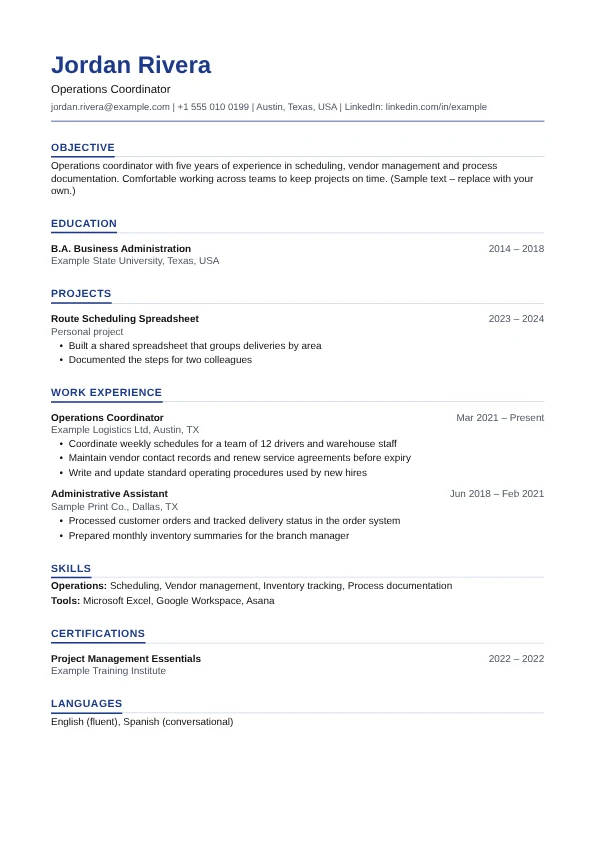
Graduate Resume
Single column

Student Resume
Single column

ATS Classic
Single column
General guidance for job seekers, not legal or immigration advice. Employers and applicant tracking systems differ, so always follow the instructions in the job advert. Spotted a mistake? Email support@jobb.ae.
Ready to build your resume?
Start with a sample or a blank page. No sign-up needed. Free to edit; US$1.00 only if you download a PDF.