
Students and Fresh Graduates
Writing your first resume
Writing your first resume can feel hard when you are not sure what belongs on the page. This guide answers the questions students, school leavers and new graduates ask most when starting from zero: what to include, how to order the sections, how long the document should be, how to write clear bullet points, and how to get useful feedback before you apply. It covers common habits in the UAE and Gulf, India, the UK and elsewhere, and explains simple checks that help your resume read well for both people and applicant tracking software.
How do I write my first resume when I have never made one before?
Start by collecting facts, not by opening a template. Write down everything you have done in the last few years: your studies, projects, part-time or holiday work, volunteering, clubs, awards, languages and software you can use. Then turn that list into a short document with clear headings.
A simple order for a first resume:
- Contact details: name, phone with country code, professional email, city and country.
- A two- or three-line profile saying what you are studying or have studied and what kind of role you want.
- Education, with your degree or school qualification, institution and dates.
- Projects, internships or work experience, with one to three bullets each.
- Skills and languages.
Write bullet points that start with an action verb and say what you did. Example: "Organised a charity book sale that sold over 300 donated books." Keep it to one page, read it aloud to catch mistakes, and ask someone you trust to check it before you send it.
What should a first resume include?
A first resume should include your contact details, a short profile, your education, any experience (paid, unpaid, academic or volunteer) and your skills. Those five parts are enough for most students and new graduates.
Add extra sections only when you have real content for them:
- Projects, if you built, researched or organised something.
- Internships or placements.
- Volunteering, clubs and societies.
- Certifications or short courses that relate to the job.
- Awards and scholarships.
- Languages, with an honest level for each.
Leave out things that do not help an employer decide, such as a list of hobbies with no detail, a full list of every school subject, or personal details that the job advert does not ask for. A shorter resume with strong, specific points is better than a long one padded with general statements.
Where do I even start if my resume page is completely blank?
Start with the section you know best, which for most students is education. Writing your degree or school name, dates and subjects gets something on the page and builds momentum.
Then work through these prompts, writing quick notes before polishing anything:
- What have I made, solved or organised in class or outside it?
- Who has trusted me with a responsibility, even a small one?
- What do friends or teachers ask me to help with?
- Which tools, apps or languages do I use confidently?
Turn each note into a bullet that starts with a verb. A starter resume or a sample resume can also help, because you replace example text instead of facing an empty screen. Just make sure every line you keep is true for you.
Is a resume the same thing as a CV for a student?
Mostly yes, in everyday use. In the UK, Ireland, India, the Gulf and much of Europe, people say "CV" for the one- or two-page document you send with a job application. In the USA and Canada, that document is called a "resume", and "CV" usually means a longer academic record used for research and teaching jobs.
For a student or new graduate, the content is the same either way: contact details, a short profile, education, experience, projects and skills. Use the word the employer uses in its advert. If a UAE company asks for your "CV", send your normal one- or two-page document; you do not need a separate academic CV unless you are applying for a research or university post.
How long should my first resume be?
One page is the right length for almost every first resume. With little work history, a single page lets you show your education, best projects and skills without padding.
If your content spills onto a second page, cut before you shrink the font. Remove school-level details if you have a degree, shorten long bullets, and drop sections that repeat what is already said elsewhere. Keep the text at a readable size and leave some white space.
A second page can be fine later, once you have several internships, published research or a substantial portfolio, but it is rarely needed for a first application.
What order should the sections go in on a first resume?
Put your strongest, most relevant section near the top, after your contact details and short profile. For most students and recent graduates, that is education.
A common order for a first resume:
- Contact details
- Profile (two or three lines)
- Education
- Projects or internships
- Work experience, including part-time jobs
- Volunteering and activities
- Skills and languages
Change the order when it helps you. If you completed a strong internship in exactly the field you are applying for, move it above education. If your degree is unrelated to the job but you have relevant projects, put projects higher. Employers read from the top, so put your best evidence where it is seen first.
Do I need a different resume for every job I apply to?
You need one strong main version and then small changes for each application. Rewriting from scratch every time is not necessary, but sending the identical file everywhere usually makes it weaker.
For each job, spend a few minutes on:
- Your profile line, so it names the type of role you are applying for.
- The order of your projects or experience, putting the most relevant first.
- Your skills, making sure the ones the advert asks for (and you really have) are clearly listed.
- Words from the job advert, used naturally where they truly describe your work.
Save each version with a clear name, such as "Aisha-Rahman-Resume-Marketing.pdf", so you know which one went where.
What contact details should go on a student resume?
Include your full name, a phone number with country code, a professional email address, and your city and country. Add a LinkedIn profile or portfolio link if it is complete and relevant.
Example: "Omar Haddad | +971 50 123 4567 | omar.haddad@email.com | Dubai, UAE | linkedin.com/in/omarhaddad"
You do not need your full street address; a city is enough for most applications. Leave out details that the job advert does not request, such as marital status or religion. Some employers in the Gulf ask for nationality or visa status, and you can include those if the advert asks for them. Double-check every digit of your phone number and email, because one typo can stop an employer reaching you.
Is my school email address OK to use on my resume?
Use a personal email address instead, unless you will keep the school address for a long time. Many schools and universities close student email accounts some time after you graduate or leave, and an employer could reply after it stops working.
Create a simple personal address based on your name, such as firstname.lastname@ or a version with an initial or number if your name is taken. Avoid nicknames, jokes or birth years in the address.
A university address can still be useful during your studies for internship or campus applications, because it shows you are a current student. If you use it, check it often and set up forwarding to your personal inbox.
My email address is a funny nickname from years ago. Does it matter?
Yes, it is worth changing before you apply. An address like "partyking2005@" or "cutieprincess@" can look unprofessional next to a serious application, and it is easy to fix for free.
Make a new address using your name, for example "sara.mendes@" or "s.mendes.work@". Use it only for job hunting so offers and interview invitations do not get lost among other messages. Keep your old address for personal use if you like; just do not put it on your resume or application forms.
Should I put a photo on my first resume?
Usually no, unless the employer or job advert asks for one. In the UK, Ireland, the USA, Canada and Australia, resumes are normally sent without photos. In the Gulf and some other regions, photos are more common, but they are rarely essential, and many employers judge on content first.
A photo also takes space you could use for projects or skills, and some applicant tracking systems (software that stores and sorts applications) handle images poorly. If an employer specifically asks for a photo, follow its instructions, perhaps by attaching it separately. Otherwise, spend your effort on the written content.
Do I need a profile or summary at the top of my first resume?
A short profile helps, but keep it to two or three lines. It tells the reader who you are and what you are looking for before they read the details.
Example: "Second-year Business Administration student at a Sharjah university, looking for a summer internship in marketing. Experienced in running social media for a student society and creating simple reports in Excel."
Avoid long lists of personality words such as "hard-working, passionate, motivated". Name your study area, the kind of role you want and one or two concrete things you can offer. If you cannot write anything specific yet, it is better to leave the profile out than fill it with general phrases.
What counts as experience on a first resume?
Experience is anything where you took on responsibility and can show what you did, not only paid jobs. Employers hiring students know you have not had a long career.
Things that count:
- Internships, placements and work shadowing.
- Part-time, weekend and holiday jobs.
- Volunteering and community work.
- Leading or helping run a club, society or event.
- Academic, personal or freelance projects.
- Helping in a family business, if you had real duties.
Label each one honestly. A volunteer role goes under "Volunteering" or a combined "Experience" heading with "(Volunteer)" after the title. What matters is that every item has a short, specific description of your actions and results.
How do I write bullet points for my first resume?
Start each bullet with an action verb, say what you did, and add a result or detail where you can. Keep each bullet to one or two lines.
A simple pattern is: verb + task + result or scale.
- Weak: "Responsible for social media."
- Better: "Planned and posted weekly Instagram content for the university robotics club, growing followers from 200 to 650 in one semester."
Useful verbs for students include organised, built, researched, presented, led, designed, tested, trained, coordinated and analysed. Use past tense for finished activities and present tense for ones you are still doing. Avoid starting every bullet with "Responsible for" or "Helped with", which hide what you actually did.
Finally, check that each bullet says something different. If two bullets describe the same skill, merge them and use the space for a new example, such as a presentation, a deadline you met or a tool you learned.
Should I write my resume in first person with "I"?
No, resumes normally leave out "I", "me" and "my" in bullet points. You start with the verb instead, which is shorter and is the style employers expect.
- Not: "I organised a careers fair for 150 students."
- Instead: "Organised a careers fair for 150 students."
In the short profile at the top, you can write in a similar clipped style ("Final-year engineering student seeking...") or use full sentences without "I". Whichever you choose, keep it consistent. Your cover letter is the place for a more personal voice using "I".
Should I use past or present tense on my first resume?
Use present tense for things you are still doing and past tense for things that have finished. Mixing tenses within one entry looks careless, so check each section.
- Current society role: "Coordinate weekly meetings for 40 members."
- Finished internship: "Prepared weekly sales summaries for the regional manager."
For your education, describe completed projects in past tense even if you are still studying, because the project itself has ended. Read your resume once just to check tenses; it is one of the most common small mistakes in first resumes.
Can I use a resume template for my first resume?
Yes, a template is a sensible way to start. It gives you headings and a clean layout so you can focus on writing good content.
Choose a template that:
- Uses a simple, single-column layout, which applicant tracking systems (the software many employers use to store applications) tend to read more reliably.
- Has clear section headings such as Education, Experience and Skills.
- Uses a readable font and enough white space.
Avoid designs with heavy graphics, skill bars, text inside images or many columns, especially for online applications. Every template on ResumeBuilder.ae is free to use and preview, and you only pay US$1.00 if you want to download the PDF.
Should my first resume be colourful and creative to stand out?
Usually no. For most jobs, a clean and simple layout stands out more than colours and graphics, because the reader can find information quickly.
Creative designs can also cause problems with applicant tracking systems, which may struggle to read text in columns, boxes, icons or images. A touch of colour in headings is fine; skill bars, photos of yourself and decorative shapes are not needed.
If you are applying for a design role, show your creativity through a portfolio link and well-chosen projects, and still keep the resume itself easy to read. Your content, not decoration, is what makes a first resume memorable.
What font and size should I use on my first resume?
Use a plain, widely available font at a size that is easy to read on screen and on paper. Common choices are Arial, Calibri, Helvetica, Georgia and similar fonts.
Practical guidelines:
- Body text roughly 10 to 12 points, depending on the font.
- Headings slightly larger or in bold.
- One font for the whole document, or at most two.
- Avoid handwriting-style or decorative fonts.
If the resume only fits by using a tiny font, cut content instead. A reader who has to squint will not take in your best points.
Should I send my first resume as a PDF or a Word file?
Send a PDF unless the employer asks for something else. A PDF keeps your layout the same on any device, so the reader sees exactly what you designed.
Check the application instructions first. Some job portals or employers ask for a Word document, and in that case you should provide one. Make sure your PDF is text-based (you can select and copy the words) rather than a scanned image, because applicant tracking systems need to read the text.
ResumeBuilder.ae exports text-based PDFs only. If an employer insists on Word, you can copy the text from the builder into a word processor and save it from there.
How should I name the file of my first resume?
Use your name and the word "Resume" or "CV", and keep it simple. The employer may download many files, and a clear name helps them find yours.
Examples:
- "Priya-Nair-Resume.pdf"
- "Daniel-Okafor-CV-Graduate-Engineer.pdf"
Avoid names like "resume final FINAL v3.pdf" or "document1.pdf". Do not include spaces or special characters if the upload page has problems with them; hyphens are a safe choice. If you keep several tailored versions on your computer, you can add the role name, but remove anything personal like "my new cv".
Who should I ask to check my first resume?
Ask at least two people: someone who knows you and someone who knows the job market. Each will spot different problems.
Good reviewers:
- Your university or school careers service, which often offers free resume checks.
- A teacher, lecturer or project supervisor who knows your work.
- A relative, family friend or alumnus working in the field you want.
- A friend with strong English, for spelling and grammar.
Give them a specific request, such as "Is it clear what job I want?" or "Which bullet is weakest?". You will get more useful answers than from "Is this OK?". You do not have to accept every suggestion, but take note when two people point to the same issue.
How do I ask my careers office for feedback on my resume?
Book an appointment or drop-in session through your careers service, and bring a draft plus a job advert you are interested in. Feedback is much more useful when the adviser can compare your resume with a real role.
Before the meeting:
- Finish a full draft, even if you are unsure about parts of it.
- Note two or three specific questions, such as how to describe a project or whether to include your school grades.
- Bring the advert, or the type of role you are aiming for.
Afterwards, make the changes quickly while the advice is fresh, and book a second check if you rewrite large parts. Many careers services also help alumni, so ask whether you can still use them after graduating.
I got conflicting advice about my resume. Who do I listen to?
Listen to the advice that best matches the job and country you are applying to. Many resume "rules" are preferences, so different reviewers will disagree.
Ways to decide:
- Prefer advice from people who hire in your field or region over general opinions.
- Check the employer's own instructions, which always come first.
- Ask "Does this change make it easier for the reader to see I fit the job?" If yes, keep it.
- Where advice involves honesty, accuracy or readability, follow the stricter view.
For example, one person may say "always use a photo" and another "never use one". The answer depends on the country and the employer, so follow local norms and any instruction in the advert.
How do I check my first resume for mistakes before sending it?
Read it slowly in several different ways, because your eyes skip errors in text you wrote yourself.
A simple checking routine:
- Run a spelling and grammar check, then read it again yourself, since checkers miss wrong words like "manger" for "manager".
- Read it aloud, line by line.
- Check that all dates, names and job titles are consistent and correct.
- Test every link and your phone number and email.
- Look at the PDF version on your phone and computer to check the layout.
- Ask another person to read it.
Leave it overnight before the final check if you can. Fresh eyes notice more.
Templates to try
Free to edit and preview. Single-column layouts are the safest choice for applicant tracking systems.

Student Resume
Single column
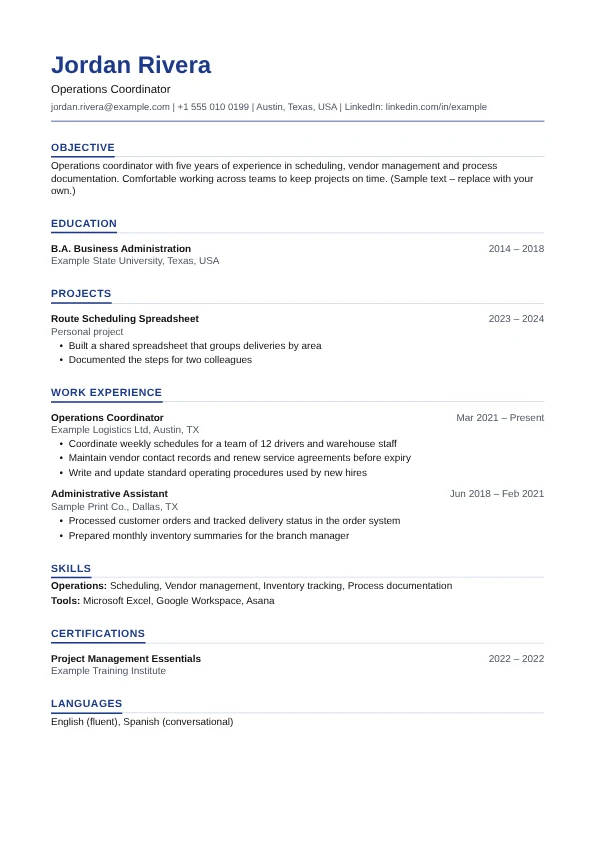
Graduate Resume
Single column

ATS Classic
Single column
General guidance for job seekers, not legal or immigration advice. Employers and applicant tracking systems differ, so always follow the instructions in the job advert. Spotted a mistake? Email support@jobb.ae.
Ready to build your resume?
Start with a sample or a blank page. No sign-up needed. Free to edit; US$1.00 only if you download a PDF.