
CV Guidance by Country
United Kingdom CV and resume guidance
This guide explains how CVs are usually written for jobs in the United Kingdom. It covers the two-page convention, British spelling and A4 layout, the personal profile, and which personal details such as date of birth, nationality and photos are usually left off. It also helps you present UK qualifications such as GCSEs, A-levels, Highers, BTECs, apprenticeships and degree classifications, and explains public sector application forms, recruitment agencies, graduate schemes and applying from abroad. Official guidance is referenced where it supports a point; always follow each employer's own instructions.
Do people in the UK call it a CV or a resume?
CV. In the United Kingdom, "CV" (curriculum vitae) is the standard word for the document you send with job applications, and "resume" sounds American to most British recruiters. Using "CV" in your file name, cover letter and job site profile fits local expectations.
A UK CV is closer to what Americans call a resume than to an American academic CV: usually two pages, focused on relevant experience and skills. Academic CVs for university posts are the exception and can run longer.
You do not need to write "Curriculum Vitae" at the top. Your name as the heading is enough.
Example file name: "Aisha-Khan-CV.pdf"
How long should a CV be for jobs in the UK?
Two sides of A4 is the usual length for a UK CV. School leavers and graduates often fit everything onto one page, and senior candidates may stretch to two full pages, but going beyond two is uncommon outside academic, medical and research roles.
How to keep it to two pages:
- Give recent and relevant roles the most detail.
- Keep older jobs to a line each or group them.
- Remove personal details that UK employers do not need.
- Keep each role to a few lines or bullets; the National Careers Service suggests around two or three lines per role.
If you are moving from a country where longer CVs are normal, cutting to two pages is often the biggest change you will make.
Sources
- How to write a CV (National Careers Service (England))
Which personal details should I remove from my CV before applying in the UK?
Remove your date of birth, age, marital status and nationality, and leave off a photo. The National Careers Service advises leaving out age, date of birth, marital status and nationality. Several of these relate to characteristics that are protected under UK discrimination rules, such as age, marriage or civil partnership and race (which includes nationality).
Keep:
- Full name.
- Phone number and email.
- Town or city (a full address is optional).
- LinkedIn profile, if it is up to date.
Leave off: religion, number of children, health details, National Insurance number and passport number.
If you need to show you can work in the UK, add a short line such as "Right to work in the UK". Employers check right to work separately before you start.
If an employer needs any of this for legal or administrative checks, they will ask for it on a separate form, usually later in the process.
Sources
- How to write a CV (National Careers Service (England))
- Discrimination: your rights (GOV.UK)
- Prove your right to work to an employer (GOV.UK)
Should I put a photo on a CV for UK jobs?
No, a photo is not expected on a UK CV for most jobs. Employers usually judge applications on skills and experience, and many prefer not to see a photo because it reveals characteristics that are not relevant to the role.
Exceptions are rare and usually obvious, such as acting or modelling, where a headshot is sent as part of a portfolio, not on a standard CV.
If your home country expects a photo, simply remove it for UK applications. Use the space for a short profile or an extra achievement instead. ResumeBuilder.ae does not add photos to the PDF, which suits UK norms.
What is a personal profile at the top of a UK CV, and how long should it be?
A personal profile (also called a personal statement or summary) is a short introduction of three or four lines under your name. It tells the reader who you are, what you offer and what you are looking for. The National Careers Service lists a short introduction as one of the standard CV sections.
Example: "Qualified payroll officer with five years in local government, experienced in high-volume monthly payroll and pension submissions. Looking for a senior payroll role in the Leeds area."
Tips:
- Write it in a neutral tone, either first person without "I" or third person; be consistent.
- Avoid clichés such as "hard-working team player".
- Change it for each type of role.
Sources
- How to write a CV (National Careers Service (England))
I'm applying from abroad. How do I show my UK right-to-work position on my CV?
Add one clear, honest line near your contact details only if it helps the employer. UK employers check that a person can work in the UK, and British and Irish citizens and others prove this with documents or an online share code. A short line can save the recruiter wondering.
Examples:
"Right to work: British citizen"
"Right to work in the UK (share code available)"
"Currently in Dubai, relocating to London in May 2026"
Do not guess or describe a visa you do not yet hold. If you will need sponsorship, it is better to be honest when asked than to leave a misleading impression. For any visa questions, check the official government guidance, not your CV.
Sources
Is it still worth writing "References available on request" on a UK CV?
It is optional, and many UK recruiters now see it as unnecessary because they assume you will provide references when asked. The National Careers Service treats references as optional on a CV.
Use the line only if you have space to spare. More useful approaches:
- Leave references off and send them when the employer asks, usually after interview.
- Prepare two referees in advance: ideally your current or last line manager and another manager.
- For graduates, a tutor or placement supervisor can be a referee.
Put full referee details on the CV only if the advert specifically asks for them, and always ask your referees first.
Sources
- How to write a CV (National Careers Service (England))
How do I show a 2:1 or First on my CV?
Put the classification right after the degree title and university, using the standard short form. UK employers, especially graduate schemes, often look for the class of degree first.
Example: "BSc (Hons) Economics, University of Nottingham, 2024. Upper Second-Class Honours (2:1)"
Example: "MA History, King's College London, 2025. Distinction"
Tips:
- Use the exact title on your certificate (BA, BSc, BEng, LLB).
- If you have not graduated yet, write "Expected 2:1, graduating July 2027", and only if it reflects your current average.
- Add a few relevant modules or your dissertation title if you are a recent graduate.
How should I list A-levels and GCSEs on my CV?
List A-levels with subjects and grades, and summarise GCSEs on one line, usually with the number of passes and the key subjects, especially English and Maths.
Example:
"A-levels: Chemistry (A), Biology (A), Mathematics (B), 2022
GCSEs: 9 at grades 9 to 6, including English Language (7) and Maths (8), 2020"
Tips:
- Put your degree or highest qualification first, then A-levels, then GCSEs.
- School name and town are enough; no need for full addresses.
- For older qualifications graded A* to G, use the grades on your certificate.
- If you took International Baccalaureate or BTECs instead, list those in the same way.
I've been working for ten years. Do I still need GCSE grades on my CV?
Usually not in detail. Experienced candidates often shorten GCSEs to one line, such as "GCSEs including English and Maths", or remove them, as employers focus on degrees, professional qualifications and work history. Some employers do still ask for English and Maths at a certain level; in that case, mention them briefly.
Example: "GCSEs: 8 passes including English and Maths"
Keep A-levels to one line too if you have a degree. Use the space for your most recent roles, achievements and professional training, which will matter more to the reader.
How do Scottish Highers and Advanced Highers go on a CV?
List them like A-levels: qualification type, subjects, grades and year. Most UK employers recognise Highers and Advanced Highers, but writing them clearly helps recruiters in England or abroad.
Example:
"Advanced Highers: Physics (A), Mathematics (B), 2023
Highers: Physics (A), Mathematics (A), English (B), Chemistry (B), Computing (A), 2022
National 5s: 7 passes including English and Maths, 2021"
If you apply outside the UK, add a short note such as "Scottish upper secondary qualifications" so international readers understand the level.
How do I present a BTEC, NVQ or apprenticeship on a UK CV?
List them under Education or Qualifications with the full title, level, awarding body and year. UK employers understand vocational qualifications well, and an apprenticeship can also appear in your work history as a job.
Example:
"Level 3 Apprenticeship in Engineering Manufacture, Midlands Training Provider, 2021 to 2024 (completed with Distinction)
BTEC Extended Diploma in Engineering, Level 3, 2021: Distinction*, Distinction, Merit"
Tips:
- Include the level, as it tells recruiters how the qualification compares.
- For the apprenticeship employer, add bullets about the work you did.
- Mention any licences or tickets gained alongside, such as forklift or CSCS cards, if relevant.
Should my UK CV use British spelling even if I learned American English?
Yes. Use British spelling for UK jobs: organise, colour, programme, centre, licence (noun) and travelled. Small spelling differences will not decide your application on their own, but consistent British spelling looks polished and shows you have adapted to the market.
Quick checks:
- Set your word processor or browser spellchecker to English (UK).
- Watch for "-ize" vs "-ise" and "-or" vs "-our".
- Use UK terms: CV not resume, mobile not cell, university not school (for degrees).
- Keep company and product names as they are spelled officially.
Example: "Organised a programme of 12 community events across Greater Manchester."
What paper size should a UK CV be?
A4. It is the standard paper size in the UK, and printed CVs at interviews or assessment centres are expected on A4. If your template defaults to US Letter, switch to A4 before you download, so the layout does not shift when printed.
Also keep margins comfortable, at least the default in your template, so nothing is cut off when an interviewer prints it on an office printer.
ResumeBuilder.ae lets you choose A4 or US Letter. Choose A4 for UK applications.
Do I need my full home address on a UK CV?
No. Your town or city, and optionally the first part of your postcode, is enough. A full address is not needed at the first stage and is collected later if you get an offer.
Example: "Bristol, BS5" or "Leeds, West Yorkshire"
Why it helps:
- It shows the employer you are within commuting distance, which matters for local roles.
- It shares less personal information on documents that may be forwarded.
If you are relocating, say so: "Currently in Glasgow, relocating to Birmingham in August 2026".
How is a CV for a UK graduate scheme different from an ordinary CV?
It puts more weight on your degree, skills and evidence of competencies, because graduate employers often assess teamwork, leadership, problem-solving and communication. Many graduate schemes also use online forms, tests and assessment centres, so your CV is only one part.
What to include:
- Education first, with degree classification or predicted grade, relevant modules and dissertation.
- Internships, placements and part-time jobs, each with one or two achievements.
- Societies, volunteering and projects that show the skills the scheme lists.
- Technical skills and languages.
Example: "Treasurer, University Hiking Society: managed a membership of 180 and organised two overseas trips within budget."
Read the scheme's competency list and match your examples to it. Graduate recruiters often compare many applicants from similar degrees, so specific examples, with what you did and what changed as a result, are what set you apart. Keep the CV to one or two pages and make sure the dates and grades match what you enter on the online form.
The NHS or Civil Service job uses an online form. Do I still need a CV?
Often not. Many UK public sector employers, including the NHS and the Civil Service, use their own online application forms with a supporting or personal statement, and some do not accept CVs at all. Read the job advert and candidate guidance carefully.
What to do:
- Follow the form exactly, filling every section.
- Use the person specification or job criteria to plan your supporting statement, giving examples for each.
- Reuse content from your CV, but adapt it to the questions asked.
- If a CV is allowed or requested, attach it in addition, keeping it consistent with the form.
How do I write a supporting statement that matches my CV?
Use the person specification as your structure and give a short example for each essential criterion, drawing on the experience already on your CV. Supporting statements are common in UK public sector, education and charity roles.
Steps:
- List each essential and desirable criterion.
- For each, write a short paragraph: situation, what you did, and the result.
- Use the same job titles and dates as your CV.
- Keep within any word limit given.
Example: "Managing a caseload: In my role as housing officer at a Midlands council, I managed 120 tenancies, resolving rent arrears through payment plans in most cases without legal action."
Should I mention my driving licence on a UK CV?
Yes, if the job involves driving or travel between sites, and it is a common short line on UK CVs. For office jobs that do not need driving, it is optional.
Example: "Full UK driving licence, clean"
Example: "Full UK driving licence, Category C (HGV)"
Tips:
- State the category if relevant, such as for delivery or HGV roles.
- If you hold an overseas licence, describe it honestly and check the official guidance on whether you can drive in the UK with it.
- If you have your own car and the job needs one, add "own transport".
Should I mention an enhanced DBS check on my CV for care or teaching jobs?
You can add a short line if you have a current DBS certificate or are on the update service, as care, education and health employers often look for it. It is not needed for jobs that do not involve this kind of check.
Example: "Enhanced DBS certificate (2025), registered with the DBS Update Service"
Tips:
- Do not put certificate numbers on the CV.
- Do not imply you have a check you do not hold.
- Employers usually run or verify their own check, so treat the line as helpful information, not a replacement.
Should my National Insurance number be on my CV?
No. Never put your National Insurance number on a CV. CVs get shared with agencies and stored in many systems, and your NI number is a sensitive personal identifier. Employers ask for it when you start work, through their payroll process.
The same applies to passport numbers, bank details and full date of birth. If an agency or employer asks for these before an interview, check that they are genuine first.
How should I tailor my CV for UK recruitment agencies?
Make your job titles, skills and locations very clear, because agency consultants often search their database by keywords and then match you to several clients. Agencies are a common route into UK jobs, especially in finance, admin, IT, engineering and temporary work.
Tips:
- Use standard job titles, adding your internal title in brackets if needed.
- Include the systems you use: Sage, Xero, SAP, Salesforce.
- Put your location, availability and notice period clearly.
- Agree with the consultant where your CV will be sent, so you do not apply twice to the same employer.
Agencies sometimes reformat CVs. Ask to see the version they send, and ask them not to add details you removed.
I've done lots of temp assignments through an agency. How do I list them?
Group them under the agency with one heading and list the main assignments briefly underneath. This keeps your CV tidy and shows steady work rather than many short jobs.
Example:
"Temporary Administrator, Example Recruitment Ltd, Manchester, 2023 to 2025
Assignments included:
- NHS trust (6 months): managed outpatient appointment letters.
- Housing association (4 months): processed repair requests on the CRM.
- Law firm (3 months): reception and document scanning."
Highlight the longest or most relevant assignment. If an assignment led to a permanent role, list that separately.
How do I help UK employers understand my overseas qualifications?
Write the qualification in its original name, add a short plain-English description of the level, and name the country. UK recruiters may not know every foreign degree, so a little context saves them guessing.
Example: "Bachelor of Commerce (three-year undergraduate degree), University of Mumbai, India, 2019"
Tips:
- Do not claim a UK equivalence unless you have an official statement of comparability. Some applicants get one from the UK's national agency for recognising international qualifications; it is optional for most private jobs.
- For regulated professions, check with the relevant UK regulator about registration.
- List any UK courses or certifications you have completed, as they help bridge the gap.
How do I write a UK CV if I am applying while still living abroad?
Follow UK CV conventions fully and make your availability and location plan clear. UK recruiters may hesitate if they cannot tell when you could start or whether you can attend interviews.
Checklist:
- Two pages, A4, British spelling, no photo, no date of birth or nationality.
- A location line: "Based in Lagos, relocating to Manchester in June 2026" or "Available for video interviews".
- A right-to-work line only if it is accurate and helps.
- UK phone number if you have one, or your international number with country code.
- Context for overseas employers and qualifications.
Be honest about your timing. Promising a start date you cannot meet causes problems later.
It also helps to show any links you already have with the UK: a UK degree, UK clients you served, or courses with UK bodies. If your experience is entirely overseas, add a line of context for each employer so the recruiter can judge its size and sector quickly.
Sources
- How to write a CV (National Careers Service (England))
Templates to try
Free to edit and preview. Single-column layouts are the safest choice for applicant tracking systems.
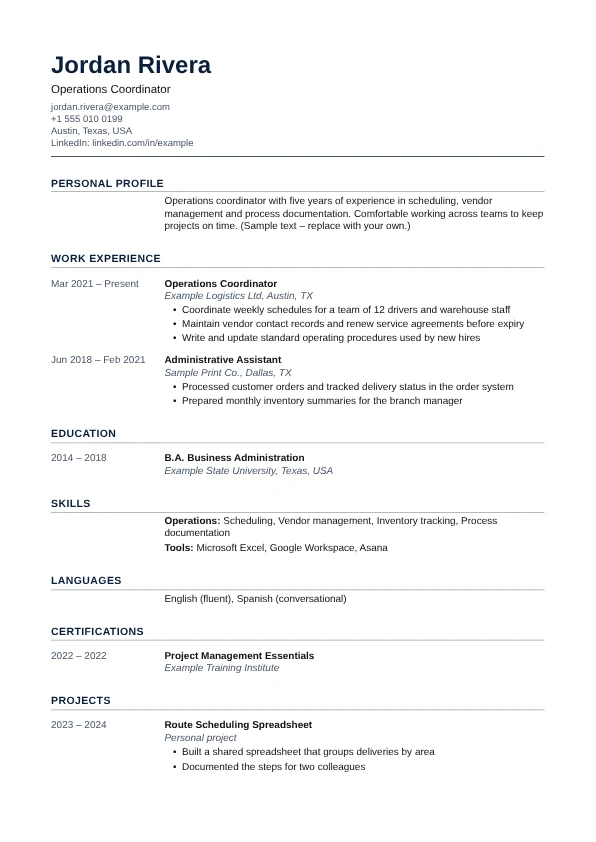
International CV
Two-column entries (more complex)

ATS Classic
Single column

ATS Professional
Single column
General guidance for job seekers, not legal or immigration advice. Employers and applicant tracking systems differ, so always follow the instructions in the job advert. Spotted a mistake? Email support@jobb.ae.
Ready to build your resume?
Start with a sample or a blank page. No sign-up needed. Free to edit; US$1.00 only if you download a PDF.