
CV Guidance by Country
India CV and resume guidance
This guide covers how resumes are written and read for jobs in India. It explains the difference between a resume, CV and biodata, how long a resume should be, and which traditional personal details many private employers no longer expect. You will also find practical help with Indian education records such as board marks, CGPA, diplomas and staged professional qualifications, along with campus placements, notice periods, job portal habits and government recruitment formats. It is written for freshers, experienced professionals and returning NRIs who want a clear, honest resume that suits Indian employers.
In India, people say CV, resume and biodata. Which one should I send to a company?
Send a resume (or CV, which most Indian recruiters treat as the same thing) for private-sector and multinational jobs. A biodata is a different document: it is mostly personal information such as date of birth, family details, religion and height, and today it is mainly used for marriage proposals or some older-style applications.
In everyday Indian hiring:
- "Resume" usually means a one- or two-page summary of skills, education and experience.
- "CV" is used loosely for the same document, and more strictly for longer academic or research CVs.
- "Biodata" is rarely what a corporate recruiter wants, even if an older relative calls it that.
If a job advert or a government notification asks for a "biodata" in a set format, follow that format exactly. Otherwise, a clear, skills-focused resume is the safe choice.
How many pages should my resume be for private jobs in India?
One page is usually right for freshers, and two pages for most experienced professionals. Indian recruiters often screen large volumes of applications on job portals, so a resume that shows your role, skills and results quickly is more useful than a long one.
A rough guide:
- Fresher or under two years of experience: one page.
- Two to ten years: one to two pages.
- Senior managers, doctors, academics or researchers: two pages or more, if the extra pages contain relevant detail such as publications or major projects.
Cut length by removing school-level details that add nothing for experienced roles, long lists of software you only touched once, and repeated duties across similar jobs. A third page filled with a personal profile, declaration and hobbies usually weakens the resume rather than strengthening it.
Do Indian recruiters still expect father's name, date of birth and marital status on a resume?
Not usually for private-sector and multinational jobs. These details were standard on older Indian resumes, and some employers in traditional sectors still ask for them, but many recruiters now see them as unnecessary on the resume itself. They are typically collected later on an application form or during joining formalities.
What to do:
- For corporate, IT, consulting, banking and start-up roles, leave out father's name, marital status and religion.
- Date of birth is optional. Include it only if the job advert asks for it or an age limit is stated in a government recruitment notice.
- If an employer's application form asks for these details, fill in the form; your resume can stay focused on skills.
The space you save is better used for projects, certifications or achievements.
What does "I hereby declare that the above information is true" do on an Indian resume, and do I need it?
It is a traditional closing statement, and most private employers do not need it. Many Indian resumes still end with a declaration, and it does no harm on applications for government jobs, PSUs or some traditional firms that expect it.
For corporate and multinational jobs, the declaration adds length without adding information, because signing the application form or offer later is what actually confirms your details. If you keep it, make it one line.
Example: "I declare that the information given above is true to the best of my knowledge."
A place and date line is optional: add it only if the employer or the required format asks for it. If you are applying to companies outside India, remove the declaration, since most foreign recruiters will not expect it. Keep a version with the declaration for government or traditional employers if they prefer it.
How should I write my 10th and 12th board marks on my resume?
List them in your Education section in reverse order, after your degree, with the board, school, year and marks. Freshers and recent graduates usually include them because many campus recruiters and IT services companies check them. After a few years of experience, you can shorten them to one line each or remove them unless an employer asks.
Example:
- "Class XII, CBSE, Delhi Public School, Hyderabad, 2021. Aggregate: 88.2%"
- "Class X, ICSE, St. Joseph's High School, Hyderabad, 2019. Aggregate: 91.0%"
Tips:
- Write the full board name once (CBSE, ICSE or the state board) so readers outside your state understand it.
- Use the marks shown on your mark sheet; do not round up.
- If your 12th stream matters (PCM, Commerce, Humanities), add it in brackets.
My university gives CGPA, but the company form asks for percentage. What do I put on my resume?
Put the CGPA exactly as it appears on your grade card, with its scale, and add a converted percentage only if your university publishes an official conversion. Recruiters can then compare fairly without you guessing.
Example: "B.Tech, Mechanical Engineering, VIT Vellore, 2024. CGPA: 8.4/10"
Points to remember:
- Always show the scale ("/10" or "/4"), because Indian and foreign scales differ.
- Do not use an informal conversion formula you found online. Universities use different rules, and a wrong number can raise questions at verification.
- If your grade card or transcript shows an equivalent percentage, you can write it as: "CGPA 8.4/10 (equivalent as per university: 79.0%)".
- When an online application form asks for a percentage, use the university's method and keep any conversion document your university issues ready.
Should I mention backlogs or arrears that I have since cleared?
You do not need to list cleared backlogs on your resume. The resume shows your final result, such as your CGPA and year of passing. Many campus recruiters ask about backlogs directly on the application form, and there you must answer honestly.
How to handle it:
- Resume: show the degree, institution, year and final CGPA or marks. No separate "backlogs" line is needed.
- Application form or eligibility check: give the exact number of backlogs, cleared and active, as asked.
- Interview: if asked, explain briefly and move to what you learned or how your later semesters improved.
If you still have an active backlog, do not write your degree as "completed". Write "B.Com (final results awaited)" or "Expected 2027" until you have cleared it. Misstating results is often discovered at document verification.
Should I write my current CTC and expected CTC on my resume?
Usually no. CTC (cost to company, the Indian term for total annual package) is commonly asked on job portal profiles, application forms or by the recruiter on a call, so it does not need to sit on the resume. Keeping it off lets you send the same resume to many employers and discuss pay at the right stage.
Exceptions:
- If a job advert explicitly says "mention current and expected CTC in your resume", follow the instruction.
- Some consultancies ask for it in your email or a form; give it there instead of editing your resume.
If you must include it, put it in a short line near the end, under "Additional information", and make sure the figure matches your payslips, because many employers verify it.
Where do I show my notice period on an Indian resume?
Put it in a short line near your contact details or at the end, only if it helps you. Notice periods matter a lot in Indian hiring, especially in IT and consulting, where long notice periods are common. A recruiter who sees "Immediate joiner" or a short notice period may shortlist you faster for urgent roles.
Example: "Notice period: 30 days (negotiable)"
Example: "Available to join immediately"
Tips:
- Be accurate. If your contract says 90 days, write that, and say "buyout possible" only if your employer actually allows it.
- If you are serving notice, write the last working day: "Serving notice, last working day 15 March 2026".
- Keep the same information in your job portal profile so recruiters do not see two different answers.
How do I write a resume for on-campus placements at an Indian college?
Follow your placement cell's format if it gives one, and keep it to one page. Many Indian colleges and institutes require a standard template so that all students' resumes look alike for visiting companies. If no format is given, use a clean one-page layout.
A typical campus placement resume includes:
- Name, branch, roll number (if the placement cell asks), email and phone.
- Education table: degree, institute, year, CGPA; Class XII and Class X with marks.
- Internships and projects, each with one to three bullets on what you built or achieved.
- Technical skills grouped by type.
- Positions of responsibility, competitions and certifications.
Write bullets that start with action verbs.
Example: "Built a Flask web app for hostel complaint tracking used by 300 students."
Check that dates and marks match your mark sheets, as placement cells often verify them.
What is the difference between industrial training, an internship and a summer project on an Indian resume?
They are all short work-based experiences, but they appear slightly differently. Industrial training is usually a mandatory part of engineering or polytechnic courses, often observation-based. An internship is more hands-on work at a company. A summer project, especially in MBA programmes, is a fixed piece of work with a final report.
How to present each:
- Industrial training: list the company, plant or department, dates, and what you learned or observed. Example: "Industrial Training, Bharat Heavy Electricals Ltd, Haridwar, June-July 2024. Studied turbine blade machining and quality checks."
- Internship: list it like a job, with bullets on tasks and results.
- Summer project: give the project title, organisation and the outcome of your report.
Use one "Internships and Training" section if you have a few of these, so the reader sees them together.
How should I describe my final-year B.Tech project so it does not look like every other student's?
Describe what you personally did, which tools you used and what result the project produced. Recruiters in India see many similar titles ("Smart Attendance System", "Face Recognition"), so the detail is what makes yours stand out.
Structure:
- Title, team size and your role.
- One bullet on the problem.
- One or two bullets on what you built and with what tools.
- One bullet on the result, testing or recognition.
Example:
"Smart Irrigation Controller (team of 4, hardware lead). Designed the sensor circuit using Arduino and soil-moisture sensors. Reduced manual watering checks in the college garden during a two-month trial. Presented at the department project expo."
Add a GitHub or demo link if you have one, and be ready to explain every part in an interview.
Should I include "Strengths" and "Hobbies" sections on a resume for India?
Only if they are specific and you have spare space. Indian resume samples often include "Strengths: hard-working, punctual, team player" and "Hobbies: reading, listening to music", but these generic words do not help a recruiter decide. Interviewers in India also ask about hobbies, so anything you list should be something you can discuss.
Better options:
- Replace "Strengths" with real evidence in your bullets, such as leading a college fest team.
- Keep hobbies only if they show a skill or commitment. Example: "Run a weekend chess club for school students in Kochi."
- Remove both sections first when you need to fit the resume onto one page.
For freshers with little experience, one line of interests can add personality, but it should never push out projects or internships.
How do I list Hindi, English and my regional language on a resume?
Add a short Languages section with each language and your level, and say clearly which ones you can read and write as well as speak. Many Indian jobs, especially in sales, customer support, banking and field roles, value regional languages, so they can be a real advantage.
Example:
"Languages: English (fluent), Hindi (fluent), Marathi (native), Kannada (conversational)"
Tips:
- Use simple levels such as native, fluent, professional or conversational. Avoid vague words like "good".
- If you can speak but not write a language, say "spoken only".
- For customer-facing roles, mention languages in your summary as well: "Customer support executive fluent in English, Hindi and Tamil."
- Do not overstate English ability; interviews will show your real level.
Is a "Career Objective" line still common in India, or should I write a summary?
Both are seen, but a short summary is more useful for experienced candidates, while freshers can use a targeted objective. Indian recruiters still see many objectives like "To work in a challenging environment...", which tell them nothing. Whatever you call it, make it specific to the role.
For freshers:
Example: "B.Com graduate with Tally and GST filing training, seeking an accounts assistant role in a manufacturing firm in Coimbatore."
For experienced professionals:
Example: "Sales manager with 8 years in FMCG distribution across Uttar Pradesh, managing a team of 12 and 600 retail outlets."
Keep it to two or three lines. Mention your field, level, key skills and the kind of role you want. Drop clichés such as "hard-working" and "dynamic".
Do I need to write my full home address with PIN code on my resume?
No. City and state are enough for most jobs in India, and you can add the PIN code if location matters, for example for local roles. A full house address takes space and shares more personal information than a recruiter needs at the first stage.
Example: "Andheri East, Mumbai, Maharashtra 400069"
Example: "Bengaluru, Karnataka (open to relocation)"
When to say more:
- Field, delivery or shift jobs where distance matters: add the area or locality.
- Relocating: write "Currently in Lucknow, relocating to Pune in June 2026".
- Government or PSU application forms: they will ask for your full address separately.
Keep your phone with the +91 code and a professional email in the same header line.
How do I show that my college is affiliated to a university, like "affiliated to Anna University"?
Name your college first and the affiliating university in brackets or on the same line. Many Indian degrees are awarded by a state university through affiliated colleges, so recruiters understand this format, and naming both helps with verification.
Example: "B.E. Electronics and Communication, PSG College of Technology (affiliated to Anna University), Coimbatore, 2023. CGPA: 8.1/10"
Tips:
- If your college is autonomous or a deemed university, use its name as it appears on your degree certificate.
- For readers abroad, you can add the country: "Coimbatore, India".
- Keep the degree name in its standard form (B.E., B.Tech, B.Sc., B.Com, MBA, PGDM) and spell out the specialisation.
Recruiters in other states may not know my state board. How should I write it?
Write the board's full official name once, with the state, and then your school and year. State board names can be unfamiliar outside the state, so clarity helps.
Example: "Class XII, Maharashtra State Board of Secondary and Higher Secondary Education, 2020. Aggregate: 84.5%"
Example: "Class X, Kerala State Board (SSLC), 2018"
Tips:
- Common short forms such as CBSE, ICSE and ISC are widely understood and can stay as they are.
- For local terms like SSLC, HSC or PUC, add the class level ("Class X" or "Class XII") so readers know what it means.
- If you are applying abroad, write "Higher Secondary Certificate (Class 12)" so foreign recruiters understand the level.
For a government job in India, should I send my normal resume or use the application format?
Use the format given in the official recruitment notification. Many central and state government, PSU and public bank recruitments use online application forms or a prescribed "biodata" or application proforma, and they often reject applications that do not follow it.
What to do:
- Read the notification fully: eligibility, required documents and the exact format.
- Fill every field in the order and style asked, including date of birth, category and qualifications, since these are part of the eligibility check.
- Keep your private-sector resume for interviews only if the process asks for it, or for contract and consultant roles where a resume is accepted.
If the notification does not mention a format and asks for a CV, use a clear, factual one with dates and qualifications in full. Do not guess on eligibility; check with the recruiting body.
I work for an IT services company on a client project. Do I list the client or my employer?
List your employer as the company and mention the client inside the role, if you are allowed to name them. In Indian IT services, the employer is the company that pays you and issues your experience letter, so background checks will look for that name.
Example:
"Senior Software Engineer, Infosys Ltd, Bengaluru, 2021 to present
Client: a UK retail bank (name withheld)
- Migrated payment batch jobs from mainframe to Java microservices."
Tips:
- Check your contract before naming a client. If unsure, describe them by industry and region.
- If you moved between several client projects, group them under the one employer with short project headings.
- Never present a client as your direct employer; it causes problems at verification.
I'm on a staffing agency's payroll but work at a big company's office. Which name goes on my resume?
Name the agency as your employer and the company where you work as the client or deployment. Third-party payroll (also called contract or outsourced staffing) is common in India, and the agency is usually the one that issues your offer letter, payslips and experience letter.
Example:
"Customer Support Associate, TeamCo Staffing Services (deployed at a national telecom company), Noida, 2023 to 2025"
Why it matters:
- Background verification will contact the company on your payslips.
- Writing only the big brand can look misleading, even if you sat in their office.
- Mentioning both shows the real environment you worked in, which still counts as useful experience.
If you were later absorbed onto the client's own payroll, show it as a new line with the new dates.
I spent two years preparing for UPSC or other competitive exams. How do I show that gap?
Show it honestly as a short entry with the dates and one line on what you did. Exam preparation is a well-understood reason for a gap in India, and a clear explanation is better than leaving a blank period.
Example:
"Civil Services Examination preparation, 2022 to 2024. Cleared the preliminary examination in 2023; self-study in public administration, economics and current affairs."
How to make it work for you:
- Mention any stage you cleared, as it shows ability.
- Link the preparation to the new role: research, writing, policy knowledge or analysis.
- Add anything you did alongside it, such as tutoring, freelance work or online courses.
In the interview, say clearly why you are now moving to the private sector and keep the explanation positive.
Can I use lakh and crore in achievement bullets, or should I convert to millions?
Use lakh and crore for jobs in India, and convert to millions or thousands for roles abroad or at global companies with foreign hiring managers. Indian recruiters read lakh and crore instantly, but many readers outside South Asia do not know them.
Example for India: "Grew branch deposits by 12 crore in one financial year."
Example for abroad: "Grew branch deposits by 120 million rupees in one financial year."
Tips:
- Be consistent within one resume.
- Name the currency when writing for an international reader, because "12 crore" alone is unclear.
- Write numbers the same way in your portal profile and your resume.
- Make sure every number is true and something you can explain.
How do I write total experience like "4.5 years" on my resume?
State it clearly in your summary in years, or years and months, and make sure it matches your job dates. Indian recruiters and portals often filter by total experience, so the number should be obvious and accurate.
Example: "Accounts executive with 4 years 6 months of experience in GST compliance and accounts payable."
Tips:
- "4.5 years" is common in India but can be read abroad as four years and five months. "4 years 6 months" avoids confusion.
- Do not count internships or training periods as full-time experience unless the employer treats them as such. List them separately.
- Use month and year for every job ("Jul 2021 to Jan 2026") so the reader can check the total.
- Mention relevant experience separately if it differs: "6 years total, 3 years in payroll."
I hold a polytechnic diploma, not a degree. How should I present it?
List the diploma as your main qualification with its full name, institute, board and year, and put your practical skills and training near the top. Diploma holders are in demand for many technical and site roles in India, so present the diploma confidently.
Example: "Diploma in Mechanical Engineering, Government Polytechnic, Nagpur (MSBTE), 2022. Aggregate: 78.3%"
Tips:
- Name the state board of technical education, as recruiters may check it.
- If you joined the diploma after Class X, you can list Class X below it; Class XII is not expected in that case.
- Add hands-on skills: machines, software, safety training, readings you can take.
- If you later did a lateral-entry B.Tech, list that above the diploma.
Templates to try
Free to edit and preview. Single-column layouts are the safest choice for applicant tracking systems.
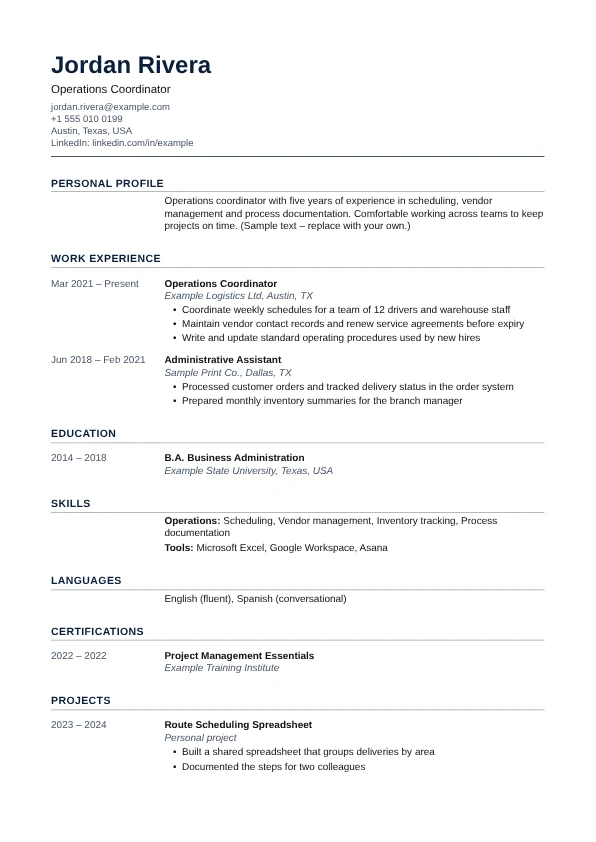
International CV
Two-column entries (more complex)

ATS Classic
Single column

ATS Professional
Single column
General guidance for job seekers, not legal or immigration advice. Employers and applicant tracking systems differ, so always follow the instructions in the job advert. Spotted a mistake? Email support@jobb.ae.
Ready to build your resume?
Start with a sample or a blank page. No sign-up needed. Free to edit; US$1.00 only if you download a PDF.