
CV Guidance by Country
Applying to the Gulf from abroad
This guide is for people outside the Gulf who want to apply for jobs in the UAE, Saudi Arabia, Qatar, Kuwait, Bahrain or Oman. It explains how to adapt a home-country CV for Gulf recruiters: writing an international phone number, showing your time zone and interview availability, wording relocation plans and start dates, and describing overseas employers, job titles, degrees and certifications so they are easy to understand. It also covers recruitment drives, trade tests, job portals and spotting fake offers. The answers describe common practice only. For visa, work-permit or document rules, check the official government portal or ask the employer.
I'm applying for Gulf jobs from abroad. How should my CV differ from the one I use at home?
Keep your strongest content, but add a few details that help a Gulf employer judge whether you can join from overseas: your current country, your availability, any relocation plans and clear context for employers they may not know. Gulf recruiters often compare candidates from many countries, so anything that makes your situation easy to understand helps.
Changes that usually help:
- Header: current city and country, phone with country code, and a line such as "Open to relocation to the GCC".
- Personal details (optional): nationality, notice period, driving licence and work authorization status.
- Experience: city and country on each job, plus a short description of lesser-known employers.
- Qualifications: full degree titles and country of study.
- Remove home-country habits that Gulf employers do not need, such as a long declaration, ID numbers or family details.
Use English, A4 and a single-column layout. Keep it to one or two pages unless you are senior or highly technical.
Do Gulf employers really consider CVs from people living outside the Gulf?
Yes, many do, especially for skilled, technical and hard-to-fill roles, but some adverts prefer candidates already in the country. Large employers in oil and gas, healthcare, construction, hospitality, aviation and education have long recruited internationally, while smaller companies often prefer local hires who can start quickly.
How to improve your chances from abroad:
- Target roles where your skills are scarce or your sector hires internationally.
- Read each advert for words such as "local hire only" or "candidates in the UAE only" and respect them.
- Make your availability and relocation readiness clear on your CV.
- Apply through employers' career pages and established recruitment agencies, not only through mass job boards.
- Show any Gulf-relevant experience, such as Gulf clients, international standards or multinational teams.
Whether you can move and work in a given country depends on official immigration rules and the employer. Check the official government portal of that country or ask the employer.
How do I show my availability for interviews across time zones?
Add a short line in your cover email, and optionally in your CV header, giving your time zone and the hours you can take calls in Gulf time. Recruiters in the Gulf may be several hours ahead of or behind you, and a clear note makes it easier to schedule you.
Example: "Based in Manila (GMT+8). Available for video interviews 12:00 to 18:00 Gulf time."
Example: "Based in Toronto. Available for calls 07:00 to 11:00 Toronto time (afternoon in the Gulf)."
Tips:
- Use the time zone of the country where the job is, as Gulf countries do not all share one.
- Make sure your video-call tools work and your profile name matches your CV.
- Answer messages promptly, even if just to suggest a time.
Should I use my home-country phone number or borrow a Gulf number on my CV?
Use your own home-country number in full international format, with your country code. Do not borrow a friend's or relative's Gulf number to look local: recruiters will call it, and messages may be missed or your honesty questioned.
Example: "+91 98XXX XXXXX (WhatsApp)"
Tips:
- Write the country code with a plus sign and drop the leading zero.
- Mark the number as WhatsApp-enabled if it is, since many Gulf recruiters message first.
- Check that your voicemail greeting and WhatsApp profile look professional.
- If you will move soon and get a Gulf number, update your CV the day it changes.
If you are often travelling, add an email address you check daily, as recruiters sometimes prefer email for first contact.
Can I put a relative's address in Dubai or Riyadh on my CV so I look local?
No. Your CV should show where you actually live. Using a relative's Gulf address can mislead an employer about your availability and right to work, and the truth usually comes out quickly when they ask you to come in for an interview.
Better options:
- Write your real city and country.
- Add a line about your plans: "Relocating to Dubai in May 2027" if that is a firm plan.
- Mention any Gulf connections that genuinely help, such as past Gulf experience or regular work with Gulf clients.
Being honest about your location is also practical: recruiters who hire from abroad will then put you in the right process from the start.
I'm open to working in any GCC country. How do I say that on my CV?
Add one clear line under your contact details or in your summary, and name the countries if you are open to all of them. Recruiters who handle roles in several Gulf countries search for candidates who are flexible.
Example: "Open to roles in the UAE, Saudi Arabia, Qatar, Kuwait, Bahrain and Oman."
Example: "Open to relocation across the GCC."
Tips:
- Only list countries you would genuinely accept.
- If you prefer one country, say so: "Preferred: Qatar; also open to the UAE."
- Tailor your summary when applying to a specific country's job.
- Do not list every city; country names are enough.
How do I show my start date when I'm abroad and need time to relocate?
State your earliest realistic joining date or your notice period plus the time you need to move. Gulf employers often ask "When can you join?", and an honest, specific answer helps them plan.
Example: "Notice period: 60 days. Can join within 2 weeks after notice, subject to visa processing."
Example: "Available to join from 1 March 2027."
Tips:
- Count your notice period, travel and any document processing time.
- Do not write "immediate joiner" if you need months to arrive.
- If your notice period can be shortened, say "negotiable" only if your employer has allowed it before.
The builder has an optional notice period field you can use for this line.
I don't have a Gulf visa yet. What should I write for visa status?
Use simple, factual wording that shows your current situation without stating rules. Many applicants from abroad write that they would need the employer to arrange a visa, while others leave the line out and discuss it at interview.
Example: "Visa status: Not currently in the UAE; would require employment visa."
Example: "Work authorization: Requires sponsorship for Qatar."
Tips:
- Keep it to one line.
- Do not claim a visa you do not have.
- If you hold a Gulf residence through family, say so accurately.
The builder has an optional work authorization field for this line. For what is required in any country, check the official government portal or ask the employer.
Gulf recruiters won't know the companies I worked for at home. How do I explain them?
Add a short descriptor under each lesser-known employer, giving the sector, size and location. This helps a Gulf recruiter see the scale and relevance of your experience at a glance.
Example:
"[Company name], Pune, India
Auto-parts manufacturer supplying global carmakers, about 1,200 staff."
Tips:
- Mention international clients, partners or certifications if relevant.
- Use the company's commonly known English name.
- If the company is part of a known group, name the group.
- Keep it to one line, so it does not crowd out your achievements.
My job title at home means something different in the Gulf. Should I change it?
Keep your real title, and add a common equivalent in brackets if it helps Gulf readers understand your level. Titles such as "Executive", "Officer", "Associate" or "Engineer" mean different things in different countries.
Example: "Executive, Accounts (Accountant level)"
Example: "Charge Hand (Electrical Supervisor)"
Tips:
- Do not inflate your title; references may be checked.
- Use your bullets to show scope: team size, budgets, responsibilities.
- Use keywords common in Gulf adverts in your summary and skills.
My project budgets are in my home currency. How do I show scale to Gulf employers?
Describe scale in ways that do not depend on currency, such as team size, number of sites, users or units, and use a rough US dollar figure only if you are confident of it. Home-currency numbers can be hard for Gulf readers to judge.
Example: "Managed a 14-storey residential project with 220 apartments and a team of 40."
Example: "Led a migration for a bank with 300 branches."
Tips:
- Keep confidential financial details out.
- If you convert, note it as approximate and keep it consistent.
- Focus on outcomes: time saved, quality improved, costs reduced.
My degree title is not common in the Gulf. How do I describe it?
Write the exact title on your certificate, then add a short English description of the subject in brackets. Gulf recruiters see degrees from many countries, but titles like "Licence", "Ingeniero", "B.Tech" or "Diplom" may not be clear.
Example: "Licence en Gestion (Bachelor's-level degree in Management), [university name], Morocco, 2021"
Example: "B.Tech Mechanical Engineering, [university name], India, 2019"
Tips:
- Include the country of study.
- Do not claim formal equivalence unless an official evaluation says so.
- Add your major and graduation year.
Should my CV mention degree attestation or equivalency for Gulf jobs?
Usually no. Attestation and equivalency are document processes that happen during hiring or visa steps, not CV content. Your CV should show your degree, institution and year.
When it can help to mention:
- The advert asks if your documents are attested.
- You have already completed the process and the role requires it.
Example line: "Degree certificate attested for use in the UAE (2025)."
Never claim attestation or equivalency you do not have. Requirements differ by country, profession and employer, so do not describe them on your CV. Check the official government portal or ask the employer what documents they will need, and keep originals ready.
I'm preparing for a Gulf professional licensing exam. Should my CV say so?
Yes, add it as "in progress" with a date if you have registered or passed a stage, because it shows you are serious about working in that country. Healthcare and some engineering roles in the Gulf may need professional licensing, and employers like to know where you are in that process.
Example: "Licensing exam for [authority name]: passed, 2026"
Example: "Licensing exam for [authority name]: scheduled, Feb 2027"
Tips:
- Keep your home-country licence listed with its details.
- Do not claim a licence you do not hold.
- Follow the regulator's instructions on what to show.
Requirements differ by profession and country; check the official regulator for details.
Will Gulf employers want proof of my English level?
Some will, especially for healthcare, teaching, aviation and customer-facing roles, so add a test score if you have one. For many other roles, your English CV, cover email and interview are the proof.
Example: "IELTS Academic: 7.0 overall, 2025"
Tips:
- Include the test name, score and year.
- If you studied or worked in English, say so: "Degree taught in English."
- Make sure your CV has no errors, because it is the first sample of your English.
- If your English is limited, choose roles where your technical skills matter most, and be honest about your level.
How do I avoid fake Gulf job offers when sending my CV from abroad?
Send your CV only to verified employers and recruiters, and be wary of anyone who asks for fees, passport copies or bank details before a real interview. Fake Gulf job offers often target people abroad who are eager to move.
Warning signs:
- An offer without any interview.
- Requests for "processing fees" or "visa fees" to be paid to a person.
- Email addresses from free providers instead of a company domain.
- Very vague job details and pressure to act fast.
Safer steps:
- Check the company's official website and career page.
- Search the recruiter's name and agency.
- Check your own government's guidance on overseas recruitment agents.
If unsure, contact the company directly using details from its official website.
A Gulf employer is holding interviews in my city. How should I prepare my CV?
Bring several printed copies of a CV tailored to the roles advertised, plus copies of key certificates, and make sure your contact details work internationally. Gulf companies sometimes hold recruitment drives in other countries, and interviewers may see many candidates in a day.
Checklist:
- One- or two-page CV with the advertised job title in your header.
- Clear list of trades, licences and certificates relevant to the role.
- Experience with dates, employers and main tasks.
- Your passport name exactly as on your passport.
- A short cover note if requested.
Arrive early, and keep originals ready to show if asked. Do not hand over original documents unless you know why they are needed.
I'm a skilled worker applying for a Gulf job that needs a trade test. What should my CV show?
Show your trade, years of practical experience, tools and equipment, and any certificates, in simple clear language. For trades such as welder, electrician, plumber or mason, Gulf employers and agencies often check skills in a practical test, and your CV helps them choose who to invite.
Example:
"Pipe Welder (6G), 7 years
- Welded carbon steel pipes on refinery projects in India and Oman.
- Certified 6G welder, [certifying body], 2024."
Tips:
- Put the trade name at the top.
- List equipment and materials.
- Show safety training.
- Keep it to one page.
Should I mention international standards and codes I've worked with for Gulf engineering jobs?
Yes, name the standards and codes you have used, because many Gulf projects use international standards, and recruiters search for them. This helps show your home-country experience fits Gulf projects.
Examples to list where true:
- Design codes: ACI, BS EN, ASME, API, IEC.
- Quality and safety: ISO 9001, ISO 45001.
- Building systems: NFPA fire codes.
Example bullet: "Designed pressure vessels to ASME Section VIII for petrochemical clients."
Tips:
- Only list codes you have actually used.
- Pair codes with projects to show practical use.
Should I mention experience working in hot or desert climates?
Yes, if it is true and relevant, mention it briefly in a bullet, as it shows you are used to conditions common in many Gulf jobs. Outdoor roles in construction, oil and gas, security and logistics often involve high summer temperatures.
Example: "Supervised outdoor pipeline work in desert conditions in Rajasthan, following heat stress safety plans."
Tips:
- Pair it with safety practice, such as heat stress management.
- Keep it to one line.
- Do not exaggerate.
For office-based roles, this detail is usually unnecessary.
My Gulf job offer is delayed and I'm waiting at home. How do I show the gap?
Show it honestly as a short line, and fill the time with useful activities you can list. Delays between offer and joining happen, and employers understand them.
Example: "Mar to Aug 2026: Awaiting overseas joining; completed IOSH Managing Safely and an advanced Excel course."
Tips:
- Keep up your skills with courses or freelance work.
- Do not claim you were employed if you were not.
- If the offer falls through, update your CV and keep applying.
Should I list my home-country or international driving licence for Gulf jobs?
Yes, list it if the job involves driving or mentions a licence, with the country and vehicle category. Gulf employers often ask about driving, but whether a foreign licence can be used or converted depends on official rules.
Example: "Driving licence: India, light motor vehicle; International Driving Permit"
Tips:
- Mention years of driving experience for driver roles.
- Include heavy vehicle categories if relevant.
- Do not claim you hold a Gulf licence if you do not.
For conversion rules, check the official government portal of the country where the job is.
Should I make a separate CV for each Gulf country?
Keep one master CV, then adjust the summary, location line and a few details for each country. Gulf countries share many hiring habits, but language needs, sectors and personal details may differ.
Adjust:
- Summary: mention the country and sector.
- Personal details: show only relevant items.
- Experience: put the most relevant projects first.
- Language: emphasise Arabic where useful.
Tip: name files clearly, such as "Rahul-Menon-CV-Qatar.pdf", so you send the right one.
What should my cover email say when I send my CV from abroad?
State the role, your current location, your availability and why you fit, in a short email. Gulf recruiters get many overseas emails, so a clear subject line and a brief message help.
Example subject: "Application: Site Engineer, Doha – Based in Cairo, available in 30 days"
Example body: "I am a civil engineer with six years in high-rise projects in Egypt. I am open to relocating to Qatar and can join within 30 days. My CV is attached."
Tips:
- Attach your CV as a PDF.
- Mention any Gulf experience or clients.
- Keep it under 150 words.
Should I set my LinkedIn location to the Gulf city I want to move to?
No, keep your real location, and show your interest through your headline and job preferences. A false location can confuse recruiters and harm trust.
Better options:
- Headline: "Project Engineer | Open to opportunities in the GCC"
- Use job preference settings to list Gulf cities.
- Mention relocation in your About section.
Keep your LinkedIn and CV consistent so recruiters see the same story in both places. If a recruiter contacts you, they will already know you are abroad, which saves time for both sides and avoids an awkward correction later. Once you have actually moved, update your location on the same day.
Templates to try
Free to edit and preview. Single-column layouts are the safest choice for applicant tracking systems.
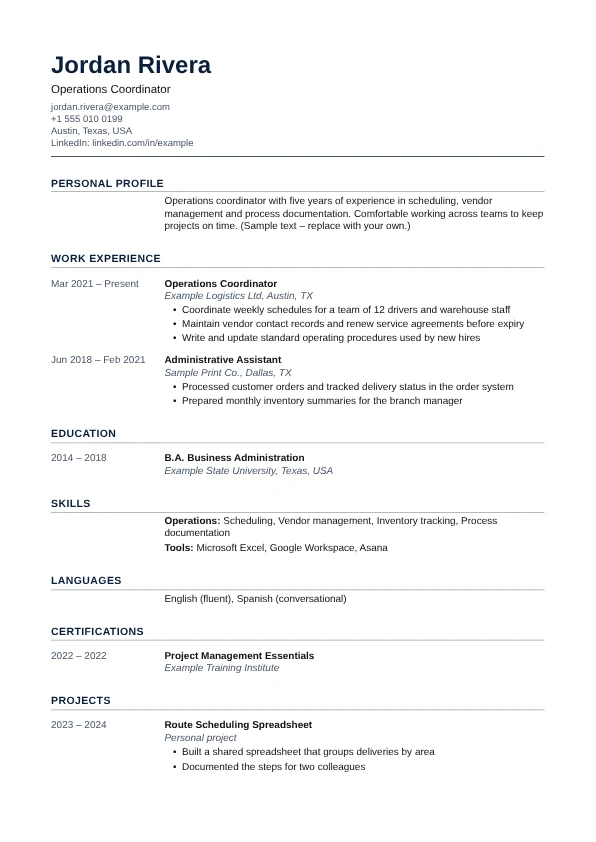
International CV
Two-column entries (more complex)

ATS Classic
Single column

ATS Professional
Single column
General guidance for job seekers, not legal or immigration advice. Employers and applicant tracking systems differ, so always follow the instructions in the job advert. Spotted a mistake? Email support@jobb.ae.
Ready to build your resume?
Start with a sample or a blank page. No sign-up needed. Free to edit; US$1.00 only if you download a PDF.