
Resume Examples by Profession
UX/UI Designer resume
This guide answers common questions about writing a UX, UI or product designer resume. It covers summaries, the methods and tools to list, example bullets that show user and business outcomes, and how to present research, design systems, accessibility, workshops, enterprise tools and right-to-left design. It explains how the resume and portfolio work together, and helps juniors, freelancers, senior designers and people moving in from graphic design or out towards product management. All sample lines are fictional examples; change them so they describe your real work.
How should a UX designer write a resume summary?
Name your design focus (research, interaction, UI or product design), the products you have worked on and one user or business outcome. Keep it to two or three sentences and point readers to your portfolio.
Example (fictional): "Product designer with five years designing mobile banking and fintech apps, from user research to high-fidelity prototypes in Figma. Redesigned an onboarding flow that reduced drop-off during account opening and cut related support calls. Portfolio includes three end-to-end case studies."
Another example (fictional), for a junior designer: "UX designer with a background in psychology and a portfolio of three case studies covering interviews, usability testing and responsive web design."
Avoid vague phrases such as "creative visionary" or "pixel-perfect perfectionist". Hiring managers want to know what problems you solve and how.
Which skills and tools should a UX/UI designer list?
List your design methods and your tools separately, because employers check both. Methods show how you think; tools show you can deliver in their workflow.
Example skills section (fictional):
- Research: user interviews, usability testing, surveys, card sorting, journey mapping
- Design: information architecture, wireframing, interaction design, prototyping, design systems
- UI: visual hierarchy, typography, responsive layouts, accessibility (WCAG)
- Tools: Figma, FigJam, Adobe XD, Miro, Maze, Hotjar, Jira
- Collaboration: workshops, design critiques, developer handoff
Lead with what the role stresses. A UX researcher role should open with research methods; a UI-heavy role should open with visual design and design systems. Leave out tools you have not used in recent projects.
Can you show example bullet points for a UX designer's experience?
Yes. Good UX bullets describe the user problem, your process and the measurable or observed result. Avoid bullets that only list deliverables such as "made wireframes".
Examples (fictional, adapt to your own work):
- "Redesigned the checkout flow for a grocery app after testing with 12 users, reducing steps from seven to four and lowering cart abandonment."
- "Ran fortnightly usability tests with Maze and shared findings with product and engineering, shaping the roadmap for two quarters."
- "Built a Figma component library with 120 components and tokens, used by three product squads."
- "Introduced accessibility checks into design reviews, fixing colour contrast and focus states before development."
If you lack numbers, describe observed changes, such as fewer support tickets or task success in testing.
How do I link my portfolio to my UX resume effectively?
Put the portfolio link in your contact line, then name the matching case studies in your experience or projects section. The resume should make the reader want to open specific case studies.
Tips:
- Use a short, clean link and check it works on mobile.
- If the portfolio is password protected, add the password in the application or contact line as the employer instructs.
- Refer to case studies by name: "See 'Clinic booking app' case study."
- Keep the resume layout simple; the portfolio carries the visual impact.
Example (fictional) contact line: "Sara Haddad | Product Designer | Dubai | portfolio link | LinkedIn".
Make sure each case study explains your role, process, decisions and result, not only final screens.
Should a UX designer use a highly designed or two-column resume?
A clean, well-typeset single-column resume is usually the safer choice. Your portfolio shows visual skill; the resume needs to be easy for both people and applicant tracking systems to read.
Good design choices on a UX resume:
- Clear hierarchy with consistent headings.
- Generous spacing and one or two fonts.
- Text, not icons, for contact details and skills.
- No skill bars or ratings, which are hard to interpret.
A small accent colour or a tidy layout shows taste without risk. If you apply to a small studio that asks for a creative resume, you can send a designed version too, but keep a plain one for online forms.
Example (fictional) heading style: name in a larger weight, then "Product Designer · Fintech and Health".
How do I write a UX resume when I am changing careers from graphic design?
Show the user-centred parts of your graphic design work, add UX case studies, and name research and testing methods clearly. Many UX designers come from graphic design, but employers want evidence of process, not just visuals.
Steps:
- Headline: "Graphic designer moving into UX/UI design".
- Add two or three UX case studies with research, iterations and testing.
- Rewrite past bullets to show user goals, feedback and data.
- Add UX training or a certificate if you have one.
Example bullet (fictional): "Redesigned event registration pages after reviewing user feedback with the marketing team, simplifying the form and reducing incomplete sign-ups."
Keep your real past job titles and let the summary and projects explain the move. Your visual design background is a strength: mention typography, layout and brand consistency in your skills, but place research, wireframing, prototyping and usability testing first so the reader sees the UX focus straight away. In the portfolio, put UX case studies ahead of print or branding work.
How do I show user research experience on my resume?
Name the methods, number of participants, who you worked with and what changed because of the findings. Research is only valuable when it influences decisions.
Include:
- Methods: interviews, contextual inquiry, diary studies, usability tests, surveys, card sorts.
- Scale: number of sessions or participants.
- Synthesis: affinity mapping, personas, journey maps.
- Impact: features changed, dropped or prioritised.
Example bullets (fictional):
- "Interviewed 18 small business owners about invoicing habits; findings led the team to drop a planned feature and build reminders instead."
- "Ran a diary study with 10 caregivers over two weeks to map medication routines for a health app."
Avoid presenting personal opinions as research. Say how the evidence was gathered.
What are good measurable results for a UX designer?
Good UX results are changes in user behaviour or business measures that your design work influenced. Name your role honestly, because results usually come from a team.
Common measures:
- Task success or completion time in usability tests.
- Conversion, sign-up or checkout completion.
- Drop-off at a key step.
- Support tickets or complaints about a feature.
- Accessibility issues fixed.
- Time saved for internal users.
Example bullets (fictional):
- "Simplified the claims form for an insurance portal; average completion time in testing fell from nine minutes to four."
- "Redesigned the internal scheduling tool, saving coordinators roughly an hour a day."
If you do not have access to analytics, use test results or qualitative feedback.
Are UX certifications useful on a designer resume?
They can help, especially for career changers, but a strong portfolio matters far more. List them in a Certifications or Training section with the provider and year.
Examples designers list:
- Google UX Design Professional Certificate
- Nielsen Norman Group UX Certification
- Interaction Design Foundation courses
- Certified Usability Analyst (CUA) from Human Factors International
- Accessibility certifications such as IAAP CPACC
Example (fictional): "Google UX Design Professional Certificate, 2025 – three portfolio case studies completed."
Mention the case studies or projects produced during the course, because those show the skills in action. Do not list every short course; choose the ones that match the job.
What keywords should a UX or product designer use?
Use the method, tool and product terms in the job advert that match your experience. Design adverts often mix process words with tool names.
Common keywords:
- User research, usability testing, personas, journey mapping
- Wireframes, prototypes, interaction design, information architecture
- Design systems, UI design, responsive design, accessibility, WCAG
- Figma, Adobe XD, Sketch, Miro, Maze
- Product design, design thinking, A/B testing, stakeholder workshops
Use them inside bullets: "Built interactive prototypes in Figma and tested them with eight users." The job-description comparison in the builder shows which of the advert's frequent terms appear in your resume, so you can add honest ones you missed.
What mistakes do UX designers make on their resumes?
The most common mistake is focusing on screens and tools instead of problems, process and outcomes. Hiring managers want to know how you think.
Other mistakes:
- Graphic-heavy layouts that applicant tracking systems cannot read.
- Skill bars showing "Figma 90 out of 100".
- Listing UX, UI, motion, branding, illustration and coding as equal strengths.
- Claiming a team's results as solely your own.
- A portfolio link that is broken or password-protected with no password.
- No mention of collaboration with developers or product managers.
Example fix (fictional): change "Designed screens for the app" to "Designed and tested the appointment booking flow, reducing booking errors reported by clinic staff."
How do I present design system work on my resume?
Describe the size of the system, who used it, how you kept it consistent and what it improved, such as speed or consistency. Design systems are highly valued, especially in product companies.
Details to include:
- Components, tokens and documentation you created.
- Tools: Figma variables, Storybook, Zeroheight.
- Collaboration with engineers to match code components.
- Adoption across teams or products.
Example bullets (fictional):
- "Led the design side of a design system with 90 components and colour tokens, adopted across web and mobile."
- "Documented usage guidelines in Zeroheight so new designers could start using the system in their first week."
If you contributed rather than led, say so: "Contributed 20 components and accessibility guidelines."
How should a senior or lead product designer present their resume?
Show your influence on product direction, design quality across teams and the growth of other designers. Senior designers are hired for judgement and leadership, not only output.
Highlight:
- Shaping strategy and roadmaps with product managers.
- Leading research programmes or design sprints.
- Setting design standards and critique processes.
- Mentoring and hiring designers.
- Results across products, not only single features.
Example bullets (fictional):
- "Led design for the merchant platform with a team of four designers, aligning three product squads on one navigation model."
- "Introduced weekly design critiques and a research repository, reducing duplicate studies across teams."
Keep two pages at most and link to case studies that show leadership decisions.
What should a junior UX designer with only course projects include?
Include two or three detailed case studies, your methods and tools, and any transferable experience, especially work with customers. Employers hiring juniors look for clear thinking and a willingness to test ideas.
Structure:
- Summary with your target role and background.
- Projects with the problem, your process, testing and results.
- Skills: methods first, tools second.
- Training and education.
- Other experience that shows empathy or problem-solving.
Example project bullet (fictional): "Redesigned a local library's book-renewal page; tested two prototypes with six members and chose the version that all participants completed without help."
Projects for real organisations, even small ones, carry more weight than invented apps.
How do I describe working with developers and product managers?
Describe specific collaboration practices and what they achieved, such as fewer rework cycles or faster releases. Cross-functional work is central to UX roles.
Examples of practices:
- Joining sprint planning and refinement.
- Writing acceptance criteria with product managers.
- Handoff using Figma Dev Mode, annotations or specs.
- Reviewing builds before release.
Example bullets (fictional):
- "Worked with four engineers and a product manager in two-week sprints, reviewing builds against designs before each release."
- "Created annotated specs for edge cases, reducing design questions raised during development."
Showing this collaboration also answers a common interview topic: how you handle disagreement and trade-offs.
What is the difference between a UX designer and UI designer resume?
A UX designer resume stresses research, user flows, information architecture and testing. A UI designer resume stresses visual design, typography, colour, layouts, components and interaction details.
In practice:
- UX bullets: "Mapped the end-to-end returns journey and tested three flow options with customers."
- UI bullets: "Created the visual language and component styles for a new banking app, including dark mode."
Both examples are fictional. Many roles combine the two, often called UX/UI or product designer. Use the title in the job advert and order your skills and bullets to match. If you apply to both kinds of role, keep two versions of your resume.
Which section order works best for a UX designer resume?
A common order is: contact details with portfolio link, summary, experience, selected projects, skills, education and training. Experience leads once you have design jobs; projects lead if you are new.
Variations:
- Juniors: summary, projects, skills, experience, education.
- Researchers: add a short "Research methods" line near the top.
- Senior designers: summary, experience, leadership highlights, education.
Example project heading (fictional): "Clinic Booking App – UX research and interaction design (case study in portfolio)".
Use standard headings so applicant tracking systems recognise each section, and keep the portfolio link in plain text so it can be copied.
How do I show accessibility skills as a UX designer?
Name the standard you design to, the checks you use and examples of decisions you made for accessibility. Accessibility is increasingly expected and is a good way to stand out.
Include:
- WCAG levels you design for, usually AA.
- Colour contrast, focus states, touch target sizes, readable typography.
- Testing with screen readers or with disabled users.
- Accessibility notes in handoff.
Example bullets (fictional):
- "Added accessibility annotations to all handoff files, covering focus order, labels and error messages."
- "Ran usability sessions with three screen reader users, leading to a simpler navigation structure."
If you hold an accessibility certificate, list it, but show practical work as well.
How should a freelance UX designer list client projects?
Use one entry for your freelance work with the full date range, then list your strongest client projects as bullets with the sector, problem and result. This keeps your history clear and easy to read.
Example (fictional):
"Freelance UX/UI Designer, 2022–present
- Designed a booking app for a chain of fitness studios, from interviews to tested prototypes.
- Audited a charity website for usability and accessibility, delivering a prioritised fix list.
- Created a design system for a fintech start-up's web dashboard."
Name clients only with permission. Mention repeat clients and long engagements, because they show trust. Link the matching case studies in your portfolio.
How do I show I can design for Arabic and right-to-left interfaces?
Name RTL design as a skill and give a specific project example, including how you handled layout mirroring, typography and testing. This is valuable for employers in the Gulf and the wider Middle East.
Details to mention:
- Mirrored layouts, icons and navigation.
- Arabic typography and line height choices.
- Mixed-language content such as numbers, names and English terms.
- Testing with Arabic-speaking users.
Example bullet (fictional): "Designed bilingual English and Arabic screens for a government-service app, including mirrored navigation and tested forms with Arabic-speaking users."
List Arabic in your Languages section if you speak it, and include RTL screens in your portfolio.
Should a UX designer mention coding skills like HTML and CSS?
Yes, if you use them, because they help you work with developers and build realistic prototypes. Keep them in a secondary position unless the role asks for a design engineer.
How to present them:
- Skills line: "Front-end basics: HTML, CSS, some JavaScript".
- Example of use: building prototypes, adjusting styles in code, reviewing builds.
Example bullet (fictional): "Built a coded prototype in HTML and CSS to test scrolling behaviour that Figma could not simulate."
Do not overstate coding ability. If an employer reads "full-stack designer", they may expect you to ship production code.
How do I describe UX work on internal tools or enterprise software?
Focus on efficiency, error reduction and adoption, because internal users care about getting work done. Enterprise UX is often less visible but very valuable.
What to show:
- Users and their tasks: agents, warehouse staff, finance teams.
- Complexity: data-heavy screens, permissions, workflows.
- Results: time saved, fewer errors, less training needed.
Example bullets (fictional):
- "Redesigned the order management screen used by 200 warehouse staff, reducing clicks for common tasks."
- "Shadowed claims handlers for two days and simplified a 12-step approval process into one screen."
Respect confidentiality. Use descriptions like "internal logistics platform" rather than product names if needed.
How can a UX designer move into product management on a resume?
Highlight your work on prioritisation, roadmaps, stakeholder alignment and measuring results. UX designers often move into product roles because they already understand users deeply.
Steps:
- Headline: "Product designer moving into product management".
- Bring forward bullets on discovery, prioritisation and outcomes.
- Show business understanding: metrics, trade-offs, launches.
- Add any product training or certification.
Example bullet (fictional): "Co-led discovery for a subscription feature with the product manager, defining success measures and the first-release scope."
Reduce detailed visual design content and keep a short skills line to show your design background.
How do I describe workshops and design sprints I facilitated?
State the format, who took part, what problem you tackled and what came out of it. Facilitation shows leadership and the ability to bring teams together.
Examples (fictional):
- "Facilitated a five-day design sprint with product, sales and engineering, producing a tested prototype for a new onboarding flow."
- "Ran journey-mapping workshops with branch staff to understand account opening pain points."
- "Led a prioritisation workshop that cut a feature backlog of 60 ideas to a focused plan for one quarter."
Mention remote tools if you facilitated online, such as Miro or FigJam. Facilitation skills also help when moving into lead or management roles.
My UX title was "Web Designer". How do I show UX work?
Keep the official title, add a short clarifier and lead with bullets that show research, flows and testing. Many web designers do UX tasks without the title.
Options:
- Job line: "Web Designer (UX and interface design)".
- First bullet: "Owned the user experience for the company website and customer portal."
- Summary: "Designer with four years of UX and UI work on websites and portals."
Example bullet (fictional): "Ran usability tests with five customers on the portal's payment page and simplified the form based on their feedback."
This keeps your history accurate while matching searches for UX roles.
Templates to try
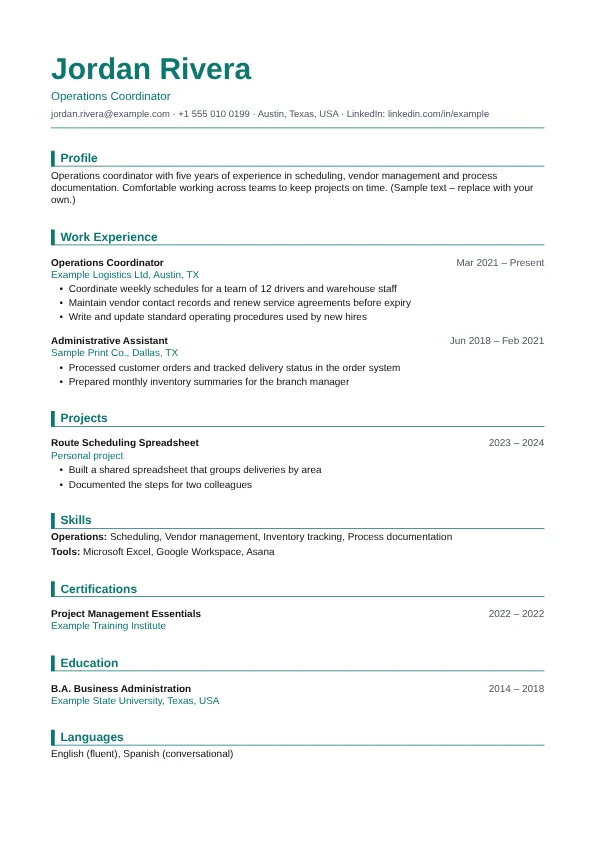
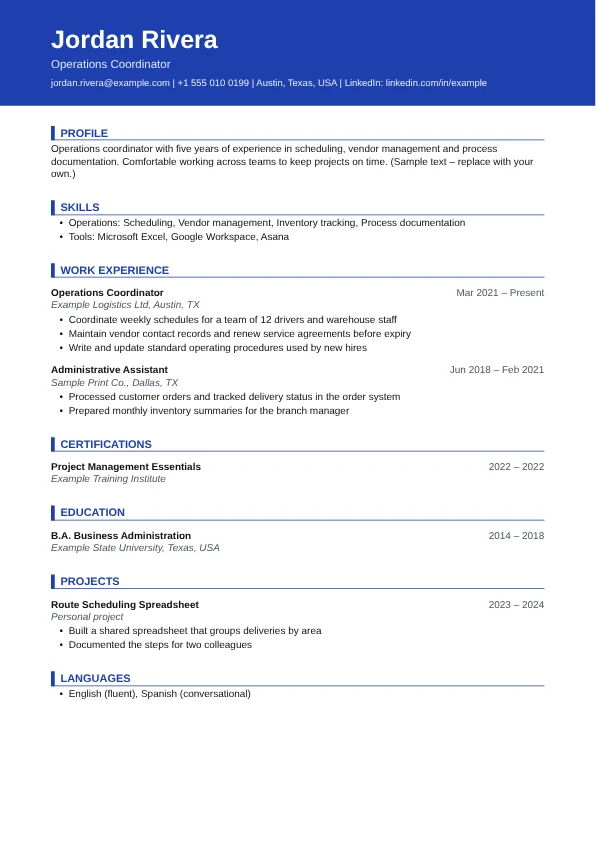
Free to edit and preview. Single-column layouts are the safest choice for applicant tracking systems.
Marketing Resume
Single column
Project Manager Resume
Single column

ATS Professional
Single column
General guidance for job seekers, not legal or immigration advice. Employers and applicant tracking systems differ, so always follow the instructions in the job advert. Spotted a mistake? Email support@jobb.ae.
Ready to build your resume?
Start with a sample or a blank page. No sign-up needed. Free to edit; US$1.00 only if you download a PDF.