
Students and Fresh Graduates
Campus placements and graduate programmes – Page 2
What is an in-tray or case study exercise?
An in-tray exercise gives you a set of emails, reports or tasks and asks you to prioritise and respond within a time limit. A case study gives you a business problem and data, and asks you to analyse it and recommend action.
How to approach both:
- Skim everything first before starting.
- Prioritise by urgency and importance, and explain your reasoning.
- Use the data provided; do not invent facts.
- Write clear, short recommendations.
- Leave a few minutes to check your work.
Practise with free examples from careers services. Coursework such as case analyses and group business projects is good preparation, and it is worth mentioning on your CV.
How should I prepare a presentation for an assessment centre?
Keep it simple, structured and on time. Assessors look for clear thinking and delivery, not fancy slides.
A simple structure:
- Opening: what you will cover and your main recommendation.
- Two or three points with evidence.
- Conclusion and next steps.
Tips:
- Practise to the exact time limit.
- Use few words on slides, or none if you are not given slides.
- Expect questions and answer honestly, including "I'd need to check that".
If your CV mentions presentations, such as final-year project defences or society talks, use those experiences to rehearse.
I'm applying to lots of graduate schemes. How do I keep track?
Use a simple spreadsheet with one row per application. Graduate recruitment often has several stages over months, and it is easy to lose track.
Columns to include:
- Employer and scheme name.
- Date applied and closing date if published.
- Version of CV and answers used.
- Current stage: form, tests, video interview, assessment centre, offer.
- Login details location (not passwords in the sheet), contacts and notes.
Save the exact answers you submitted for each application, because later stages may refer back to them. Keep several named CV versions so you know which one each employer has.
When should I apply for graduate schemes?
Apply as early as you can once applications open, and check each scheme's page for its closing date. Many schemes open about a year before the start date, and some review applications as they arrive and may close early when places fill.
Practical steps:
- Make a list of target employers early in your final year (or sooner).
- Sign up for alerts from employers and your careers service.
- Prepare your CV and answers to common questions in advance.
- Do not wait until the last day; portals can be slow near deadlines.
Dates vary by employer and country, so rely on the employer's official page rather than general guides.
How do I list a spring week or insight programme on my CV?
List it under Experience or a "Professional Development" heading, with the employer, programme name and dates, plus one or two bullets about what you did.
Example: "Spring Insight Programme | City Investment Bank, London | April 2025
- Attended workshops on markets and investment banking divisions.
- Worked in a team on a case study presenting an acquisition recommendation to senior staff."
These short programmes are not jobs, so do not describe them as internships. They still show genuine interest in the sector and are often a route into later internships and schemes.
I was rejected from a graduate scheme. Can I apply again?
Often yes, but employers set their own rules, such as waiting until the next recruitment cycle. Check the scheme's FAQ or terms before re-applying.
Before you re-apply:
- Ask for feedback if the employer offers it.
- Identify the stage you failed at: form, tests, interview or assessment centre.
- Improve that area, for example by practising tests or strengthening examples.
- Add something new to your CV, such as a course, project or work experience.
Many people succeed on a second attempt. Applying to similar schemes at other employers in the meantime is also good practice.
Do graduate schemes need a cover letter?
Some do and many do not. Many large schemes use application form questions instead of a cover letter, while smaller employers may ask for a CV and cover letter.
What to do:
- Follow the instructions on the application page exactly.
- If a cover letter is optional, a short, tailored one can help, especially for smaller firms.
- If there is a "Why do you want to join?" question, treat it like a mini cover letter: motivation, fit and evidence.
Never upload a generic cover letter addressed to another company. If you write one, keep it to one page and name the scheme.
What is a management trainee programme in the Gulf?
A management trainee programme is a structured graduate entry route, common in Gulf banks, airlines, hotels, retail groups and energy companies, where new graduates train across several departments before taking a specific role.
Typical features:
- Rotations through different functions.
- Formal training and mentoring.
- A selection process that may include online tests, interviews and assessment days.
- Some programmes are designed for nationals of the country, while others are open more widely.
Each employer sets its own eligibility, duration and selection stages. Read the programme page carefully before applying, and tailor your CV to the programme's stated goals.
Because trainees move between departments, recruiters look for adaptability, communication and leadership potential as much as technical knowledge. A CV that shows varied experience, such as part-time work, a society role and a relevant internship, suits these programmes well. Keep it clean, one or two pages long and focused on evidence rather than adjectives.
How do I tailor my CV for a management trainee programme?
Show potential to lead, adaptability across departments and interest in the employer's industry. Management trainee recruiters look beyond one technical skill.
Focus on:
- Leadership: society roles, team projects, training others at work.
- Adaptability: varied experiences, study abroad, different part-time roles.
- Business sense: internships, case competitions, relevant modules.
- Communication: presentations, languages, customer-facing jobs.
Example summary line: "Business graduate with retail, banking internship and student leadership experience, seeking a management trainee programme in retail operations."
Mention languages such as Arabic and English if relevant, and keep the CV to one or two pages in a clean format.
Some Gulf graduate programmes are for citizens only. How do I check if I'm eligible?
Read the eligibility section on the programme's official page and the employer's careers site. Many Gulf employers run graduate programmes as part of national workforce initiatives, and these are often open only to citizens of that country.
How to check:
- Look for "eligibility", "requirements" or "who can apply" on the programme page.
- Check nationality, degree, graduation year and language requirements.
- Contact the employer's graduate recruitment team if anything is unclear.
If you are not eligible for a national programme, look for the employer's general graduate or entry-level roles, which may have different criteria. Do not apply to a programme you clearly do not qualify for.
Do I need to speak Arabic for graduate programmes in the Gulf?
It depends on the employer and the role. Many Gulf employers work mainly in English, but some roles and programmes require or prefer Arabic, especially in government, customer-facing and national programmes.
What to do:
- Read the advert for language requirements.
- List your Arabic level honestly in your Languages section.
- If you are learning Arabic, say so with your current level.
Bilingual graduates often have an advantage for customer-facing roles, so if you speak Arabic, make it visible in your summary as well.
Can I apply for Gulf graduate programmes while studying abroad?
Often yes, depending on the employer's eligibility rules and recruitment process. Many programmes accept online applications, tests and video interviews, though some stages may need you to attend in person.
Tips:
- Check the programme's eligibility and the stages that need attendance.
- Include a contact phone number with country code and your current location.
- State your graduation date and when you could start.
- Mention any links to the region, such as previous residence or languages, if relevant.
For questions about whether you could legally work there, check the official government sources for that country; your CV only needs to state facts such as your location and availability.
How do I tailor my CV for graduate programmes in banking, aviation or energy?
Learn what each sector values, then move your most relevant evidence to the top. The core of your CV can stay the same.
Sector focus:
- Banking: numeracy, customer service, attention to detail, finance modules or internships.
- Aviation: customer focus, teamwork, languages, working shifts or under pressure, safety awareness.
- Energy and engineering: technical projects, safety training, site visits, relevant software.
Example summary for aviation: "Business graduate with three years of part-time hospitality experience and fluent English and Arabic, applying for the commercial graduate programme."
Read the programme page for the competencies they mention and make sure your CV shows evidence for each.
The application portal makes me retype everything from my resume. Is that normal?
Yes. Many employer portals parse your uploaded resume into fields, and you then need to check or retype details. Some ask you to fill everything in manually.
To make it easier:
- Keep a plain-text master copy of your resume to copy and paste from.
- Check every field the portal fills in automatically; parsing often puts text in the wrong place.
- Keep dates and titles exactly as on your resume.
- Save progress often, if the portal allows.
The portal entries and your uploaded resume may both be read by recruiters, so make sure they match.
What file format should I upload to a graduate application portal?
Use the format the portal asks for. When it accepts several, a text-based PDF is usually a safe choice because it keeps your layout. If the portal asks for Word, provide Word.
Check before uploading:
- File size is within the portal's limit.
- Text can be selected and copied (it is not a scanned image).
- The file name is clear, such as "Aisha-Rahman-CV.pdf".
- The layout is simple, ideally single-column.
If you build your resume in a tool that exports only PDF and a portal insists on Word, copy the text into a word processor and tidy the formatting before uploading.
The portal asks for module-by-module grades. Where do I find them and what if they're low?
Use your official transcript and enter the grades exactly as shown. Graduate portals sometimes ask for detailed results, and employers may check them against certificates later.
Tips:
- Request a transcript from your university early.
- Enter predicted grades only if the form asks for them, and label them as predicted.
- If one module was low, do not change it. Many forms include a box for extenuating circumstances, which you can use briefly if relevant.
Honesty matters here: any difference between your form and your official documents can lead to an offer being withdrawn.
What are eligibility or knockout questions on graduate applications?
Eligibility or knockout questions check whether you meet essential requirements, such as degree type, graduation year, right to work or willingness to relocate. An answer that does not meet a requirement can end the application automatically.
How to handle them:
- Read each question carefully and answer honestly.
- Check the scheme's eligibility page before starting.
- If you are unsure how your situation fits, contact the graduate recruitment team.
Never give a false answer to get through. Employers usually check these facts later, and a false answer can lead to an offer being withdrawn.
How many resume copies should I bring to a career fair?
Bring more than you expect to need, for example one for each employer on your shortlist plus a few spares, in a folder that keeps them flat and clean.
Tips for career fair resumes:
- Print on plain white paper in good quality.
- Use a one-page version with your contact details clearly at the top.
- Have a version tailored to your main target sector.
- Keep a digital copy ready to share by email or QR if an employer prefers.
Some employers ask you to apply online instead of taking paper, so note their instructions and follow up the same week.
What should I say when I hand my resume to a recruiter at a career fair?
Give a short introduction of three or four sentences: your name, degree, what you are interested in and one relevant strength, then ask a question.
Example: "Hi, I'm Rahul, a final-year mechanical engineering student. I'm interested in your graduate engineering programme. I did my capstone on HVAC energy efficiency and an internship in maintenance planning. Could you tell me what the graduate engineers do in their first year?"
Listen to the answer, ask how to apply, and note the recruiter's name. Mention the conversation in your application or cover letter if appropriate.
Should I mention an employer presentation or campus event in my application?
Yes, briefly, if you attended and learned something useful. It shows genuine interest and can make your motivation answer more specific.
Example: "At your campus presentation in October, the talk on your digital banking team's work with small businesses confirmed my interest in the programme."
Do not exaggerate: if you only collected a leaflet, do not claim a long conversation. Mentioning a person by name is fine if you actually spoke with them and they agreed to keep in touch.
Should I get my resume reviewed by my university careers service before placements?
Yes. Careers advisers and placement officers see many resumes and know what recruiters at your college expect. A review can catch errors and weak descriptions.
To get the most from it:
- Bring a complete draft, not a blank page.
- Bring an advert or the type of role you are targeting.
- Ask specific questions, such as "Is my project section clear?"
- Make changes and ask for a second check if possible.
Also ask a senior student who was placed recently, or an alumnus in your target field, for a quick look. Different readers spot different problems.
Can alumni referrals help with campus placements or graduate programmes?
They can help, especially for off-campus roles and some graduate programmes, but referral rules differ by employer. A referral may get your resume seen; it does not replace the selection process.
How to ask politely:
- Connect with alumni from your course on LinkedIn.
- Send a short message explaining your interest and asking for advice first.
- If they offer a referral, send your tailored resume and the exact job link.
- Thank them and update them on the outcome.
Never pressure someone for a referral. For on-campus drives, follow your placement cell's process; referrals may not apply.
How do I tailor my CV for a CA articleship in India?
Highlight your CA progress, accounting and audit knowledge, software skills and any practical exposure. Articleship firms look for reliability, accuracy and willingness to learn.
Include:
- CA level cleared, with attempt month and year if you choose to show it.
- Your degree (if pursuing or completed).
- Skills: Tally, Excel, GST and TDS basics, audit procedures from coursework.
- Any internships or work with a CA firm or in an accounts department.
- Achievements such as ranks or merit certificates.
Example: "Cleared CA Intermediate (both groups), May 2025. Skilled in Tally Prime, Excel and GST return preparation from a two-month internship."
How do I apply for public sector or government graduate programmes?
Follow the official programme's application process exactly, because public sector schemes often have strict eligibility rules, specific forms and set stages. Your CV may be replaced by a structured form.
Steps:
- Read the eligibility criteria carefully, including nationality and degree requirements.
- Prepare answers to the competency or "behaviour" questions they publish.
- Prepare for online tests and an assessment centre.
- Keep copies of everything you submit.
Use only the official programme website for deadlines and rules. Avoid paying third parties who promise you a place; no one can promise that.
What should BCom or BBA students focus on for campus placements?
Focus on business skills, analytical tools and communication, plus any practical exposure such as internships or live projects. Non-engineering students compete for roles in finance, sales, operations, HR and analytics.
Highlight:
- Excel and data tools, as many roles test them.
- Internships, even short ones, and live projects with companies.
- Certifications linked to your target area, such as finance, digital marketing or HR.
- Leadership through college fests, clubs and competitions.
Example bullet: "Analysed sales data for a regional FMCG distributor as part of a two-month live project, presenting stock-turn findings to the branch manager."
Templates to try
Free to edit and preview. Single-column layouts are the safest choice for applicant tracking systems.
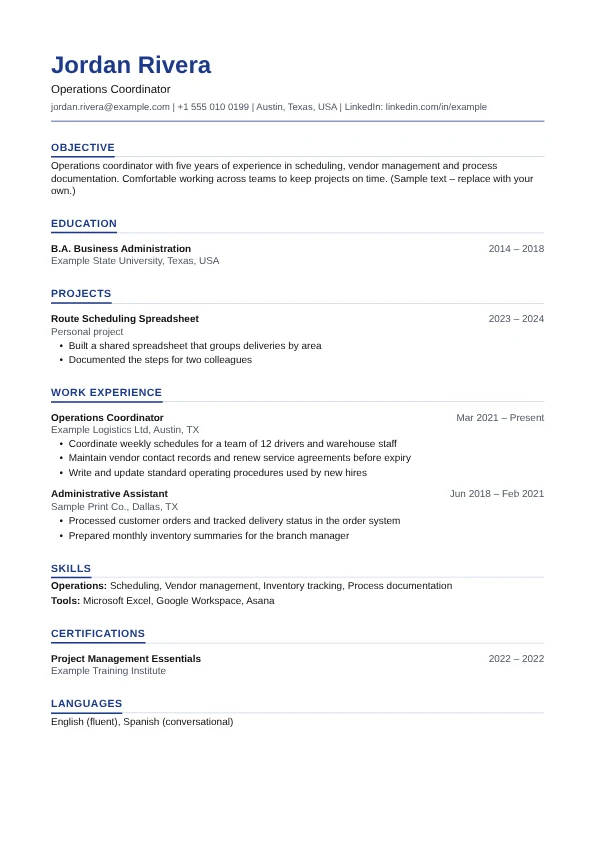
Graduate Resume
Single column

Student Resume
Single column

ATS Classic
Single column
General guidance for job seekers, not legal or immigration advice. Employers and applicant tracking systems differ, so always follow the instructions in the job advert. Spotted a mistake? Email support@jobb.ae.
Ready to build your resume?
Start with a sample or a blank page. No sign-up needed. Free to edit; US$1.00 only if you download a PDF.