
CV Guidance by Country
Germany CV and resume guidance
Applying for a job in Germany often means preparing a Lebenslauf, the German-style CV, and sometimes a full application package with a cover letter and certificates. This guide answers common questions about German CV conventions: length, layout and dates, photos and personal details, the language of your CV, presenting foreign degrees and grades, references, and applying from abroad. It is written for international applicants, graduates and career changers. Conventions vary by employer and sector, so always check the job advert and follow the employer's instructions.
What is a Lebenslauf and how is it different from a resume?
A Lebenslauf is the German word for CV, and it is usually a factual, tabular overview of your career rather than a marketing document. In practice it covers the same ground as an English resume (contact details, experience, education, skills), but the style differs in a few common ways.
Typical features of a German Lebenslauf:
- A clear timeline with month and year for every entry, most recent first.
- Short, factual bullet points rather than a long personal pitch.
- A section for languages and IT skills, often with a level for each.
- Optional personal details such as nationality, which many applicants still include and many now leave out.
It normally forms part of a wider application (Bewerbung) that can also include a cover letter (Anschreiben) and copies of certificates. If you already have a good English resume, you do not need to start again: tighten the dates, make the layout tidy and tabular, and adjust the language to the job advert.
Is a two-page Lebenslauf acceptable for a mid-career role in Germany?
Yes. Two pages is a very common length for an experienced applicant in Germany, and few employers expect you to squeeze ten years of work onto one page.
Aim for:
- One page if you are a student or recent graduate.
- Two pages for most professionals with several jobs.
- Three pages only for senior, academic or highly technical profiles where the extra detail is relevant.
Keep the second page as useful as the first. Older or less relevant roles can shrink to one line each, with job title, employer, place and dates. Do not reduce the font or margins to force a shorter document; a clean A4 layout with enough white space reads better than a crowded one.
Do I have to put a photo on my CV for a job in Germany?
No. A photo (Bewerbungsfoto) is a long-standing convention in Germany, but it is optional, and many applicants now leave it out. Germany's General Equal Treatment Act (AGG) protects job applicants from discrimination on grounds such as ethnic origin, gender, religion, disability, age and sexual orientation. Partly in keeping with this, many employers, including some public bodies, now say they do not expect a photo.
How to decide:
- Read the advert and the online portal. If they ask for no photo, follow that.
- If you do add one, use a recent, professional head-and-shoulders photo, not a holiday or selfie picture.
- International companies and many start-ups rarely expect one.
A CV without a photo is not incomplete. Your experience, skills and a well-written cover letter matter far more. If you build your CV in ResumeBuilder.ae, note that photos are not supported in the PDF, which keeps the text easy for applicant tracking systems to read; you can still upload a photo separately if a portal asks for one.
Sources
- General Equal Treatment Act (AGG), English translation (Federal Ministry of Justice, Germany)
Should my Lebenslauf show my date of birth and marital status?
It is optional, and many applicants now leave both out. Older German CV templates often list date of birth, place of birth and marital status (Familienstand), so you will still see them in examples. However, Germany's General Equal Treatment Act (AGG) covers access to employment, including selection, and protects applicants from discrimination on grounds such as age, so employers should not base selection decisions on your age. Marital status is simply not relevant to whether you can do the job.
A practical approach:
- Leave out marital status and children; they do not show whether you can do the job.
- Date of birth is a personal choice; some applicants include it out of habit, and leaving it out is widely accepted.
- Keep contact details, location and, if relevant, your right to work.
ResumeBuilder.ae has no date-of-birth field, so a CV made there leaves it out by default.
Sources
- General Equal Treatment Act (AGG), English translation (Federal Ministry of Justice, Germany)
What goes into a complete German job application besides the CV?
A typical German application (Bewerbung) is a small package rather than a single CV. The usual parts are:
- Anschreiben: a one-page cover letter tailored to the job.
- Lebenslauf: your CV.
- Anlagen: attachments such as degree certificates, references from former employers (Arbeitszeugnisse) and relevant training certificates.
Some applicants also add a cover page (Deckblatt), but this is optional. Many employers now use online portals with separate upload fields, and some no longer ask for a cover letter at all. Always follow the instructions in the advert: if it asks only for a CV, send only the CV, and if it asks for "aussagekräftige Bewerbungsunterlagen" (meaningful application documents), it usually means the full package.
What is an Arbeitszeugnis and should I include it with my CV?
An Arbeitszeugnis is a written reference that a German employer gives you when you leave, describing your role and assessing your performance. German recruiters often read them, so including your most recent ones with an application is common.
Tips:
- Attach them as copies, in date order, after your CV and cover letter.
- If you worked outside Germany, you probably do not have one. Use a reference letter or experience letter from your former employer instead, if you have it.
- Do not list the full text in your CV. The CV shows the role and dates; the reference is a separate attachment.
If you have no written references at all, that is fine for applicants from abroad. Mention in your cover letter that contact details for referees are available on request.
Do German employers expect the CV to be signed and dated?
Not any more, in most cases. Adding the place, date and a signature at the bottom of the Lebenslauf was a traditional convention, and some applicants still do it, especially for paper applications or conservative employers. For online applications it is usually unnecessary.
If you choose to add it, keep it simple:
Example: "Berlin, 12.03.2026" followed by your typed name or a scanned signature.
Make sure the date is current every time you send the CV; an old date suggests you are sending the same document everywhere. If you are unsure, leave it out. A missing signature will not count against you on an online portal.
What is a tabellarischer Lebenslauf?
A tabellarischer Lebenslauf is a CV laid out as a table or timeline: dates on the left, and the job, school or qualification on the right. It is the standard style in Germany and has replaced the old written-out CV in full sentences.
Example:
"03/2022 – today Project Engineer, Muster GmbH, Munich
- Planned and coordinated maintenance for 3 production lines."
If you use an online form or applicant tracking system, keep the layout simple. A single-column CV where each entry starts with the dates and title gives the same tidy effect without complex tables, which some systems read poorly. Most recent entries come first.
How should I write dates on a German CV?
Use month and year for every entry, in a consistent format. The most common style is MM/YYYY, for example 04/2021 – 09/2024. Writing only years can look as if you are hiding gaps.
Other points:
- For a current job, write "heute" (today) or "seit 04/2021" (since) in a German CV, or "present" in an English one.
- Full dates (DD.MM.YYYY) are only needed for things like a signature date.
- Keep the order reverse-chronological, with the newest entry at the top.
Example: "10/2023 – heute Sachbearbeiterin Buchhaltung, Beispiel AG, Hamburg"
Check that every date uses the same separators and dash style. Small inconsistencies stand out in a tidy German-style layout.
The job ad is in English. Can I send an English CV to a German company?
Yes. As a rule of thumb, apply in the language of the job advert. If a German company writes the advert in English, it usually works in English for that role and expects an English CV.
Watch for these cases:
- The advert is in German but says English is the working language: English is normally accepted, but German shows effort.
- The advert is in German with no mention of English: a German CV is the safer choice if your German is good enough.
- The advert asks for "German and English" skills: send the CV in German or English, and state both language levels clearly.
Never send a machine translation you cannot check. A CV in clear English is better than one in poor German.
How do I show my German language level on a CV?
Use the CEFR levels (A1 to C2), which German employers widely understand, and add a certificate if you have one. A vague word like "intermediate" is harder to judge.
Example:
"German: B2 (Goethe-Zertifikat B2, 2025)
English: C1
Arabic: native"
Tips:
- Be honest. Interviews in Germany are often partly in German if the job requires it, and your level will be obvious.
- If you are studying, say so: "German: B1, currently taking a B2 course".
- In a German CV, the words are "Muttersprache" (native), "verhandlungssicher" (business fluent), "fließend" (fluent) and "Grundkenntnisse" (basic).
How do I present a degree from outside Germany on my Lebenslauf?
Write the original degree name, the institution, the country and the dates, and add a short explanation if the title is not obvious to a German reader.
Example:
"09/2015 – 06/2019 Bachelor of Technology (B.Tech.), Mechanical Engineering
Anna University, Chennai, India"
Tips:
- Keep the official title; do not rename it as a German degree.
- If your degree has been formally assessed or recognised in Germany, you can add a short note such as "recognised in Germany" with the date, as long as it is true.
- For regulated professions such as medicine, nursing or teaching, recognition rules can apply. Check the official German recognition information for your profession rather than guessing on your CV.
Should I convert my foreign grades to the German grading scale?
Usually not on the CV itself. Converting grades can create mistakes, and the German scale (1.0 is best, 4.0 is a pass) works differently from most other systems. Show your original result and, if it helps, explain what it means.
Examples:
- "GPA 3.6 / 4.0"
- "First Class Honours"
- "Final grade 16/20"
If you have an official conversion from a university or recognition office, you can add it in brackets, for example "(German equivalent: 1.7)". Do not calculate one yourself and present it as official. If your grades are average, you can leave them out; work experience matters more after a few years.
Is the Anschreiben (cover letter) still expected in Germany?
Often, but not always. Many German employers still expect a one-page Anschreiben, especially traditional companies, the public sector and smaller firms. A growing number of employers, especially larger and international ones, have made it optional or dropped it from their online forms.
Follow the advert:
- If it asks for an Anschreiben or "Motivationsschreiben", write one tailored to the role.
- If the online form has no field for it, do not force it in.
- If it is optional, a short, specific letter can still help when you are changing careers or applying from abroad.
A good German cover letter is concise and factual: why this role, what you bring, and your earliest start date. ResumeBuilder.ae lets you write a matching cover letter in the builder.
Should I list hobbies on a German CV?
You can, but keep it short. A brief "Interessen" or "Hobbys" line is still common on German CVs, particularly for students and graduates, and some interviewers like to ask about it. For experienced applicants it is optional.
Make it useful:
- Pick two or three specific interests rather than "reading, travel, music".
- Prefer interests that show commitment, teamwork or a relevant skill.
- Leave out anything that reveals religion or political views unless it is directly relevant to the job.
Example: "Interessen: Marathon running (Berlin Marathon 2025), volunteer football coach for under-12s"
If space is tight, remove hobbies before you cut relevant experience.
Do German employers ask for references on the CV?
Not usually in the way UK or US employers do. In Germany, written employer references (Arbeitszeugnisse) attached to the application often play the role that referee contacts play elsewhere, so a list of referees on the CV is less common.
What to do:
- Do not add "References available on request"; it uses space without adding anything.
- If you have no German-style written references, a recommendation letter from a former manager is a good substitute.
- If an employer asks for referees later, provide names and contact details then, after asking those people first.
For academic and some international roles, named referees are more common. Follow the advert's instructions.
Which page size should I use for a CV sent to Germany?
Use A4. It is the standard paper size in Germany and the rest of Europe, and a CV in US Letter size can look slightly off when printed or viewed by a German recruiter.
When you switch:
- Check that nothing moves onto a new page by accident.
- Keep margins of around 2 cm so the page does not feel crowded.
- Save and send the final file as a PDF unless the employer asks for something else.
ResumeBuilder.ae offers both A4 and US Letter, so you can keep one master CV and export an A4 version for German applications.
I am applying to Germany from abroad. What should my CV say about my location?
State where you live now and, if it is true, that you are willing to relocate. German recruiters need to know quickly whether you are local and when you could start.
Example contact line:
"Cairo, Egypt | Relocating to Germany from 06/2026 | +20 100 000 0000"
Also consider:
- Your earliest start date and notice period, either in the CV header or the cover letter.
- Your German level, stated clearly.
- Your work authorisation, only if you already have permission to work in Germany. Do not imply a permit you do not have; if you will need sponsorship, it is usually better explained honestly in the cover letter or when asked.
Use a phone number with the country code and an email you check daily.
Should I mention my nationality on a Lebenslauf?
It is optional. Many German CVs still list "Staatsangehörigkeit" (nationality) under personal details, partly because it helps employers understand whether a work permit may be needed. Many applicants now leave it out, and it is not a measure of whether you can do the job.
A balanced approach:
- If you are an EU citizen or already hold permission to work in Germany, a short line such as "EU citizen" or "Work permit: valid" can save questions.
- If you will need a permit, you do not have to lead with nationality; your cover letter can address relocation and availability.
ResumeBuilder.ae has optional fields for nationality and work authorization, so you can include or omit them for each version.
What headings does a German-language Lebenslauf usually use?
The common headings are short and standard, which also helps applicant tracking systems recognise each section.
Typical headings:
- Persönliche Daten (personal details)
- Berufserfahrung (work experience)
- Ausbildung or Bildungsweg (education)
- Weiterbildung (further training)
- Kenntnisse (skills), sometimes split into Sprachkenntnisse and EDV-Kenntnisse (IT skills)
- Ehrenamt (volunteering)
- Interessen (interests)
Keep the order logical: experience first if you have worked for several years, education first if you are a student or graduate. In ResumeBuilder.ae you can choose German as the resume language on the Design tab; check that every heading reads as you want, and use the Custom Section if you need a heading of your own.
How do I list a German vocational apprenticeship (Ausbildung) on my CV?
List it like education, with the official occupation name, the training company, the vocational school if relevant, and the dates. In Germany a completed Ausbildung is a respected qualification, so name it precisely.
Example:
"09/2017 – 06/2020 Ausbildung zum Industriemechaniker
Muster Maschinenbau GmbH, Stuttgart
Final exam: IHK, grade 2"
If you write in English for an international employer, add a short explanation:
Example: "Industriemechaniker (three-year dual vocational training in industrial mechanics, IHK certified)"
If the training included real work for the company, you can add one or two bullets about tasks or projects, just as you would for a job.
How should a Praktikum appear on a German CV?
List a Praktikum (internship) under work experience with its dates, the company, the department and two or three concrete tasks. German employers often value internships highly, especially for graduates.
Example:
"03/2025 – 08/2025 Praktikum Marketing, Beispiel GmbH, Cologne
- Prepared weekly social media reports for 4 brand accounts
- Supported organisation of a trade fair stand"
Tips:
- Mark compulsory internships (Pflichtpraktikum) as part of your studies if that helps explain timing.
- Do not inflate titles; "Praktikant" or "Intern" is fine.
- If you have many short internships, keep the most relevant ones detailed and shorten the rest.
How do I list a Werkstudent job while studying in Germany?
List it under work experience with the job title, the employer and the dates, and mark it as a working-student role. A Werkstudent job is part-time work alongside a degree, and employers often treat it as real professional experience.
Example:
"10/2024 – today Werkstudent Data Analytics (part-time), Beispiel AG, Frankfurt
- Built monthly sales dashboards in Power BI for the regional team
- Cleaned and merged customer data from 3 systems"
Mention the weekly hours only if they help, for example when the role was substantial. Put the role above your education if it is your strongest selling point for the job.
Do German recruiters look closely at gaps in a CV?
Many do. German CVs traditionally show a continuous timeline, and recruiters often notice gaps of several months. A short, honest explanation is better than blurring dates.
Examples of brief entries:
- "01/2024 – 06/2024 Parental leave"
- "07/2023 – 12/2023 Relocation to Germany and German course (B1)"
- "03/2022 – 08/2022 Career break: caring for a family member"
You do not have to give private details, such as medical reasons. A neutral line such as "Career break" is enough, and you can explain more in an interview if you wish. Any courses, freelance work or volunteering done during the gap are worth listing.
Should I include my school leaving certificate, like the Abitur, on my CV?
Yes for students and graduates, and usually as one line for everyone else. German employers commonly see the school qualification as part of the education history.
Example:
"2014 – 2016 Abitur, Goethe-Gymnasium, Leipzig"
If you finished school outside Germany, give the name of your qualification and the country rather than calling it an Abitur.
Example: "2016 Higher Secondary Certificate (HSC), Dhaka, Bangladesh"
Once you have a degree and several years of work, you can shorten school to a single line or drop it if space is tight, but many German CVs keep it.
Templates to try
Free to edit and preview. Single-column layouts are the safest choice for applicant tracking systems.
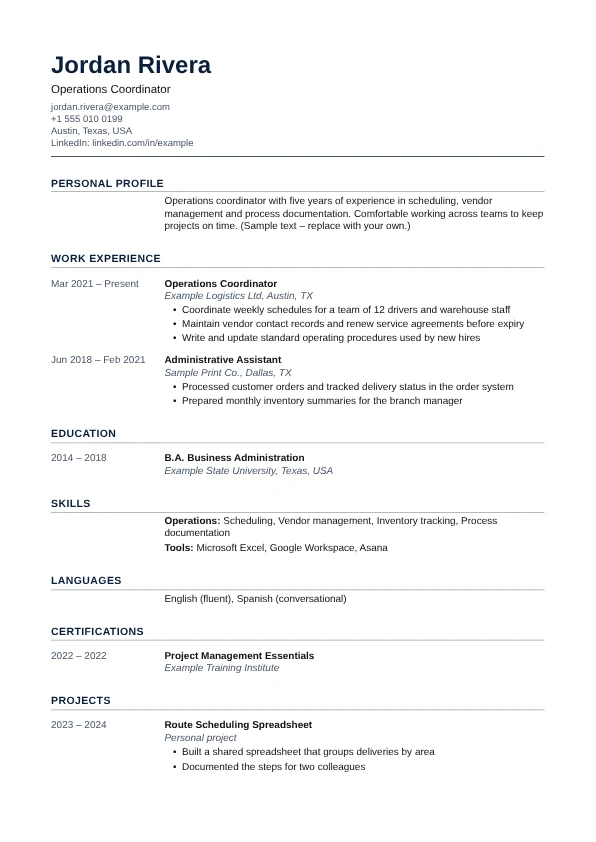
International CV
Two-column entries (more complex)

ATS Classic
Single column

ATS Professional
Single column
General guidance for job seekers, not legal or immigration advice. Employers and applicant tracking systems differ, so always follow the instructions in the job advert. Spotted a mistake? Email support@jobb.ae.
Ready to build your resume?
Start with a sample or a blank page. No sign-up needed. Free to edit; US$1.00 only if you download a PDF.