
CV Guidance by Country
Ireland CV and resume guidance
This guide explains how CVs are usually written for jobs in Ireland. It covers the two-page A4 convention, Irish and British spelling, and which personal details, photos and identity numbers are normally left off. It also shows how to present Irish qualifications such as the Leaving Certificate, QQI awards, NFQ levels, degree classifications and apprenticeships, and how to approach graduate programmes, public service competitions, multinational employers, recruitment agencies and multilingual roles. It is useful for school leavers, graduates, experienced professionals and people relocating to Ireland from abroad.
What does a typical Irish CV look like?
A typical Irish CV is two A4 pages, written in reverse chronological order, with a short profile, work experience, education, skills and sometimes references. It is close to the UK style: no photo, few personal details and a strong focus on relevant experience.
A common structure:
- Name and contact details: phone, email, town or county, LinkedIn.
- Personal profile of three or four lines.
- Work experience, most recent first, with achievements.
- Education and training, including your NFQ level where helpful.
- Skills, languages and certifications.
- References, or a note that they are available.
Irish recruiters, including those at large multinational employers, generally expect this clean, concise format. Use British/Irish spelling throughout.
Write each role with a short line on what the organisation does if it is not well known, then three to five bullets that show results rather than duties. Save the file as a text-based PDF with your name in the file name, unless the employer asks for another format.
How long should a CV be for jobs in Ireland?
Two pages is the usual maximum, and one page is fine for students and recent graduates. Irish recruiters often read many applications for popular roles, so a focused CV is easier to shortlist.
Guidelines:
- Students, Leaving Certificate holders and graduates: one page, or two if you have placements and part-time jobs worth detailing.
- Experienced professionals: two pages.
- Academic, research and senior medical roles: longer, with publications or clinical detail.
If you have come from a country where longer CVs are normal, trimming to two pages is one of the most useful changes you can make.
Do Irish employers expect a photo, date of birth or marital status on a CV?
No, these are not usually expected on a CV in Ireland. Most Irish employers focus on skills and experience, and leaving personal details off helps keep the process fair. Your name, phone, email and location are enough.
Leave off:
- Photo.
- Date of birth or age.
- Marital status and family details.
- Nationality, unless it helps to explain your right to work, which you can address in a separate line.
- PPS number.
Some roles, such as acting or modelling, have their own conventions, but for most jobs a plain CV without these details is the norm.
How do I list my Leaving Certificate results on my CV?
List the subjects with their grades and the year, usually with the higher-level subjects first. For school leavers and recent graduates, Leaving Certificate results are useful; for experienced applicants, one line is enough.
Example:
"Leaving Certificate, St. Mary's College, Galway, 2022
Higher Level: English H2, Biology H1, French H3, Mathematics H3
Ordinary Level: Irish O2, Accounting O1"
Tips:
- Use the grade codes from your results (H1 to H8, O1 to O8).
- If you did the Leaving Certificate Applied or Leaving Certificate Vocational Programme, name it.
- Once you have a degree, shorten it: "Leaving Certificate, 2022: 6 Higher Level subjects."
Should I put my CAO points on my CV?
Usually not. CAO points are for college entry, and employers are more interested in your actual subjects, grades and what you did afterwards. Listing your Leaving Certificate subjects and grades is clearer.
There are a few cases where points can be mentioned:
- You are a school leaver applying for an apprenticeship or first job, and your total is notably strong.
- An employer's form specifically asks for it.
Even then, the subjects and grades say more about your strengths than one total number.
How do I show the NFQ level of my qualification?
Add the National Framework of Qualifications (NFQ) level in brackets after the qualification title. Irish employers know the NFQ levels well, and including them helps when your course title does not make the level obvious.
Example:
"BSc (Hons) Computing, Technological University Dublin, 2024. Second Class Honours, Grade 1 (NFQ Level 8)"
"QQI Level 5 Certificate in Healthcare Support, 2023"
Tips:
- Use the level stated on your award.
- For qualifications from abroad, do not guess the NFQ level. Describe the qualification instead, or use an official recognition statement if you have one.
How do I write an Irish degree classification like 2.1 on my CV?
Write the classification after the degree, using the standard Irish wording or short form. Irish employers, especially graduate programmes, often look at degree results first.
Example: "BA (Hons) Economics and Finance, University College Cork, 2025. First Class Honours"
Example: "BEng (Hons) Civil Engineering, University of Galway, 2024. Second Class Honours, Grade 1 (2.1)"
If you have not finished, write "Expected 2.1" only if your results so far support it. For a master's, use the result on your transcript, such as "Distinction" or "Merit".
How should I present a QQI award or a PLC course on my CV?
List it in your Education section with the full award title, the NFQ level, the college and year. QQI awards from Post Leaving Certificate (PLC) courses are well known to Irish employers in fields like childcare, healthcare, business and IT.
Example: "QQI Level 6 Advanced Certificate in Early Childhood Care and Education, Dun Laoghaire Further Education Institute, 2024"
Tips:
- Mention work placements from the course as experience, with tasks and results.
- If you hold older FETAC awards, list them by their original name and level.
- Add relevant modules if they match the job advert.
Should I mention Irish language ability on my CV?
Yes, if you have it and especially for public sector, education and some media or customer-facing roles where Irish is valued or requested. State your level honestly.
Example: "Languages: English (native), Irish (fluent spoken and written), French (B1)"
Tips:
- If you studied Irish only for the Leaving Certificate, write a level that reflects your current ability, such as "basic" or "conversational".
- Teaching and some public service roles may have their own requirements; check the advert.
- Use a common scale for other languages, such as the CEFR levels (A1 to C2), which Irish employers recognise.
Should my PPS number go on my CV?
No. Never put your PPS number on a CV. It is a sensitive personal identifier and a CV may be forwarded to many people and stored in different systems. Employers ask for it when you start work, through their payroll process.
The same applies to passport numbers, bank details and your date of birth. If anyone asks for these before an interview, check that the employer or agency is genuine.
Should I use British, Irish or American spelling for jobs in Ireland?
Use British or Irish spelling, which are essentially the same: organise, colour, programme, licence, centre. American spelling is understood but looks out of place on an Irish CV, unless you are applying to a US company that writes in American English.
Tips:
- Set your spellchecker to English (Ireland) or English (UK).
- Use "CV" rather than "resume".
- Keep names of software, companies and certifications as officially spelled.
If you are applying to a US multinational's office in Ireland, check the tone of their job advert; Irish spelling is still safe.
How much of my address should I put on an Irish CV?
Your town or city and county are usually enough, such as "Swords, Co. Dublin" or "Ennis, Co. Clare". A full address and Eircode are not needed at the application stage, though some people include an Eircode for local jobs where commuting distance matters.
If you are relocating:
Example: "Currently in Warsaw, relocating to Cork in April 2026"
Include an Irish mobile number with +353 if you have one, or your international number with its country code.
Do Irish employers want references listed on the CV?
Many Irish employers check references, often before making a final offer, but listing them on the CV is optional. Many applicants write "References available on request" or leave the section out and give names when asked.
When to list them:
- The job advert asks for referees.
- You are applying to smaller employers who may call before interview.
- Graduate or school-leaver roles where a lecturer or teacher reference helps.
Give two referees, ideally recent managers, with name, title, organisation, phone and email. Ask permission before listing anyone.
I'm moving to Ireland from abroad. What should I change on my CV?
Convert it to Irish conventions and make your location and availability clear. Irish recruiters receive many international applications, and a CV that already looks local is easier to assess.
Changes to make:
- Two A4 pages, Irish or British spelling.
- Remove photo, date of birth, marital status and identity numbers.
- Add a location line: "Relocating to Dublin in March 2026, available for video interviews."
- Explain foreign qualifications and employers in plain terms.
- Add any Irish or EU experience, contacts or studies.
If you need permission to work in Ireland, check the official Irish government guidance yourself and describe your status accurately; do not guess on your CV. A short, factual line is better than a vague one, and the details belong on the employer's form if they ask.
How should I write my CV for a US tech multinational's office in Dublin?
Follow Irish CV conventions, but make it concise and results-focused, as these employers often have US-influenced hiring styles. One to two pages, strong achievement bullets and clear skills sections work well.
Tips:
- Lead with impact: numbers, scale and outcomes.
- List technologies and tools clearly for keyword searches.
- Keep Irish spelling unless the company's own content uses American spelling heavily; either is acceptable if consistent.
- Leave off photos and personal details.
Example: "Reduced average ticket resolution time for EMEA enterprise customers by redesigning the escalation process."
What should a CV for pharma or medical device jobs in Ireland highlight?
Highlight regulated-environment experience: GMP, cleanroom work, documentation, validation and quality systems. Ireland has a large pharmaceutical and medical device sector, and recruiters look for these terms early.
Include:
- Quality and compliance experience: GMP, GDP, deviations, CAPA, batch records.
- Equipment and processes you have worked with.
- Validation or audit involvement.
- Shift patterns you have worked, if relevant.
Example: "Process Technician, a medical device manufacturer, Galway, 2022 to Present. Ran cleanroom assembly lines and completed batch documentation in line with GMP."
Use the same terms as the job advert where they honestly match your experience.
Do Irish public service jobs accept a CV?
Many Irish public service and civil service competitions use their own application forms, often with competency-based questions, rather than a standard CV. Some roles ask for a CV in addition. Always follow the instructions in the candidate information booklet.
Tips:
- Read the competencies or key requirements and plan one example for each.
- Use specific examples with situation, actions and results.
- Keep dates and titles consistent with your CV.
- Respect word limits.
If a CV is requested, use the standard Irish format and keep it to two pages unless told otherwise.
Should I mention Garda vetting on my CV?
You can add a short line if you have recently been vetted for similar work, as employers in childcare, education, healthcare and care roles look for it. Employers normally run their own vetting process, so the line is helpful context rather than a replacement.
Example: "Garda vetted for childcare work, 2025"
Tips:
- Do not include reference numbers or copies on the CV.
- Do not imply you are vetted for a role you have not been vetted for.
- If you have not been vetted, simply leave it out; the employer will arrange it if needed.
How do I show Transition Year work experience on my first CV?
List it under work experience with the organisation, dates and a few tasks. Transition Year placements are well recognised in Ireland and are a good start for students with no paid work.
Example:
"Transition Year Work Experience, a veterinary clinic, Kilkenny, two weeks, 2024
- Helped with reception, animal care and cleaning.
- Observed routine procedures with the vet team."
Tips:
- Add any part-time jobs, babysitting, sports coaching or volunteering.
- Mention Gaisce or similar awards if you have them.
- Keep the CV to one page.
How do I show a craft apprenticeship on my CV in Ireland?
Put the apprenticeship in your work experience with the employer, trade and dates, and list the qualification in your education section with its level. Irish employers in construction, engineering and electrical work look for both.
Example:
"Apprentice Electrician, a building services contractor, Limerick, 2021 to 2025
- Wired domestic and commercial installations under supervision.
- Completed off-the-job training phases at college."
"Advanced Certificate, Craft: Electrical (NFQ Level 6), 2025"
Add safety training and site cards, and list any licence the role requires with the details its issuing body asks for.
I speak German and Spanish. How do I show languages for multilingual roles in Dublin?
Put languages in their own section near the top and use CEFR levels (A1 to C2), so recruiters can match you to roles that need a particular level. Many shared service, customer support and tech roles in Ireland ask for a specific language at a business level.
Example:
"Languages: German (native, C2), English (C1), Spanish (B2)"
Tips:
- Mention the language in your profile line too: "German-speaking customer support specialist."
- Say whether you can write professionally, not just speak.
- Expect a language test; be honest about your level.
How should I list seasonal hospitality work in Ireland on my CV?
Group seasonal roles clearly with dates and locations, and focus on skills that carry across, such as customer service, working under pressure and teamwork. Seasonal work in hotels, restaurants and tourism is common in Ireland and is valued experience.
Example:
"Seasonal Bar and Restaurant Staff, hotels in Killarney and Dingle, summers 2022 to 2024
- Served up to 200 covers per evening in peak season.
- Trained new seasonal staff on the till system."
If you returned to the same employer each season, say so, as it shows reliability.
Should I use a recruitment agency CV format in Ireland?
Keep your own clean CV and let the agency adapt it if they need to. Recruitment agencies are widely used in Ireland, especially for IT, finance, pharma and engineering, and they may add their own cover page before sending your CV to a client.
Tips:
- Make sure job titles, skills and availability are clear for database searches.
- Ask to see the version they send.
- Ask them not to add a photo or personal details you removed.
- Track where agencies send your CV to avoid duplicate applications to one employer.
How do I format my phone number on an Irish CV?
Use the +353 country code and drop the leading zero, such as "+353 87 123 4567". This works for local and international recruiters. For purely local applications, "087 123 4567" is also understood.
Tips:
- Use one mobile number that you answer.
- If you are abroad and do not yet have an Irish number, use your current number with its country code.
- Keep the same number on your LinkedIn and job site profiles.
Is a cover letter expected with a CV in Ireland?
Often yes, especially for professional roles and smaller employers. Many Irish job adverts ask for a CV and cover letter, and a short, tailored letter can help when applications are similar. Online systems may use a cover letter box instead.
A good Irish cover letter:
- Is under one page.
- Names the role and where you saw it.
- Gives two or three specific reasons you fit, linked to the advert.
- Mentions availability and location if you are relocating.
If the advert asks only for a CV, a short covering email is enough.
Templates to try
Free to edit and preview. Single-column layouts are the safest choice for applicant tracking systems.
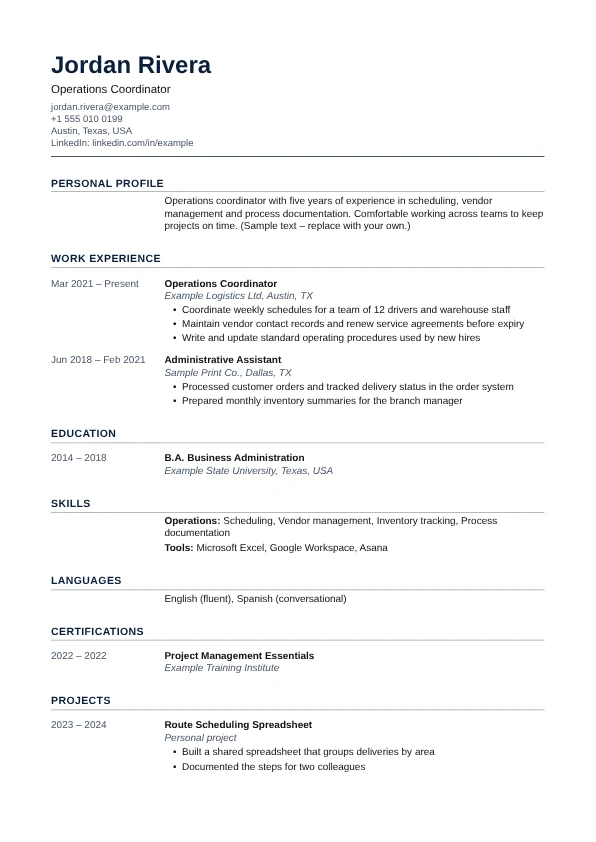
International CV
Two-column entries (more complex)

ATS Classic
Single column

ATS Professional
Single column
General guidance for job seekers, not legal or immigration advice. Employers and applicant tracking systems differ, so always follow the instructions in the job advert. Spotted a mistake? Email support@jobb.ae.
Ready to build your resume?
Start with a sample or a blank page. No sign-up needed. Free to edit; US$1.00 only if you download a PDF.