
Students and Fresh Graduates
Summaries and objectives for graduates
The few lines at the top of a graduate resume shape how the rest is read. This topic explains whether to use a summary, an objective or a UK-style personal statement, how long it should be, what to include and which clichés to drop. It shows how to tailor a summary for graduate schemes, internships, part-time work and roles outside your degree, and gives example summaries for many fields, from accounting and engineering to nursing, design and law. It is written for final-year students and fresh graduates who want an opening that is specific, honest and quick to read.
Should a fresh graduate write a summary or an objective?
Most fresh graduates are best served by a short summary that also mentions the kind of role they want. That combines the strengths of both: a summary shows what you offer, and an objective shows where you are heading.
The difference:
- An objective focuses on what you want: "Seeking an entry-level role in marketing."
- A summary focuses on what you bring: your degree, key skills and best evidence.
Old-style objectives that only talk about your wishes ("a challenging role where I can grow") tell the employer nothing. A blended graduate summary works better:
Example: "Marketing graduate from Al Noor University with internship experience in social media campaigns and strong skills in Canva and Meta Business Suite. Looking for an entry-level digital marketing role in Dubai."
Two to four lines is enough. If you are applying for a specific scheme or role, name it, and make sure the skills you mention appear again in your experience or projects.
What should a graduate resume summary include?
A good graduate summary includes four things: who you are (degree and field), your strongest relevant skills, one piece of evidence and the role you are aiming for.
A simple formula:
- Line 1: degree, subject and university or graduation year.
- Line 2: two or three skills that match the job.
- Line 3: one proof point, such as an internship, project or achievement.
- Optional line 4: the type of role you want.
Example: "Computer science graduate (2025) with skills in Python, SQL and REST APIs. Built a student timetable app used by classmates during a final-year project. Seeking a junior software developer role."
Keep it specific to the job and remove anything that would fit every applicant.
How long should a graduate resume summary be?
Two to four lines, or roughly 30 to 60 words. A graduate summary is an introduction, not an essay, and on a one-page resume it must leave space for your education, projects and experience.
Signs it is too long:
- It repeats details from your education section word for word.
- It lists more than three or four skills.
- It includes several sentences about your personality or goals.
If you need to cut, keep your degree, the two most relevant skills and your best piece of evidence. Everything else can go in the body of the resume or in your cover letter.
Which clichés should I avoid in a graduate summary?
Avoid phrases that every applicant uses and that cannot be proved. They take up space and make your summary sound copied.
Common clichés:
- "Hard-working and highly motivated graduate"
- "Seeking a challenging position in a reputed organisation"
- "Team player who can also work independently"
- "Fast learner with excellent communication skills"
- "Passionate about making a difference"
Replace each with something specific. For example, instead of "fast learner", write "Learned SQL in six weeks through an online course and used it in my final-year project." Instead of "reputed organisation", name the type of role and sector you want. One concrete detail is worth more than three adjectives.
Should my summary be written in the first person?
Usually not. The common style on resumes is "implied first person": you leave out "I" and "my" and start with a description or a verb.
Examples:
- Implied first person: "Accounting graduate with internship experience in accounts payable."
- Full first person: "I am an accounting graduate with internship experience in accounts payable."
Both are understandable, and some UK "personal statements" do use "I", but the implied style is shorter and reads more professionally. Whatever you choose, stay consistent and never write about yourself in the third person ("Sara is a dedicated graduate").
How do I write a summary when I haven't graduated yet?
Describe yourself as a final-year student and give your expected graduation date. Employers hiring for graduate roles expect many applicants to be still studying.
Example: "Final-year BSc Civil Engineering student at Gulf Technical University, graduating June 2027. Completed an eight-week site internship and a capstone project on drainage design using AutoCAD. Seeking a graduate engineer role starting summer 2027."
Do not write "graduate" if you have not yet finished, as that can confuse screening questions about your qualification. Make sure the date in your summary matches the date in your education section.
What should my summary say if I'm applying for a job outside my degree field?
Lead with the skills and evidence that match the new field, and mention your degree as background rather than the main point. Then give a short reason for the move, if it helps.
Example: "Data-focused graduate with a BA in Economics and hands-on experience in SQL, Excel and Power BI, built through an online certificate and a project analysing public transport data. Looking to start a career as a junior data analyst."
Keep the reason positive and brief. Do not apologise for your degree. Make sure the skills you claim appear again in your projects or experience.
How do I mention my internship in my graduate summary?
Mention it in one short phrase that shows what kind of work you did and where, then move on. The details belong in your Experience section.
Examples:
- "Finance graduate with a three-month internship in a Dubai audit firm, supporting year-end testing for retail clients."
- "Mechanical engineering graduate with a summer internship in HVAC maintenance planning."
If you had more than one internship, mention the most relevant one or summarise them: "two internships in supply chain operations." Do not list your intern title in a way that makes it sound like a permanent role.
My only real experience is my degree. What do I put in my summary?
Build your summary from your degree, your strongest project or piece of coursework and the skills you used. A degree has plenty of evidence in it if you look for specifics.
Example: "Business administration graduate with skills in market research, financial analysis and Excel. Final-year project analysed customer loyalty for a local supermarket chain, combining a 120-response survey with sales data. Seeking an entry-level business analyst or operations role."
Add any part-time work, activities or courses in a few words if they support the role. Keep the tone confident: you are presenting what you have, not apologising for what you lack.
How much should I change my summary for each application?
Change a few words each time: the job title you are targeting, the two or three skills that match the advert, and the proof point that fits best. The basic structure can stay the same.
A quick routine:
- Replace the target role with the exact title from the advert.
- Swap in skills the advert stresses, if you genuinely have them.
- Choose the internship, project or job that matches this role best.
Example: For a finance role, "Accounting graduate with Excel and reconciliation skills"; for an audit role, "Accounting graduate with audit internship experience and attention to sampling and documentation." It takes five minutes and makes the whole resume feel targeted. Save each version with a clear name, such as "Summary - audit roles", so you can reuse it for similar adverts later.
Should I put the company's name in my summary?
You can, but it is optional and carries a risk: if you forget to change it, the next employer sees a competitor's name. Naming the role and sector is usually enough.
If you do use it:
- Keep it short: "Seeking a graduate trainee role with Gulf Logistics Group."
- Double-check it before each send.
- Make sure your cover letter also names the company correctly.
A safer approach is to name the role and industry, for example "Seeking a graduate trainee role in logistics and supply chain", and let your cover letter carry the company-specific message.
What's the difference between my summary and my cover letter?
Your summary is a two to four line snapshot at the top of your resume; your cover letter is a short letter explaining why you want this particular job and why you fit. They should agree with each other but not repeat each other word for word.
In practice:
- Summary: degree, key skills, one proof point, target role.
- Cover letter: your motivation, two or three examples in more detail, knowledge of the employer.
If an application does not allow a cover letter, your summary carries more weight, so make sure it mentions the role and your strongest evidence.
Should I put keywords from the job advert in my summary?
Yes, a few, when they are true for you. The summary is a natural place for the key terms an advert uses, such as the job title and two or three core skills.
Example: an advert asks for "a graduate accountant with knowledge of IFRS and Excel". Your summary could start: "Graduate accountant with coursework in IFRS reporting and strong Excel skills, including pivot tables and lookups."
Do not stuff the summary with a long list of keywords, and do not copy sentences from the advert. Use the terms naturally and make sure the rest of your resume backs them up.
Should my summary be different for a graduate scheme than for a regular job?
Slightly. Graduate schemes often rotate you through several departments, so your summary can show broad strengths and interest in the scheme's area rather than one narrow skill.
Example for a scheme: "Economics graduate with experience in data analysis, client-facing part-time work and leading a student investment society. Interested in a rotational graduate programme in banking and finance."
Example for a specific job: "Economics graduate with Excel and SQL skills, seeking a junior credit analyst role."
Read the scheme's description and use their language for the qualities they want, such as "commercial awareness" or "leadership potential", backed by your own evidence.
Should my summary say I'm willing to relocate?
You can add a short phrase if you are applying to jobs in another city or country, because it answers a question the employer may have. Keep it brief and factual.
Examples:
- "Open to relocation within the GCC."
- "Relocating to Riyadh in August 2026."
- "Currently based in Kochi; available to move to Dubai."
If your work authorization in the destination country matters for the role and you already have it, you can mention it once in your personal details. For rules about working in another country, check the official government immigration sources for that country rather than relying on a resume guide.
How do I write a summary if I graduated a while ago and haven't found a job yet?
Focus on what you have done since graduating as well as your degree: courses, projects, temporary work, volunteering or family responsibilities. Showing recent activity is more persuasive than the degree alone.
Example: "Business graduate (2024) who has since completed a digital marketing certificate and managed social media for two small local businesses on a freelance basis. Seeking an entry-level marketing role."
Do not hide your graduation year or invent experience. If the gap was for personal reasons, you do not need to explain it in the summary; a short, honest answer at interview is enough.
How should a mature or older graduate write a summary?
Combine your new degree with your earlier experience, and present them as a strength. A mature graduate brings work habits and life experience that younger graduates may not have.
Example: "Psychology graduate (2025) with eight years of experience in retail management, including staff training and customer service. Seeking a graduate role in HR or learning and development, where both people skills and my degree are relevant."
Keep the focus on what is relevant to the new role. You do not need to mention your age, and you can trim older, unrelated experience to keep the resume focused.
How do I fix a weak objective like "Seeking a challenging position"?
Replace the vague wish with specifics: your degree, the role you want and what you offer.
Before: "To obtain a challenging position in a reputed organisation where I can utilise my skills and grow."
After: "Electrical engineering graduate seeking a graduate engineer role in power distribution. Skilled in AutoCAD Electrical and MATLAB, with an internship in substation maintenance planning."
The rewrite tells the employer exactly what you are looking for and why you could do it. Read your objective aloud and ask: could any graduate in any field have written this? If yes, add specifics until the answer is no.
The same method works for any field: name your degree, name the role, then add one or two skills and one real piece of evidence. Objectives built this way are short, but every word helps the reader decide to keep going.
Is it OK to use the word "passionate" in my summary?
It is OK occasionally, but it is so common that it rarely persuades on its own. If you use it, add evidence straight away.
Weak: "Passionate about sustainability."
Better: "Committed to sustainability, with a final-year project on reducing energy use in student housing and a role as president of the campus environment society."
Often you can drop the word and let the evidence show your interest. "Ran the campus environment society and wrote a dissertation on solar adoption" shows passion without saying it.
Can I write my graduate summary as bullet points?
Yes, two or three short bullets can work, especially if your summary would otherwise be a dense paragraph. Keep the total length the same as a short paragraph.
Example:
"- BSc Nursing graduate (2025) with clinical placements in medical and paediatric wards.
- Skilled in patient observation, medication rounds under supervision and electronic records.
- Seeking a newly qualified nurse role in a hospital setting."
Choose one style and stick to it. Some templates format the summary as a paragraph, so check that your bullets display neatly in the preview before you download.
Should I mention long-term career goals in my summary?
Keep long-term goals out of the summary unless they directly support the job you are applying for. Employers want to know what you can do in this role now.
Fine: "Aiming to develop towards a chartered accountancy qualification" for a trainee accountant role, because it matches the employer's path.
Risky: "Long-term goal is to start my own consultancy" for a junior analyst role, because it may suggest you will leave soon.
Save fuller career plans for the interview, where you can explain them with context.
Can I use AI to write my graduate summary?
You can use AI to get a first draft or ideas, but rewrite it in your own words and make sure every claim is true. AI-written summaries often sound generic and may include skills or achievements you do not have.
A safe approach:
- Give the tool real facts: your degree, projects, skills and the advert.
- Treat the output as a rough draft.
- Remove clichés and anything you cannot prove.
- Read it aloud: it should sound like you.
Interviewers often ask about lines in your summary, so you must be able to explain each one.
How do I use ready-made example summaries without sounding generic?
Use them as a structure, then replace the content with your own facts. ResumeBuilder.ae, for example, offers example summaries grouped by job role, including for fresh graduates, with [brackets] where you add your own details.
Steps:
- Pick an example for the role closest to yours.
- Replace every bracketed prompt with real information.
- Change any skill or claim that is not true for you.
- Add one specific detail no one else would have, such as your project topic.
Before you download, the builder's checklist flags leftover [bracketed] prompts and sample text, so nothing generic slips through.
Should I mention languages in my summary when applying in the Gulf?
Yes, if the languages are relevant to the role, especially Arabic and English. Many Gulf employers value bilingual candidates, and a summary is a quick way to show it.
Examples:
- "Bilingual (Arabic and English) business graduate with customer service experience in a busy telecom store."
- "Hospitality graduate fluent in English, Hindi and Malayalam, with basic Arabic."
Keep the full list with levels in your Languages section. In the summary, mention only the languages that help with this job.
What should I call the section: Summary, Profile, Objective or Personal Statement?
Use the term that is common where you are applying. Any of these is understood, but standard headings make your resume easier for people and applicant tracking systems to scan.
General guide:
- "Professional Summary" or "Summary": widely used internationally, including the Gulf and US.
- "Profile" or "Personal Profile": common in the UK.
- "Personal Statement": used on some UK CVs, especially for graduates and school leavers.
- "Career Objective": still common in India and parts of the Gulf for freshers.
Avoid creative headings such as "About Me in a Nutshell". Whichever term you choose, keep the content short, specific and evidence-based.
Templates to try
Free to edit and preview. Single-column layouts are the safest choice for applicant tracking systems.
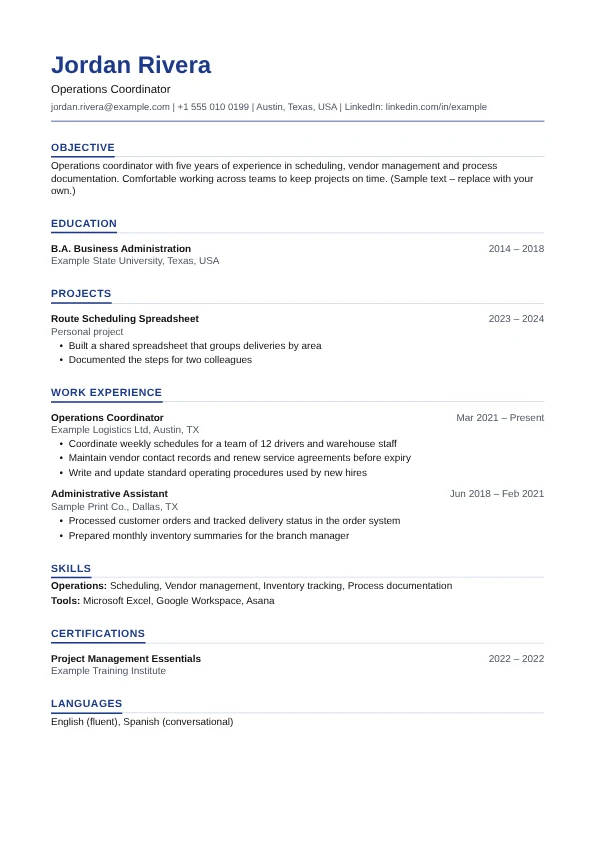
Graduate Resume
Single column

Student Resume
Single column

ATS Classic
Single column
General guidance for job seekers, not legal or immigration advice. Employers and applicant tracking systems differ, so always follow the instructions in the job advert. Spotted a mistake? Email support@jobb.ae.
Ready to build your resume?
Start with a sample or a blank page. No sign-up needed. Free to edit; US$1.00 only if you download a PDF.