
Students and Fresh Graduates
Master's and PhD graduates moving into industry
Master's and PhD graduates often have years of valuable work behind them, but an academic CV does not always show it in a way companies understand. This topic explains how to turn an academic CV into a focused industry resume: how long it should be, where your PhD or postdoc belongs, how to describe research, teaching and supervision in business language, and how to handle publications, patents, grants and awards. It also covers tailoring for data science, consulting, policy and R&D roles, unfinished degrees and long PhDs, helping postgraduates present their expertise clearly and honestly.
How do I turn my academic CV into an industry resume?
Cut it down to one or two pages, lead with skills and results that matter to the employer, and describe your research as work rather than as a list of academic outputs.
Key changes:
- Add a short summary that names the role you want and your strongest relevant skills.
- Treat your PhD or research post as a job entry, with bullets about what you delivered.
- Replace academic jargon with plain business language.
- Move publications, conferences and teaching lower down, and keep only a selection.
- Add a clear skills section with tools, methods and software.
- Remove long lists of courses, every conference poster and detailed grant histories.
Example bullet: "Designed and ran a three-year study of battery degradation, building a Python pipeline that processed lab data from 12 test rigs and cut analysis time from days to hours."
Keep your full academic CV for academic applications. For industry, every line should answer the question "Why would this help us?"
How long should an industry resume be for a PhD graduate?
Usually one to two pages. Many industry employers expect a short resume even from PhD holders, so two pages is a sensible maximum for most roles.
How to fit:
- Keep your summary to three or four lines.
- Give your PhD and any postdoc a handful of strong bullets each.
- List three to five selected publications, or a single line pointing to a full list.
- Cut teaching to one or two bullets unless the role involves training.
Some research and development roles, especially in pharmaceuticals or government labs, accept longer CVs. Follow the employer's instructions where they give them; otherwise aim for two pages.
If you are struggling to cut, ask for each line: would a hiring manager for this role miss it if it were gone? Old conference posters, minor committee roles and detailed module lists usually fail that test. Your full record can stay in your academic CV and on an online profile, so nothing is lost by leaving it out here.
What's the difference between an academic CV and an industry resume?
An academic CV is a full record of your scholarly work and can run to many pages; an industry resume is a short, targeted document that shows how your skills solve an employer's problems.
Main differences:
- Length: academic CVs keep growing; industry resumes are usually one or two pages.
- Order: academic CVs lead with education and publications; industry resumes lead with a summary, experience and skills.
- Language: academic CVs use field terminology; industry resumes use plain business terms.
- Content: academic CVs list every paper, talk and grant; industry resumes select only what is relevant.
Keep both documents. Use the CV for academic jobs and fellowships, and the resume for companies.
Terms vary by country: in the UK and much of the Gulf, "CV" is used for both, so read the advert for clues. If it is a company job asking for a CV, it usually wants the short industry style, not your full academic record.
Should I list all my publications on an industry resume?
No. Choose a few that are most relevant to the job, usually three to five, and add a line saying a full list is available on request or via a profile link.
How to choose:
- Papers closest to the role's subject or methods.
- High-profile or well-cited work you can explain simply.
- Papers where you were first author or had a major role.
Example line under the selected list: "Full publication list available on Google Scholar (link in contact details)."
Industry readers often care more about what the research achieved than where it was published, so make sure your experience bullets explain the impact.
How should I format publications on an industry resume?
Use a short, consistent citation style and highlight your name, keeping each entry to one or two lines. A heading such as "Selected Publications" makes clear it is not the full list.
Example:
"Selected Publications
- Rahman, A., Lee, K. (2025). Low-cost sensors for air quality monitoring in hot climates. Journal of Environmental Monitoring.
- Rahman, A. et al. (2024). Machine learning for predicting sensor drift. Conference on Smart Cities."
Shorten long author lists with "et al." You do not need volume or page numbers for industry readers. If a paper is under review, label it clearly: "(under review)".
Where should the publications section go on an industry resume?
Near the end, after experience, skills and education, unless the role is research-focused. For most industry jobs, publications support your case rather than lead it.
How to handle them:
- Use the heading "Selected Publications" and choose the three to five most relevant to the job, not your full list.
- Order them by relevance to the role if one topic matters most, otherwise newest first.
- Mention a key paper in a bullet under your PhD or postdoc too, so readers who only skim experience still see it.
- Keep a full publication list ready to share if asked.
For research scientist roles in industry, you can move selected publications higher, just after experience. Builders that let you reorder sections make it easy to keep two versions.
Should I include conference presentations on an industry resume?
Include only a few, and only if they show something the employer values, such as presenting to large audiences, invited talks or industry conferences. A long list of posters adds little.
Ways to use them:
- Mention presentation skills in a bullet: "Presented research at four international conferences, including an invited talk."
- List one or two notable talks under Selected Publications and Presentations.
Drop small departmental seminars and repeated posters. If the role involves client presentations or training, conference experience is useful evidence of communication skills.
How do I describe teaching assistant work on an industry resume?
Frame it as training, communication and coordination, and keep it short unless the role involves teaching or customer education.
Example:
"Graduate Teaching Assistant | University of Glasgow | 2022 to 2025
- Taught weekly tutorials for groups of 20 undergraduate engineering students.
- Explained complex topics in plain language and gave written feedback on assignments.
- Coordinated marking with three other assistants to meet deadlines."
Skills it shows: explaining complex ideas, giving feedback, managing groups and handling deadlines. These are useful for consulting, training, sales engineering and team leadership roles.
Should my PhD go under Education or Work Experience?
Put the degree itself under Education, and describe the research you did as a job under Experience, with a title such as "Doctoral Researcher". This shows recruiters that your PhD involved real work, not just study.
Example:
"Experience
Doctoral Researcher | Department of Chemical Engineering, Khalifa University | 2021 to 2025
- Designed catalysts for low-temperature CO2 conversion and ran 200+ lab experiments.
- Built a Python model to predict reaction yields, reducing failed experiments.
Education
PhD, Chemical Engineering | Khalifa University | 2025"
Avoid repeating the same bullets in both places.
This approach also helps applicant tracking systems and recruiters count your PhD years as relevant experience, especially when a job asks for a number of years in research, analysis or engineering. Use a title that describes your work accurately; "Doctoral Researcher" or "PhD Researcher" are widely understood.
How do I translate research skills into business language?
Describe what you did in terms of outcomes, tools and decisions, and swap academic words for workplace ones. Employers need to see how your skills apply to their problems.
Translations:
- "Conducted a literature review" becomes "Researched and summarised existing solutions to guide project direction."
- "Collected and analysed data" becomes "Built data pipelines and analysed results to answer business-style questions."
- "Wrote a thesis" becomes "Delivered a multi-year project, producing a 200-page technical report."
- "Collaborated with another lab" becomes "Coordinated work across two teams and an external partner."
- "Presented at conferences" becomes "Presented technical findings to expert and general audiences."
Read job adverts for your target role and reuse their terms where they truthfully describe your work.
How can I show project management experience from my PhD?
Describe your PhD in project terms: the goal, timeline, resources, stakeholders and how you delivered. A PhD is a long project you planned and ran yourself.
Example bullets:
- "Planned and delivered a four-year research project to schedule, managing milestones and progress reviews with two supervisors."
- "Managed a shared lab equipment schedule for a team of eight researchers."
- "Coordinated data sharing with an industry partner under a formal collaboration agreement."
Avoid calling yourself a "project manager" unless that was your title. If you want project management roles, a recognised entry-level certification can support your claim.
How should a PhD present data analysis skills for industry jobs?
Name the tools and methods you used, the type and size of data, and what the analysis led to. Data skills from research transfer well to analyst and data science roles.
Example skills line: "Python (pandas, scikit-learn), R, SQL, MATLAB; regression, time-series analysis, experimental design."
Example bullet: "Analysed five years of satellite and ground-sensor data (about 2 million records) in Python to identify drivers of urban heat, informing a city council report."
Mention version control (such as Git) and reproducible workflows if you used them; industry teams value them. Link to code if it is public.
Which lab skills matter most for biotech and pharma industry roles?
Lead with techniques the job advert names, plus your experience with quality, documentation and regulated work. Industry labs value reliable, well-documented work as much as technical range.
Include:
- Core techniques: for example PCR, qPCR, cell culture, flow cytometry, HPLC, mass spectrometry.
- Quality: following SOPs, keeping lab notebooks, any GLP or GMP training.
- Data: analysis software and data analysis methods.
- Safety: biosafety and chemical safety training.
Example bullet: "Optimised a qPCR assay for low-abundance targets, writing the SOP adopted by the lab group."
Only list GLP or GMP experience if you actually worked under those standards; coursework awareness should be described as such.
Should I include scholarships and research grants on an industry resume?
Yes, briefly, if they were competitive. They show that experts judged your work worth funding. Do not list amounts; the name and type of award are enough.
Example:
"Awards and Funding
- Doctoral Scholarship, National Science Fund (competitive, 2021 to 2025)
- Travel Grant, International Society of Materials Science (2024)"
Leave out small internal grants unless they show something specific, such as managing your own budget. If you wrote a successful grant application, you can mention it as a skill: "Co-wrote a successful funding proposal for a two-year project."
Should I include my thesis title, and how do I explain it?
Include it if it helps, followed by a one-line plain-English explanation. Long technical titles can confuse industry readers.
Example:
"PhD, Electrical Engineering | University of Toronto | 2025
Thesis: Adaptive control of grid-connected inverters under weak-grid conditions (developing control methods that keep solar power systems stable on unreliable networks)."
If the title is very long or unrelated to the job, you can shorten it or leave it out and describe the work in your experience bullets instead.
What's a good summary for a PhD graduate moving into industry?
Name your field and target role, your strongest transferable skills and one result. Avoid starting with "PhD in" followed by a long research topic.
Examples:
- "Data scientist with a PhD in computational biology and five years of experience building machine learning models in Python. Developed a gene expression classifier now used by two partner labs. Seeking a data scientist role in healthcare analytics."
- "Materials engineer with a PhD and hands-on experience in battery testing, failure analysis and process optimisation. Seeking an R&D engineer role in energy storage."
Make the target role clear and use the employer's terms.
What's a good summary for a master's graduate with little work experience?
Lead with your master's specialisation, your strongest technical skills and your dissertation or a project, then name the role.
Example: "MSc Data Science graduate skilled in Python, SQL and machine learning. Dissertation built a demand forecasting model for a retail dataset, improving accuracy over a baseline method. Seeking a junior data scientist or data analyst role."
If you worked before your master's, add a phrase about it: "with two years of experience in banking operations". This shows a combination of practical and advanced study.
I have a master's but no work experience. What should my resume emphasise?
Emphasise your specialist knowledge, your dissertation or major projects, technical skills and any practical exposure such as internships, lab work or consulting projects.
Structure:
- Summary naming your target role.
- Education with your master's first, then your bachelor's.
- Projects and dissertation, written like work entries with results.
- Skills section matched to job adverts.
- Any part-time, teaching or volunteer work.
Example: "Consulting project: Worked in a team of four with a logistics company to analyse warehouse picking times and recommend layout changes, presented to the operations manager."
How should I present my master's dissertation on an industry resume?
Give it a short entry with the title, a plain description and two bullets about methods and findings. Treat it like a project.
Example:
"MSc Dissertation: Predicting customer churn for a telecom provider
- Built and compared logistic regression and gradient-boosting models in Python on an anonymised dataset of 50,000 customers.
- Identified the three strongest predictors of churn and suggested retention actions."
If the dissertation was with a company, name the partner if allowed and mention any practical outcome. Keep the grade in your Education section if it is strong.
Should I write "Dr" before my name on an industry resume?
Usually not. Most industry resumes simply use your name, and the PhD appears in your Education section and summary. Writing "Dr" can seem formal or academic in many business settings.
Options:
- "Aisha Rahman, PhD" in the header is acceptable in research, healthcare and scientific roles.
- Plain "Aisha Rahman" works for most other roles.
Norms vary by country and sector. In some places, including parts of the Gulf and Europe, titles are used more, so follow what is common in the companies you are targeting.
Will employers think I'm overqualified because of my PhD?
Some may, especially for roles that do not need advanced research skills. You can reduce the concern by showing clear motivation for the role and practical, results-focused skills.
How to address it:
- Write a summary that explains why you want this role.
- Focus bullets on delivery, teamwork and tools, not on academic prestige.
- Keep the resume to industry length and style.
- In your cover letter, explain what attracts you to the work and how you would add value.
Target roles that value research depth, such as R&D, data science, consulting, regulatory affairs or technical specialist positions, where a PhD is an advantage.
Can I leave my PhD off my resume for a non-research job?
You can choose what a resume highlights, but leaving off a degree creates a gap of several years that you would need to explain, and some application forms ask you to list all qualifications. Usually it is better to keep it and present it in practical terms.
If you are considering it:
- Never misrepresent your qualifications on an application form or when asked directly.
- Describe the PhD years as research work with transferable skills.
- Reduce academic detail instead of removing the degree.
A short, practical description of the PhD is normally more effective than a gap you cannot explain.
How do I show a PhD I didn't finish?
List the programme honestly with the dates you attended and what you completed, without implying you hold the degree. Then describe the research work under Experience.
Example:
"Doctoral studies in Physics (not completed) | University of Melbourne | 2021 to 2024"
or
"PhD candidate, Physics | University of Melbourne | 2021 to 2024; left to pursue industry work"
Under Experience, list "Research Student" with bullets on what you delivered. If you were awarded a master's on the way out (where the university offers this), list that degree. Be ready to explain the decision positively and briefly at interview.
How should I present postdoc experience for an industry job?
List it as a job with your title, institution and dates, and write bullets that show delivery, leadership and collaboration, not just papers.
Example:
"Postdoctoral Research Associate | Imperial College London | 2023 to 2025
- Led a three-person team developing low-cost water sensors, from design to field testing.
- Managed a collaboration with an industry partner, including monthly progress reports.
- Mentored two PhD students and trained new lab members on equipment."
Show any budget responsibility without figures, such as "Managed a project budget and equipment orders." Postdocs often have real management experience, so make it visible.
Should I list peer review for journals on an industry resume?
Usually only as one short line, if at all. Reviewing papers shows expertise and critical judgement, but most industry employers will not weigh it heavily.
Options:
- Add a single line: "Peer reviewer for two journals in materials science."
- Mention it in a bullet about quality checking or technical judgement.
For research-heavy industry roles, such as R&D scientist or medical affairs, peer review is more relevant and worth keeping. For general industry roles, use the space for skills and results.
Templates to try
Free to edit and preview. Single-column layouts are the safest choice for applicant tracking systems.
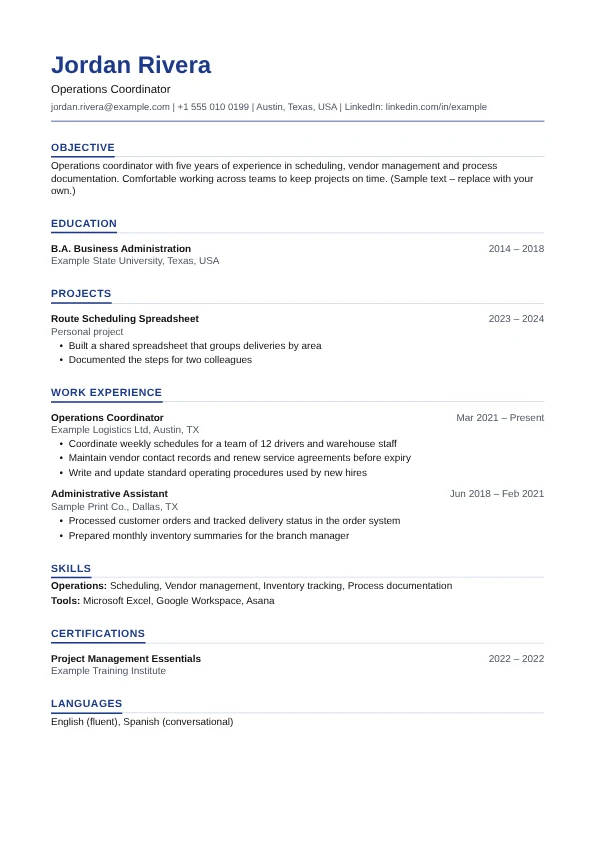
Graduate Resume
Single column

Student Resume
Single column

ATS Classic
Single column
General guidance for job seekers, not legal or immigration advice. Employers and applicant tracking systems differ, so always follow the instructions in the job advert. Spotted a mistake? Email support@jobb.ae.
Ready to build your resume?
Start with a sample or a blank page. No sign-up needed. Free to edit; US$1.00 only if you download a PDF.