
CV Guidance by Country
Europass and EU-wide applications
This guide covers Europass and applying for jobs in more than one European country. It explains what the free official Europass CV tool does, when employers, programmes and public bodies ask for it, and how to turn a long Europass CV into a focused one. It also answers questions about writing CVs for several EU countries: language versions, personal details and photos, dates and page size, qualifications and EQF levels, Erasmus and volunteering, regulated professions and stating your right to work. Expectations vary by country and employer, so always follow each advert or call.
Who runs Europass, and does it cost anything to make a Europass CV?
Europass is run by the European Union, and creating a Europass CV is free. The official Europass website offers an online tool where you build a profile once and then create CVs from it, in any of 31 languages.
What that means in practice:
- You do not need to pay a website that claims to sell "official Europass CVs". The official tool is free.
- Your profile can hold all your experience, and you choose what goes into each CV.
- You can create versions in different languages, but you still need to write or check the translated text yourself.
Europass is a format, not a qualification. Employers do not give extra credit simply because a CV uses it. Use it when an employer, programme or public body asks for it, or when you find its structure helpful; otherwise a well-written standard CV is equally acceptable across most of Europe.
Sources
- Create your Europass CV (European Union (Europass))
When is a Europass CV actually requested?
Mainly by some public bodies, EU-funded programmes and projects, and some education and training providers. You will most often see it in calls for traineeships, mobility schemes, research or project posts, and some public-sector roles in certain countries.
How to check:
- Read the call or advert. If it says "Europass format" or attaches a Europass template, use it.
- If it says only "CV", you are free to use any clear format.
- If you are unsure, ask the contact person named in the advert.
Most private employers across Europe do not ask for Europass and are happy with a standard CV tailored to the role.
Can I create my Europass CV in more than one language?
Yes. The official Europass tool lets you create CVs in 31 languages from your saved profile, so you can produce, for example, an English and a German version from the same information.
Keep in mind:
- The tool changes headings and labels, but you write the content. Your job descriptions and achievements must be translated by you or someone you trust.
- Check that both versions match exactly on dates, titles and qualifications.
- Only send a language version you can stand behind in an interview.
Machine translation can help with a first draft, but always have a fluent speaker review it before you apply.
Sources
- Create your Europass CV (European Union (Europass))
What is the difference between a Europass profile and a Europass CV?
The profile is your full record, and the CV is a document you create from it. On the official Europass tool, you build and save a profile with your experience, education and skills, and then generate CVs from that profile.
Why this is useful:
- You can keep everything in the profile and choose only the relevant parts for each CV.
- You can create several CVs for different roles or languages without retyping.
- Updating the profile makes future CVs easier.
Treat the profile as your master record and each CV as a tailored selection. Sending everything in your profile to every employer makes the CV too long.
Sources
- Create your Europass CV (European Union (Europass))
How do I turn my long Europass CV into a shorter standard CV?
Keep the content, change the structure, and cut hard. Europass CVs can become long because the format invites detail for every field.
Steps:
- Keep only the last 10 to 15 years of experience in detail; shorten older roles to one line.
- Rewrite job descriptions as three to five achievement bullets.
- Merge skills into a short, grouped list instead of separate boxes.
- Keep the languages section, but simplify it to one CEFR level per language.
- Remove personal details not needed, such as date of birth or gender.
Aim for one or two A4 pages. A single-column template in a resume builder is a quick way to rebuild it cleanly.
Should I add a photo to my Europass CV?
It is optional. The Europass format allows a photo, but you do not have to include one, and whether it helps depends on the country and employer you are applying to.
Guidelines:
- Follow the advert or call; some ask for no photos.
- Photos are more traditional in some countries (for example Germany, Spain and parts of Eastern Europe) and less expected in others, such as the UK and Ireland.
- If you include one, use a recent, professional head-and-shoulders photo.
A Europass CV without a photo is complete. Your experience, skills and languages are what count.
Which personal details should I fill in on a Europass CV?
Only what an employer needs to contact you and understand your situation. The Europass tool offers fields such as date of birth, gender and nationality, but you can leave them empty.
Usually include:
- Name, email, phone with country code and city or region.
- A LinkedIn or portfolio link if relevant.
- Nationality or work authorisation only if it answers a practical question for the role.
Usually leave out:
- Date of birth, gender and marital status, unless the call specifically asks for them.
- Identity or passport numbers, which a CV never needs.
Less personal data also means less to update and less risk if the CV is forwarded.
What is a Diploma Supplement, and can it help my applications?
A Diploma Supplement is a document that many European universities issue with a degree, describing the programme, its level, the courses and the grading system in a standard format. It helps employers in another country understand a foreign qualification.
How to use it:
- Keep a copy ready and attach it if an employer asks for degree documents.
- Mention it in your CV only briefly, if at all: "Diploma Supplement available".
- Use it to describe your degree accurately, for example its length and level.
If your university did not issue one, an official transcript in English serves a similar purpose. Ask your university's registry if you are unsure.
How do I apply to jobs in several EU countries with one CV?
Keep one master CV and make small country-specific versions. Expectations about length, photos, personal details and language differ across Europe, so one identical file rarely fits everywhere.
Adjust for each country:
- Language: match the job advert.
- Personal details and photo: follow the local convention and the advert.
- Qualifications: add a plain explanation of degrees the reader may not know.
- Contact line: show where you are and, if true, that you will relocate.
Keep the core content (titles, dates, achievements) identical in every version. Use A4 throughout.
Example of a simple system:
- "CV_Elena_Novak_master_EN.pdf" for international roles in English
- "CV_Elena_Novak_DE.pdf" for German-speaking employers, with a full month-and-year timeline
- "CV_Elena_Novak_FR.pdf" for France, with a clear job title at the top
Track which version you sent to which employer, so you can bring the right one to the interview and answer questions consistently.
What is EURES, and should my CV be ready for it?
EURES is the European job mobility network and portal, run with the public employment services of European countries, where people can search jobs in other countries and publish a CV. If you want to work in another European country, it is one of several useful places to look.
To prepare:
- Use clear, standard job titles so employers in other countries understand them.
- State your languages with CEFR levels.
- Say which countries or regions you would move to.
- Keep your CV and online profile consistent.
Each employer still decides its own process, so read every advert carefully and follow its instructions.
Which language should I use when applying to jobs across Europe?
The language of each job advert. English is common for international roles, EU-funded projects, research, tech and multinationals, but many local employers expect a CV in the national language.
A practical approach:
- Prepare a strong English master CV.
- Add versions in the languages you speak well enough to work in.
- For countries whose language you do not speak, target roles advertised in English.
Do not send a CV in a language you cannot use in an interview. State every language with an honest CEFR level so employers can judge for themselves.
Example languages section:
"English: C1 (IELTS 7.5, 2025)
Portuguese: native
Spanish: B2
German: A2 (course in progress)"
If you are learning the local language of the country you are targeting, say so; it signals commitment even at a basic level. Keep your cover letter in the same language as the CV you send.
Do EU institutions and agencies want a Europass CV?
It depends on the organisation and the type of post. Large selection competitions for the EU institutions usually use their own online application forms, so you fill in your details there instead of uploading a CV. Some EU agencies, bodies and EU-funded projects ask for a CV in Europass format for specific posts.
What to do:
- Read the vacancy notice carefully; it states the format and documents required.
- If it asks for Europass, use the official Europass tool.
- If it uses an online form, prepare your content in advance and copy it in carefully.
Wrong format can lead to an incomplete application, so the vacancy notice is the final word.
How do I list an Erasmus semester or traineeship on my CV?
List it under education if it was study, or under experience if it was a traineeship, with dates, the host institution, the country and what you did or learned. International experience is valued by many European employers.
Examples:
"09/2024 – 01/2025 Erasmus+ exchange semester, Universidad de Granada, Spain
Courses in international marketing, taught in Spanish"
"03/2025 – 08/2025 Erasmus+ traineeship, Marketing Assistant, Example Oy, Helsinki, Finland
- Ran social media for 2 product lines in English and Finnish markets"
Mention the language you studied or worked in; it proves your language level better than a self-assessment.
Can I use Europass if I am not an EU citizen?
Yes. The official Europass CV tool is free and open to anyone, wherever you are from. Using it does not change your right to work in any country, and it does not make your application more official.
When it helps non-EU applicants:
- When a European employer, university or programme asks for a Europass CV.
- When you want a structured way to describe your qualifications and languages for European readers.
When it does not matter:
- For most private employers, a clear standard CV works just as well.
Whatever format you use, state your current location, availability and, only if true, any permission to work you already hold.
Sources
- Create your Europass CV (European Union (Europass))
What is the EQF level, and should I put it on my CV?
The EQF (European Qualifications Framework) is a common reference scale with eight levels, used to compare qualifications across European countries. For example, bachelor's degrees are generally linked to level 6 and master's degrees to level 7.
Should you list it?
- If your diploma or certificate states an EQF level, you can add it in brackets: "BSc Nursing (EQF level 6)".
- If it does not, do not guess; describe the degree and its length instead.
- Some public calls and EU projects mention EQF levels in their requirements, which is when it is most useful.
Most private employers will not look for it, so keep it short.
Do European research jobs and fellowships use Europass CVs?
Usually they use their own CV templates or formats. Research funders, universities and fellowship schemes in Europe often specify exactly which CV structure to use, with sections for publications, funding and supervision, and sometimes a page limit.
What to do:
- Download the template from the call itself and follow it exactly.
- Keep a full academic CV as your master record, and cut it down to the requested format.
- If the call says only "CV", a clear academic CV is fine; Europass is optional.
Ignoring a required template is a common reason for applications to be marked incomplete, so check the call text carefully.
What page size should I use for applications across Europe?
A4. It is the standard paper size throughout the European Union, the UK and most of the world outside North America.
If your CV is in US Letter:
- Switch it to A4 and check that page breaks still fall in sensible places.
- Make sure no line or section is cut off at the bottom.
- Export as PDF so the layout looks the same everywhere.
ResumeBuilder.ae lets you choose A4 or US Letter, so you can keep one version for North American roles and an A4 version for Europe.
How should I write dates on a CV that will be read in several European countries?
Use month and year in numbers, such as "09/2021 – 06/2024", which readers across Europe understand. Avoid formats that can be misread.
Avoid:
- "06/09/2021": in most of Europe this means 6 September, but in the US it means 9 June.
- Month names in a language the reader may not know.
For a current role, write "present" in English, or the local word in a local-language CV. Use the same format for every entry, newest first. Full day-month-year dates are rarely needed on a CV.
How do I describe my work experience well in a Europass CV?
Use short achievement bullets, not long lists of duties. The Europass format gives you a free-text box for each role, and it is tempting to paste in a job description, but recruiters respond better to concrete results.
Example:
Weak: "Responsible for customer service, handling complaints, using CRM."
Better:
"- Resolved about 40 customer queries a day by phone and email in English and Polish
- Introduced a shared FAQ document that cut repeat questions from new staff"
Keep three to five bullets for recent roles and one or two for older ones. Use the same language and tense throughout.
Can I keep separate CVs for different EU countries and languages in ResumeBuilder.ae?
Yes. You can save up to 10 resumes, and each one can use its own resume language, chosen on the Design tab. The PDF supports English, French, Spanish and German, among others, so you could keep, for example, an English master CV and French and German versions.
Tips:
- Start each language version from your strongest content and translate it yourself; the example text in the builder is in English for now.
- Set A4 page size for European applications.
- Check that dates and titles match across all versions.
Creating and editing are free. Each PDF export costs US$1.00. After paying, you can download again for 7 days, up to 10 attempts, including after edits.
How should I explain a regulated profession on a CV for another EU country?
State your qualification and home-country registration clearly, and do not claim registration in the new country until you have it. Professions such as nursing, medicine, pharmacy, teaching and some engineering roles are regulated in many European countries, and the rules differ.
Example lines:
"Registered Nurse, Portugal (registration no. available on request)
Registration in Ireland: application submitted 02/2026"
Check the official regulator or recognition information in the country you are moving to. On your CV, list only facts you can prove, and explain timelines in your cover letter.
Other details that help a recruiter in another country:
- Your language level in the local language, with any certificate, since many regulated roles involve direct contact with patients or the public.
- Specialist areas and settings, such as intensive care, community pharmacy or primary school teaching.
- Continuing professional development courses with dates.
Avoid translating your professional title into the local protected title (for example a local word for "nurse" or "engineer") until you are entitled to use it.
How do I list volunteering with the European Solidarity Corps or similar programmes?
List it like a job, with the dates, the host organisation, the country and what you did. Structured volunteering abroad shows independence, language use and teamwork, and many European employers recognise programmes such as the European Solidarity Corps.
Example:
"02/2025 – 12/2025 Volunteer, European Solidarity Corps
Youth Centre Example, Tartu, Estonia
- Ran weekly English conversation clubs for 20 teenagers
- Organised 3 community events with local partners"
If the project was long and substantial, you can put it in your experience section rather than a separate volunteering section.
How do I show a driving licence on a CV for jobs in Europe?
Write the category and, if useful, the issuing country. In Europe, the common car licence category is "B", and many CVs list it under personal details or additional information.
Examples:
- "Driving licence: B"
- "Driving licence: B, C (issued in Poland)"
- "Driving licence: UAE (light vehicle)"
Mention it when the job needs driving or travel. Whether a licence from outside the EU can be used or exchanged depends on each country's official rules, so do not claim it is valid somewhere unless you have checked.
How do CV length expectations differ across European countries?
They vary, but one to two A4 pages is a safe target almost everywhere in Europe. Some broad patterns:
- Many countries, such as France, Spain and the Netherlands, favour one page for early-career applicants.
- Germany and other German-speaking countries often accept two pages or more for experienced applicants, with a full timeline.
- UK and Irish employers commonly expect two pages for experienced applicants.
- Academic and EU project CVs are often longer or follow a fixed template.
Always check the advert for a page limit. If you apply in several countries, a strong two-page master CV can be cut to one page where needed.
How should I state my right to work when applying in another European country?
Only state what is true, in a short line, and only when it helps the employer. Recruiters often want to know quickly whether you can start without a permit process.
Examples:
- "EU citizen (Italian nationality)"
- "Residence permit allowing work in the Netherlands, valid until 2028"
- No line at all, if you will need sponsorship and prefer to discuss it when asked.
Do not suggest you have permission to work if you do not. The rules for non-EU citizens vary by country and situation, so check official sources for the country you are applying to. ResumeBuilder.ae has optional nationality and work authorization fields you can include or leave out per CV.
Templates to try
Free to edit and preview. Single-column layouts are the safest choice for applicant tracking systems.
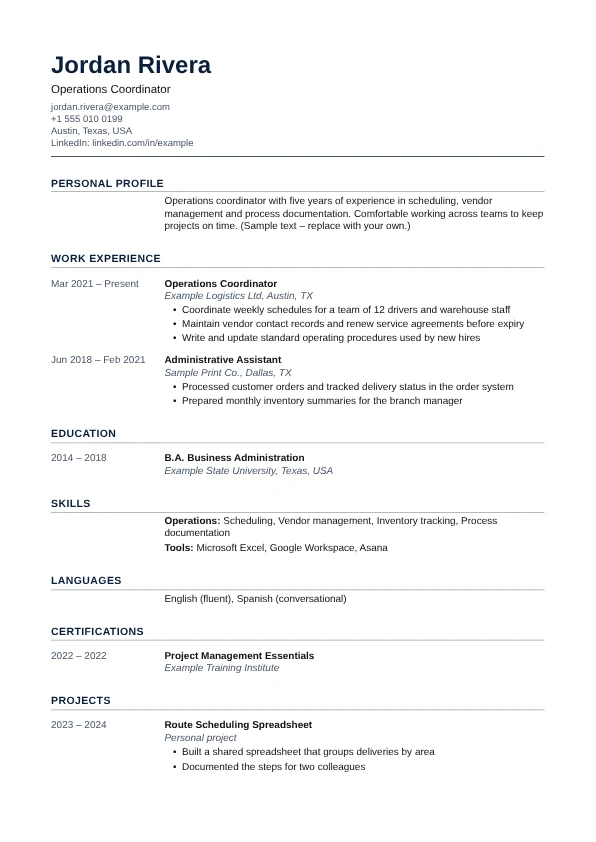
International CV
Two-column entries (more complex)

ATS Classic
Single column

ATS Professional
Single column
General guidance for job seekers, not legal or immigration advice. Employers and applicant tracking systems differ, so always follow the instructions in the job advert. Spotted a mistake? Email support@jobb.ae.
Ready to build your resume?
Start with a sample or a blank page. No sign-up needed. Free to edit; US$1.00 only if you download a PDF.