
Students and Fresh Graduates
International students and graduates
Studying abroad gives you languages, independence and international experience, but writing a resume for a new country raises questions. This topic helps international students and graduates adapt their resume to local expectations: which format and page size to use, which personal details to remove, how to explain home-country degrees, employers and job titles, and how to present names, phone numbers and languages. It also explains how to mention work authorization briefly if you have it, without describing visa rules, and points you to official government immigration sources and your university's international office for anything about your own permission to work.
How should an international student write a resume for jobs in the country where they study?
Follow the local format of the country you are applying in, not the format you used at home, and make your background easy for local employers to understand.
Practical steps:
- Use the local length, page size and section order. Your university careers service can show local examples.
- Remove personal details that are not expected locally, such as a photo, date of birth or marital status, where that is the norm.
- Explain anything unfamiliar: add a short description of home-country employers or universities.
- Write your degree and job titles in terms local employers recognise, while staying accurate.
- Show your languages and international experience as strengths.
- If you have permission to work and it is relevant, you can state it in one short line.
Example line: "Languages: Mandarin (native), English (fluent, IELTS 7.5), Japanese (basic)."
Ask your careers service to review a draft. Local advisers know what employers in that country expect and can spot details that look unusual.
Should I mention my visa or work authorization on my resume?
Only briefly, and only if it helps. If you already have permission to work in the country and employers there commonly wonder about it, one short factual line can save questions. If not, you do not need to mention it on the resume at all.
Ways to handle it:
- If you have it: a short line in your personal details, such as "Work authorization: [country], valid until [month year]", written exactly as your documents allow.
- If it is complicated: leave it off the resume and answer the employer's questions honestly on the application form or at interview.
- Never guess or describe rules you are not sure of.
Rules about who can work, for how long and under what conditions are set by each country's government and change over time. Check the official government immigration website for the country, or ask your university's international student office, rather than relying on a resume guide.
How should I word a work authorization line if I have one?
Keep it short and factual, using wording that matches your actual documents. Put it in your personal details or at the end of your resume.
Examples of format (replace with your real details):
- "Work authorization: [country], valid until [month year]"
- "Authorized to work in [country]; no sponsorship required" (only if this is true for you)
- "Permanent resident of [country]"
Do not include document numbers, copies of visas or personal ID details on the resume. Employers who need to check your status will ask for documents through their own process. If you are unsure which wording is accurate, check the official immigration website for that country or ask your university's international office.
I'm not sure if I'm allowed to work in this country. What should my resume say?
Leave work authorization off your resume until you are sure, and find the answer from an official source first. Your resume should only contain statements you know are accurate.
Where to check:
- The official government immigration website for the country.
- Your university's international student office or adviser.
- The documents issued to you, which may state conditions.
Do not rely on friends, forums or job sites for this. Once you know your position, you can decide whether a short line on your resume is helpful. Answer any application form questions about it honestly.
The application form asks if I need sponsorship. How do I answer?
Answer honestly based on your own situation, after checking the meaning of the question and official information if you are unsure. A false answer can lead to an offer being withdrawn later.
Tips:
- Read the question carefully: some ask about now, some about the future.
- If you do not understand what it means for your situation, ask your university's international office or check the official government immigration website.
- Keep your answer consistent across applications to the same employer.
Some employers cannot sponsor workers and will say so. It is better to focus your time on employers and roles that match your situation than to answer inaccurately.
Should I use my home-country resume format or the local format?
Use the format of the country where the job is. Employers read resumes through their local expectations, and a format that is normal at home can look unusual elsewhere.
Things that often change between countries:
- Length (one page versus two or more).
- Whether a photo, date of birth or marital status is expected.
- Page size (A4 or US Letter).
- What the document is called (CV or resume).
- How much detail on education and school results.
If you are applying to jobs in two countries, keep two versions. A guide to resume formats by country and your careers service can help you choose.
A quick way to learn the local style is to collect three or four resumes from recent graduates in that country, for example through your careers service or alumni, and compare them with yours. Look at the order of sections, how much personal information they show and how they describe education. Then adjust your own layout, keeping your content honest and your achievements the same.
At home everyone adds a photo and date of birth. Should I keep them on a UK or Canadian resume?
No. Remove them for UK and Canadian applications. Official careers guidance in both countries recommends leaving them out.
What official guidance says:
- UK: the National Careers Service suggests leaving out age, date of birth, marital status and nationality.
- Canada: Job Bank advises leaving out age, marital status, religion and similar details, and notes that a photo is not the norm. It also says never to include your Social Insurance Number.
Keep your name, contact details, education, experience and skills. These are what employers need to shortlist you. If you later apply in a country where a photo is common, add one only for that version.
Sources
- How to write a CV (National Careers Service (England))
- How to write a good resume (Job Bank, Government of Canada)
As an international student, should my resume show my nationality?
It depends on the country. In the UK, official careers guidance suggests leaving nationality out. In the Gulf, many employers expect to see it, and it is a common optional field.
General guide:
- UK, Canada, US, Australia and much of Europe: usually leave it out.
- UAE and wider GCC: commonly included in personal details.
- Elsewhere: check local examples and the advert.
If you want to show that you can work in the country, a short work authorization line is more useful than nationality. Never include passport or ID numbers.
Sources
- How to write a CV (National Careers Service (England))
How do I describe my home-country degree so local employers understand it?
Use the official degree name from your certificate, and add a brief explanation if the name is unfamiliar. Do not rename it to something it is not.
Examples:
- "Bachelor of Technology (BTech), Computer Science | Anna University, India | 2023 (four-year undergraduate engineering degree)"
- "Licenciatura en Administración | Universidad de Lima, Peru | 2022 (five-year bachelor's degree in business administration)"
If you have an official credential evaluation or recognition statement from a recognised body in the host country, you can mention it in one line. Keep transcripts and certificates, with official translations if needed, ready in case an employer asks.
Should I mention a credential evaluation on my resume?
You can add one short line if you have an official evaluation and the employer or sector values it, for example in regulated professions or government jobs. It is not needed for most private-sector roles.
Example: "Degree assessed as comparable to a bachelor's degree by [recognised evaluation body], 2025."
Use the exact wording from the evaluation, and do not claim an equivalence you have not received. If you are unsure whether you need an evaluation, check the job advert, the relevant professional body or official government guidance for that country.
Employers abroad won't know my university. Does that matter?
It matters less than you might think. Employers mainly want to see what you studied and what you can do. You can help by adding a little context.
Ways to add context:
- Include the city and country next to the university name.
- Mention notable rankings or accreditations only if true and from a reputable source.
- Let your projects, skills and internships show the quality of your education.
Example: "BSc Computer Science | National University of Sciences and Technology, Islamabad, Pakistan | 2024"
Do not exaggerate the university's reputation. A specific final-year project tells employers more than a ranking.
How do I describe work experience from my home country?
List it like any other job, with the employer, location (city and country), title and dates, and explain the company briefly if it is not well known abroad.
Example:
"Junior Accountant | Al Faisal Trading Co. (regional distributor of building materials), Amman, Jordan | 2022 to 2024
- Reconciled supplier accounts and prepared monthly VAT reports."
Use local terms where they help, but keep job titles accurate. Home-country experience is real experience; present it with the same confidence and detail as local experience.
My job title from home doesn't exist in this country. What do I write?
Keep your real title and add a recognised equivalent in brackets, so the reader understands the level and function. Then let your bullets explain the work.
Examples:
- "Executive Trainee (graduate trainee, finance)"
- "Officer, Credit Department (junior credit analyst)"
- "Engineer Grade II (junior site engineer)"
Do not replace your official title with a more senior one. Employers may check with your former employer, and the official title must match.
Which phone number should I put on my resume if I have two countries' numbers?
Use the number for the country where you are applying, with its country code. Add your other number only if employers may need to reach you there, for example while you travel home.
Examples:
- "+44 7700 900123" (UK applications)
- "+971 50 123 4567 (UAE) | +91 98765 43210 (India, from July)"
Make sure the number you list is active and has a voicemail greeting. For international numbers, messaging apps may be easier for recruiters, but keep the main contact a normal phone number and email.
Should my resume show my home address or my address abroad?
Show the city and country where you live now, especially if it is where you are applying. A full street address is not usually needed on a resume.
Examples:
- "Manchester, UK"
- "Dubai, UAE (relocating to Toronto, Canada in June 2026)"
If you are applying from abroad, say when you will be available locally. Keep any statement about your ability to move or work there factual and consistent with your situation.
Can I use an English name on my resume?
Yes, if you use it consistently and your legal name is clear where needed. Many international students use a preferred English name for convenience.
A clear format:
- "Wei (David) Zhang" or "Zhang Wei (David)"
- Use the same version on your resume, LinkedIn and email signature.
On official application forms, use your legal name in the legal name field and your preferred name where asked. Employers will need your legal name for contracts and checks, so make it easy to match.
My name is written family name first. How should I show it on my resume?
Write it in the order you want to be addressed, and make the family name clear if there may be confusion. Some people use capital letters for the family name.
Examples:
- "TANAKA Yuki"
- "Yuki Tanaka"
- "Nguyen Thi Lan (Lan Nguyen)"
Choose one form and use it everywhere. Employers will match your resume with your documents, so make sure your legal name is easy to recognise.
Should I list my native language as a skill?
Yes. Your native language is a real skill, especially for employers with customers, partners or markets in your home region. List it in your Languages section with "Native".
Example:
"Languages: Vietnamese (native), English (fluent), French (B1)"
If the job involves your home market, mention the language in your summary too: "Bilingual Spanish and English marketing graduate with knowledge of Latin American consumer trends." Many students forget this advantage.
How can my international background help me find jobs?
Target employers who value your languages, cultural knowledge and international experience, and make those strengths obvious on your resume.
Where it helps most:
- Companies with clients, suppliers or offices in your home region.
- International organisations and multinational firms.
- Roles in export, tourism, education, translation, customer support or market research.
Show it clearly: languages in your summary, study-abroad experience, international projects and any work with diverse teams. Example: "Arabic and English speaker with experience supporting international students as a peer mentor."
Should my resume be in English or the local language?
Use the language of the job advert. If the advert is in German, French or Spanish, employers usually expect your resume in that language too, unless they say otherwise. If it is in English, use English.
Tips:
- Only write in a language you can use well, or ask a fluent speaker to check it.
- Keep a version in each language you apply in.
- Make sure your language skills section is honest; an employer may interview you in that language.
ResumeBuilder.ae lets you choose the resume language on the Design tab, including English, French, Spanish and German, so headings match the language you write in.
How do I show an exchange semester or study abroad period?
List it in your Education section under your main degree, or as its own short entry, with the university, country and dates. Add one line about what you studied or gained.
Example:
"Exchange Semester | University of Lisbon, Portugal | Feb to Jun 2025
- Took modules in international marketing taught in English and Portuguese."
International experience shows adaptability and independence. Mention any project, internship or language you developed during the exchange.
How do I list part-time jobs I did while studying abroad?
List them like any other job, with the employer, title, city and dates. They show that you adapted to a new country and workplace, which employers value.
Example:
"Customer Assistant (Part-time) | City Supermarket, Leeds, UK | 2024 to 2025
- Served customers and handled payments in a busy store, using English daily at work."
Do not describe your visa conditions or working-hour limits on your resume. If an employer asks about them, answer honestly, and use official government sources to check your own position.
Should I name a post-study work scheme on my resume?
Usually it is clearer to state your status simply than to name a scheme. Scheme names and rules change, and employers may not know them. A plain line such as "Work authorization: [country], valid until [month year]" is easier to understand.
If you do name a scheme:
- Use its official name exactly.
- State only what applies to you, from your own documents.
- Do not describe the scheme's rules on your resume.
Check the official government immigration website for current information about any scheme before you mention it.
I'm going back home after studying abroad. How should I change my resume?
Switch to your home country's format and highlight the international experience you gained. Your foreign degree, language skills and adaptability are strengths there.
Changes to consider:
- Use the local layout, length and personal details that are normal at home.
- Add context for foreign employers or universities if local recruiters may not know them.
- Mention languages and cultural skills gained abroad.
- Remove host-country details that do not apply, such as a local work authorization line.
Example summary: "Data analyst with an MSc from the University of Melbourne and two years of part-time analytics work in Australia, returning to Kerala to build a career in fintech."
Be ready to explain in interviews what you learned abroad and why you came back. Employers at home often value graduates who bring new methods, tools and international contacts, so give one or two concrete examples rather than general statements about "global exposure".
I studied in one country and want to work in a third country. What should I do?
Research the third country's resume format and use it, explain both your home and study backgrounds clearly, and check that country's official government sources about working there before you apply.
Practical steps:
- Use the local format: length, page size, personal details.
- Add city and country next to every university and employer.
- Show languages and international experience as strengths.
- Look for employers who recruit internationally.
Example: a Pakistani graduate of a UK university applying in the UAE would use a Gulf-style CV, list both countries clearly and mention English, Urdu and any Arabic.
Templates to try
Free to edit and preview. Single-column layouts are the safest choice for applicant tracking systems.
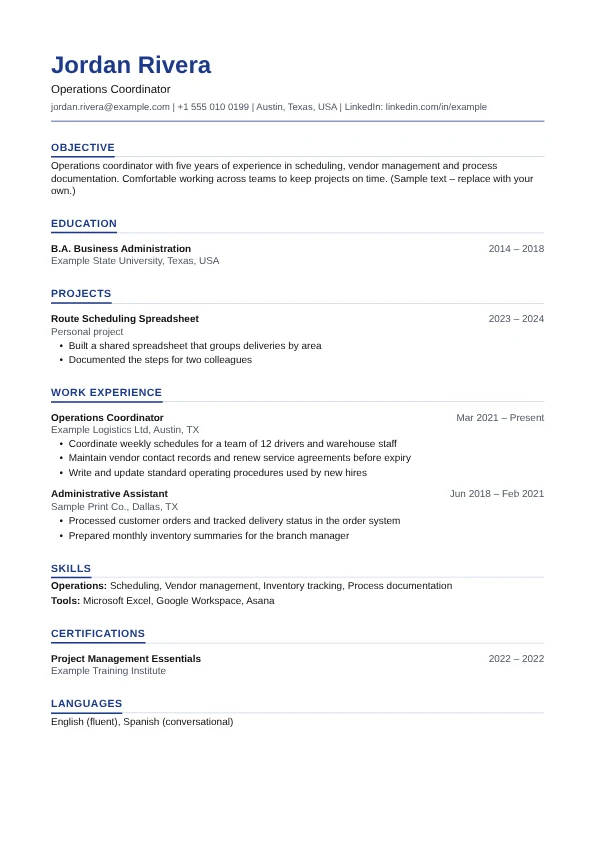
Graduate Resume
Single column

Student Resume
Single column

ATS Classic
Single column
General guidance for job seekers, not legal or immigration advice. Employers and applicant tracking systems differ, so always follow the instructions in the job advert. Spotted a mistake? Email support@jobb.ae.
Ready to build your resume?
Start with a sample or a blank page. No sign-up needed. Free to edit; US$1.00 only if you download a PDF.