
Students and Fresh Graduates
Resumes for school leavers
Leaving school and looking for a first job or apprenticeship can feel daunting when you have little to put on a CV. This topic helps school leavers and other young people write a short, honest one-page CV: what personal details to include (and leave out), how to write a personal statement, which skills and small jobs count, and how to ask a teacher, coach or volunteer leader for a reference. It also covers apprenticeship applications, availability, gap years, handing in CVs at local shops and staying safe from fake job adverts.
How do I write a CV when I'm leaving school?
Keep it to one page and build it from what you have: your school studies, any part-time or volunteer work, skills you use every day and a short statement about the kind of work you want. Employers hiring school leavers know you are just starting out.
A simple layout:
- Your name, phone number, email address and town or city.
- A short personal statement of two or three lines.
- Education: your school and the qualifications you have or are taking.
- Experience: part-time jobs, school work experience placements, volunteering or helping out regularly.
- Skills: things like using computers, languages, working with customers or teamwork.
- References: a teacher or someone you have worked or volunteered with, or "available on request".
Example personal statement: "Hard-working school leaver who has volunteered at a weekend food bank for a year. Looking for a part-time retail job before starting college."
Ask a teacher or careers adviser to check it before you send it.
How long should a school leaver's CV be?
One page. That is plenty of space for your contact details, a short statement, your education, any experience and your skills. Employers hiring for first jobs and apprenticeships prefer a short, clear CV.
If your CV goes over one page:
- Shorten your personal statement to two or three lines.
- Use short bullet points instead of long sentences.
- Remove things that are not useful for the job, such as primary school details.
If it looks a bit empty, that is fine. Use clear headings, readable spacing and a simple layout rather than adding filler.
Do I need to put my age or date of birth on my CV?
No. You do not need to include your age or date of birth on your CV. Your contact details, education, experience and skills are what employers need to decide whether to invite you to an interview.
If an employer needs to know your age, for example because some jobs or hours have age rules, they will usually ask on the application form or at interview. You can answer then.
Rules about the work and hours young people can do differ by country, so if you are under 18, check your government's official guidance or ask your school careers adviser.
What personal details should a teenager put on a CV?
Only the basics: your full name, a phone number, a sensible email address and your town or city. That is enough for an employer to contact you.
Leave these off:
- Your full home address (the town is enough).
- Date of birth, photo, ID or passport numbers.
- Your parents' names or contact details.
- Bank details or anything to do with money.
- Social media accounts, unless they show relevant work such as art or design.
Only share more personal information when a trusted employer needs it after offering you a job, for example for payroll. If anyone asks for ID or bank details before an interview, check with an adult you trust first.
Remember that a CV can be passed around or left on a counter, so treat it as something a stranger might read. Keeping it to the basics protects you and still gives employers everything they need.
What email address should I use on my first CV?
Use a simple address based on your name, such as firstname.lastname@ with a free email provider. Avoid nicknames, jokes or numbers that look odd, because employers will see the address before they meet you.
Tips:
- Create a new account just for job applications if your current one is not suitable.
- Check it every day while you are applying, including the spam folder.
- Use the same address on every application.
Example: "sara.ahmed.cv@" followed by your provider is better than an address based on a game name or a joke.
Should I put a photo on my school leaver CV?
Usually not. In many countries, including the UK, US and Canada, photos are not expected on CVs, and leaving one off keeps the focus on your skills. In some countries photos are more common, so check what local employers expect.
If a job advert specifically asks for a photo, use a simple, recent head-and-shoulders picture with a plain background. Otherwise, leave it off; it also means sharing less personal information, which is sensible when you are young and sending your CV to people you have not met.
What's a good personal statement for a school leaver's CV?
A good school leaver statement is two or three lines saying who you are, one or two strengths with a bit of proof, and what kind of job or apprenticeship you want.
Examples:
- "School leaver with experience helping at my aunt's café on weekends, serving customers and handling payments. Looking for a part-time job in hospitality."
- "Practical and reliable school leaver interested in electrical work, with a school work experience week at a local electrician's. Seeking an electrical apprenticeship."
- "Friendly school leaver who volunteers at a children's sports club every Saturday. Looking for a role in childcare or customer service."
Keep it honest and specific. Avoid long lists of adjectives such as "hard-working, punctual, motivated".
Who can I use as a reference if I've never had a job?
Ask an adult who knows you in a responsible setting and is not a family member. Common choices for school leavers are:
- A teacher or form tutor.
- A school careers adviser or head of year.
- A sports coach, club leader or youth leader.
- The organiser of a place where you volunteered.
- The person who supervised your school work experience placement.
Always ask permission first, and check how they would like to be contacted (usually a work email address). You can write "References available on request" on your CV and give their details when an employer asks, rather than putting their phone number on every copy.
Avoid using relatives or friends of your own age, because employers want an independent view of how you behave and work. Let your referees know when you have applied somewhere, so they are not surprised by a call.
How do I ask a teacher to be my reference?
Ask politely, in person or by a short email, and give them the information they need. Teachers are often happy to help but appreciate notice.
Example message: "Dear Ms Khan, I'm applying for part-time jobs and an apprenticeship in retail. Would you be willing to act as a reference for me? I've attached my CV. Thank you for considering it. Best wishes, Omar Ali."
Tips:
- Choose a teacher who knows you well, ideally one who has seen your effort or responsibility.
- Send them your CV and tell them the kinds of jobs you are applying for.
- Let them know when an employer might contact them, and thank them afterwards.
How do I list a school work experience week on my CV?
List it under Experience with the organisation, a simple title, the dates and one or two bullets saying what you did. It is real experience of a workplace, even if it was short.
Example:
"Work Experience Placement | Riverside Veterinary Clinic | June 2025 (one week)
- Helped reception staff greet clients and book appointments.
- Observed animal care routines and helped clean and restock treatment rooms."
Be honest about what you did and what you observed. If the supervisor was helpful, ask whether they would be willing to give a short reference.
Can I put a paper round, odd jobs or helping neighbours on my CV?
Yes, if they were regular and showed responsibility. Small jobs like a paper round, washing cars, gardening for neighbours or helping in a family shop show reliability and that you can manage your time.
Example:
"Paper Round | Local newsagent | 2023 to 2025
- Delivered newspapers to 60 homes every morning before school, in all weather."
Keep each one short. If you have several, you can group them: "Odd jobs for neighbours (gardening, car washing), 2024 to 2025." Do not include names or addresses of the people you worked for.
What do employers look for in a school leaver applying for an apprenticeship?
Employers mainly look for genuine interest in the trade or career, reliability and a willingness to learn. They do not expect experience; they expect potential.
Show these on your CV:
- Interest: practical projects, hobbies, school subjects or work experience linked to the field.
- Reliability: attendance, part-time work, regular volunteering or team sport.
- Ability to learn: good effort in relevant subjects or anything you taught yourself.
- Practical or people skills, depending on the apprenticeship.
Example: "Rebuilt an old bicycle and repaired friends' bikes for two years" is a strong line for a motor vehicle apprenticeship. Check each apprenticeship's entry requirements on its official listing.
The apprenticeship has an application form. Do I still need a CV?
Follow the instructions. If the advert asks only for the form, complete the form carefully; your CV still helps you, because it holds all the facts and examples you will copy into the form.
Tips for apprenticeship forms:
- Write your answers in a document first, then paste them in.
- Answer the exact question, using real examples from school, work or activities.
- Check spelling and grammar before submitting.
- Keep a copy of your answers to prepare for the interview.
If the form allows you to upload a CV as well, add a one-page version that matches what you wrote in the form.
How do I show interest in a trade like plumbing or electrical work on my CV?
Show what you have done that is linked to the trade: school subjects, practical projects, hobbies, helping someone in the trade or short courses.
Ideas:
- "Helped a family friend, a qualified electrician, on small jobs during school holidays (carrying tools, tidying the site, observing safe working)."
- "Built a wooden garden bench in Design and Technology, from drawing to finished product."
- "Completed an online introduction to electrical safety."
Add a personal statement that names the trade: "Practical school leaver keen to begin an electrical apprenticeship." Never claim you did qualified work; just describe what you helped with honestly.
What skills can a school leaver put on a CV?
Put skills you really use and can give a quick example of. School leavers have more than they think.
Common skills:
- Computer skills: typing, Word, PowerPoint, Google Docs, basic spreadsheets.
- Languages: any language you speak at home or learned at school, with an honest level.
- Customer or people skills: from part-time work, volunteering or helping in a family business.
- Teamwork: school projects, sports teams, drama or music groups.
- Practical skills: cooking, simple repairs, using tools safely.
- Creative skills: drawing, photography, video editing.
Choose five to eight that fit the job. Example: "Bilingual in English and Urdu" is useful in customer-facing jobs.
What should my CV say for a first job in a shop or supermarket?
Show that you are friendly, reliable and willing to learn, and mention when you can work. Shops care a lot about availability and attitude.
Include:
- A short statement: "Friendly and reliable school leaver looking for a part-time role as a sales assistant."
- Any customer experience, even informal, such as helping at a school fair or a family shop.
- Skills such as counting money accurately, working in a team and following instructions.
- Your availability: "Available Saturdays, Sundays and after 4pm on weekdays."
Keep it to one page and hand it in or apply online neatly. A short, tidy CV makes a good first impression.
Should I put my availability on my CV?
Yes, for part-time, weekend and holiday jobs. Employers hiring young people often need to know straight away when you can work.
Add a short line near the end or under your personal statement:
- "Availability: weekends and school holidays."
- "Available after 4pm Monday to Friday and all day Saturday."
- "Available full time from July 2027."
Be realistic, especially during exams. It is better to offer fewer hours you can always keep than to promise more and cancel shifts. Keep your availability up to date as your school timetable changes.
Should I include hobbies on my school leaver CV?
Yes, briefly. With less experience to show, a short Interests line can tell an employer something useful about you, especially if a hobby shows commitment or skills.
Make them specific:
- "Play in the school football team and train twice a week."
- "Edit short videos for a gaming channel with friends."
- "Learning to cook dishes from different countries for my family."
Avoid vague lines like "watching TV" or "hanging out with friends". Keep it to one or two lines, and do not share anything you would not want an employer to ask about.
I've never had any kind of job. What can go on my CV at 16?
Use your school life, responsibilities, activities and skills. At 16, employers do not expect work history; they look for signs you are reliable and willing.
Things you can include:
- School responsibilities, such as helping at open evenings or being a class representative.
- Clubs, sports, music or drama, especially if you have stuck with them.
- Volunteering or helping in your community.
- Projects or things you have made, such as a website, a piece of art or a repaired bike.
- Skills you use daily, like computers or a second language.
Write a short personal statement saying what job you want and why you would be good at it. Keep everything honest; employers would rather see a short, true CV than a padded one.
Can my parents write my CV for me?
It is better to write it yourself and ask a parent, teacher or careers adviser to check it. Employers will ask you about your CV, so it needs to sound like you and describe things you can talk about.
How a parent can help:
- Remind you of things you have done that could go on it.
- Check spelling, layout and that your contact details are correct.
- Practise interview questions with you.
Do not let anyone add skills or experience you do not have. A simple, honest CV written in your own words is more convincing than a polished one you cannot explain.
How do I hand in my CV in person at local shops and cafés?
Go at a quiet time, dress neatly, ask politely for the manager and hand over a clean printed CV. A short, confident introduction helps.
What to say: "Hi, I'm looking for part-time work. Are you hiring at the moment? I've brought my CV."
Tips:
- Avoid busy times such as lunchtime or Saturday afternoons.
- Bring several copies in a folder so they stay flat.
- Note which places you visited and who you spoke to.
- If they say to apply online, do it the same day.
Go with a friend if you like, but speak to the manager on your own. Always stay in public areas of the business.
What should I write when I email my CV to an employer?
Write a short, polite email with a clear subject line, a few lines about the job you want and your CV attached as a PDF.
Example:
Subject: Application for Part-time Café Assistant - Layla Hassan
"Dear Hiring Manager,
I would like to apply for the part-time café assistant role advertised in your window. I am leaving school this summer and am available at weekends and in the evenings. I have attached my CV. Thank you for your time.
Kind regards,
Layla Hassan
07xxx xxxxxx"
Name the file clearly, such as "Layla-Hassan-CV.pdf", and check the attachment before you press send.
How do I show a gap year on my CV?
List it as a short entry with dates and a line about what you did, such as working, volunteering, travelling, learning a skill or helping at home. A planned gap year is common and easy to explain.
Example:
"Gap Year | Sep 2025 to Jun 2026
- Worked part time in a garden centre and completed an online course in graphic design before starting university."
Focus on what you learned or achieved. You do not need to share private reasons. If part of the year was quieter, that is fine; keep the line short and positive.
I'm starting college next year. Should my CV mention it?
Yes, if you are looking for part-time or holiday work, because it explains why you want flexible hours. Add it to your Education section with the course and start date.
Example: "Starting: Level 3 Diploma in Business, City College, September 2026."
You can also add it to your personal statement: "School leaver starting a business course in September, looking for weekend retail work." Employers hiring part-time staff often like students, because they know what availability to expect.
I left school without finishing my exams. How do I write my CV?
Be honest and focus on what you can do now. List the school you attended with the years, and include any qualifications you did complete. Then put more weight on skills, work, volunteering and any courses since.
Tips:
- Do not claim qualifications you did not finish.
- Highlight practical skills and reliability.
- Mention any learning since leaving, such as a short course or training at work.
- If you plan to finish your qualifications, say so: "Currently retaking English at evening classes."
Many people build good careers after leaving school early. Apprenticeships, traineeships and adult education courses can help, so ask a careers adviser about options near you.
Templates to try
Free to edit and preview. Single-column layouts are the safest choice for applicant tracking systems.

Student Resume
Single column
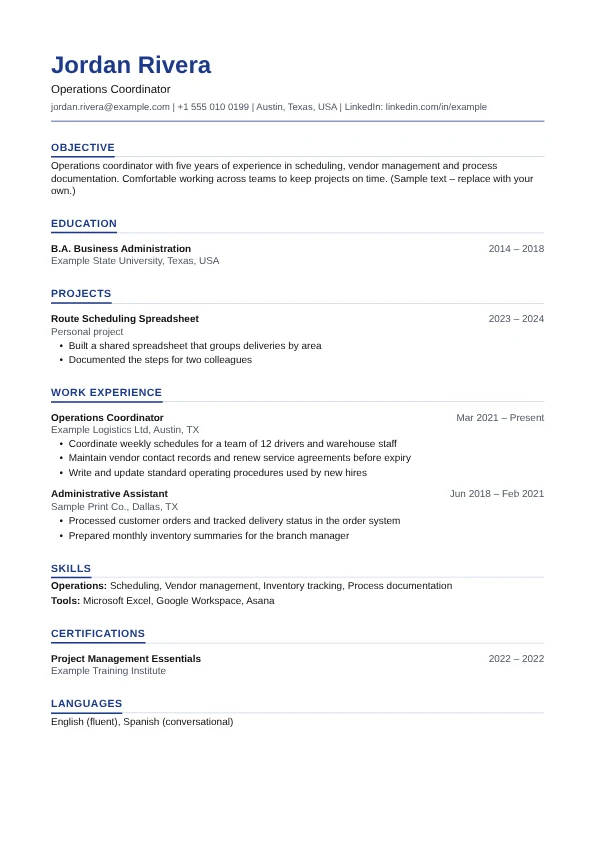
Graduate Resume
Single column

ATS Classic
Single column
General guidance for job seekers, not legal or immigration advice. Employers and applicant tracking systems differ, so always follow the instructions in the job advert. Spotted a mistake? Email support@jobb.ae.
Ready to build your resume?
Start with a sample or a blank page. No sign-up needed. Free to edit; US$1.00 only if you download a PDF.