
Students and Fresh Graduates
Skills for student and graduate resumes – Page 2
How do I turn what I learned in my degree into skills on my resume?
Translate course content into the practical skills an employer would recognise. A module title is not a skill; what you can do after the module is.
Examples:
- "Corporate Finance module" becomes "Discounted cash flow valuation, ratio analysis".
- "Research Methods" becomes "Survey design, interviews, thematic analysis".
- "Structural Analysis" becomes "Load calculations, use of SAP2000".
- "Digital Marketing" becomes "SEO basics, campaign planning, Google Analytics".
Look at your assignments: what did you produce, and with what tools? Those are your skills. Keep module names for the Education section if they are useful, and keep the skills section for the abilities themselves.
What lab skills should a science graduate list?
List the specific techniques and instruments you used yourself, not everything you saw demonstrated. Science employers look for precise, recognisable terms.
Examples by area:
- Biology and biomedical: PCR, gel electrophoresis, cell culture, ELISA, microscopy.
- Chemistry: titration, HPLC, GC-MS, spectroscopy, safe chemical handling.
- General: lab safety procedures, accurate record keeping, data analysis in Excel or R.
Example skills line: "Laboratory: PCR, gel electrophoresis, aseptic technique, pipetting and serial dilutions."
If you used a technique in a research project or placement, mention it in that bullet too, so the employer sees the context.
How should design students list software skills?
List the design software you can use confidently, grouped by purpose, and let your portfolio prove the level. Design employers judge mostly from your work, so the list just needs to be accurate.
Example:
"Design: Figma, Adobe Illustrator, Photoshop, InDesign
Motion and video: After Effects, Premiere Pro (basic)
Other: HTML and CSS basics, Canva, Procreate"
Tips:
- Put the software named in the job advert first.
- Add design methods too if relevant, such as wireframing, user research or typography.
- Include a portfolio link in your contact details.
What software should an engineering graduate list?
List the engineering and analysis tools you used in projects or placements, plus any general tools the job needs. Group them so the list is easy to scan.
Examples by discipline:
- Mechanical: SolidWorks, AutoCAD, ANSYS, MATLAB.
- Civil: AutoCAD, Revit, ETABS, SAP2000, Primavera P6 basics.
- Electrical: MATLAB/Simulink, PLC programming basics, circuit simulation software.
- General: Excel, MS Project, Python for calculations.
Example: "CAD and modelling: SolidWorks, AutoCAD (2D drafting) | Analysis: MATLAB, ANSYS (basic FEA)".
Show at least one main tool in a project bullet, such as "Designed a gearbox housing in SolidWorks and checked stresses with basic FEA."
Which data skills should a business student put on a resume?
Put the tools and methods you can use with real data, especially Excel, plus any extra tools you learned such as SQL or a dashboard tool. Data skills help business graduates stand out across finance, marketing and operations roles.
Common items:
- Excel: pivot tables, lookups, charts.
- Dashboards: Power BI or Tableau basics.
- Databases: SQL queries for filtering and joining tables.
- Analysis: descriptive analysis, forecasting basics, survey analysis.
Example bullet: "Built a Power BI dashboard from a public sales dataset to compare regional performance, as part of a self-study project."
If you are new to these tools, one small, finished project is enough to start listing them honestly.
Is using Instagram and TikTok a skill I can put on my resume?
Using social media personally is not a skill, but creating content, growing an account or running pages for others can be. The difference is whether you did something an employer would pay for.
Can count as skills:
- Planning and scheduling content for a society or small business.
- Editing short videos with tools such as CapCut or Premiere Pro.
- Reading platform insights and adjusting posts.
- Writing captions in a brand's style.
Example: "Managed the student society's Instagram account, planning weekly posts and doubling event sign-ups compared with the previous year." Only use results you can check from the account's insights.
Should I include my typing speed on my resume?
Only if the job involves a lot of typing, such as data entry, transcription, administration or customer support by chat. For most other roles it is not needed.
If you include it:
- Use a recent result from a reputable typing test.
- Give words per minute and, if possible, accuracy, for example "Typing: 65 words per minute with high accuracy".
- Put it in the skills section, not the summary.
Be ready to take a typing test at the assessment stage, as some employers run their own.
Should I list "hard-working" and "punctual" as skills?
No. Words such as hard-working, punctual, motivated and fast learner are qualities every applicant claims, so they take up space without convincing anyone.
Do this instead:
- Show hard work through facts, such as working part time while studying.
- Show punctuality through reliability, such as being trusted to open the shop.
- Show fast learning through what you learned and how quickly, such as "Learned the booking system in my first week and trained the next new starter."
Keep the skills section for skills you could be tested on: software, languages, methods and techniques.
Can I list ChatGPT or other AI tools as a skill?
Yes, if you have used them for real work and can explain how, and if the role values it. List the actual use, not just the tool name.
Examples:
- "AI tools: used ChatGPT and Copilot to draft code tests and research summaries, checking all output manually."
- "Prompt writing for content drafts, with editing and fact-checking."
Be careful:
- Many employers want to know you can work without AI, so do not let it replace core skills.
- Do not claim deep AI or machine learning knowledge if you have only used chat tools.
- Make sure the resume itself is in your own words and accurate.
How should I group skills on a student resume?
Group them into two to four clear categories, so recruiters can find what they need quickly. Category names should be simple and match your field.
Example for a business student:
"Software: Excel (pivot tables, XLOOKUP), PowerPoint, Power BI (basic)
Languages: English (fluent), Arabic (native), French (basic)
Analysis: market research, financial ratio analysis, survey design"
Example for a computer science student:
"Languages: Python, Java, SQL
Tools: Git, Docker, VS Code
Concepts: REST APIs, data structures, unit testing"
Avoid a separate "Soft skills" list; show those through your bullets instead.
Can I list skills I taught myself from YouTube or online tutorials?
Yes. Employers care whether you can use a skill, not where you learned it. Self-taught skills can even show initiative, as long as you can prove them.
How to make them credible:
- Build something with the skill: a website, a video, a spreadsheet model, a small app.
- Mention the project in a bullet or a Projects section.
- Add a link to a portfolio or code repository if relevant.
Example: "Video editing (self-taught): edited and published 20 short tutorials for a student channel using DaVinci Resolve."
You do not need to write "self-taught" next to every skill. Just make sure you can demonstrate it.
How do I show self-taught coding skills without a computer science degree?
Show what you built. For self-taught coders, finished projects and a public code repository are the main evidence employers look for.
Steps:
- List your languages and tools in the skills section, with honest levels.
- Add a Projects section with two or three projects, each with a one-line description and the technologies used.
- Link to your GitHub or portfolio in the contact details.
- Add any assessed courses or certifications that support the skills.
Example: "Weather dashboard web app | JavaScript, React, public weather API | Fetches and displays a 5-day forecast with search by city."
Mention in your summary that you are a business, science or arts graduate who builds software, so the mix makes sense. Keep your code tidy and add a short README to each project, because employers may open it.
Can skills from my hobbies go on my resume?
Yes, when the hobby gave you a skill the employer can use. Present it as a skill, with evidence, rather than just as an interest.
Examples:
- Photography: "Photo editing in Lightroom; shot product photos for two local businesses."
- Gaming: "Built and moderated a community server of 300 members" shows community management.
- Writing: "Run a book review blog with weekly posts" shows writing and consistency.
- Music: performing shows confidence; producing shows audio software skills.
If the hobby does not give a relevant skill, it can still go in a short Interests line, but keep it to one line and make it specific.
What research skills can an undergraduate put on a resume?
List the methods, tools and stages of research you actually carried out, such as literature reviews, data collection, analysis and report writing.
Examples:
- "Literature review: searched and summarised 40 peer-reviewed sources for a dissertation on renewable energy policy."
- "Survey design and analysis: built a questionnaire in Google Forms and analysed 150 responses in SPSS."
- "Qualitative research: conducted and coded eight semi-structured interviews."
Research skills are useful well beyond academia: consulting, policy, marketing, user research and analysis roles all value them. Name your software (SPSS, NVivo, R, Excel) because adverts often ask for it.
How do I show presentation skills on my resume?
Mention a specific presentation, the audience and the setting. Size and type of audience tell employers more than the word "confident".
Examples:
- "Presented my final-year project to a panel of lecturers and industry judges."
- "Delivered a 15-minute talk on campus sustainability at the student research conference."
- "Led weekly product demonstrations for customers at a part-time electronics job."
If you have taken part in debating, Model United Nations or public speaking competitions, these are strong evidence as well. In your skills section you can simply write "Presenting to groups" and let the bullets do the proving.
How can I show I work well in a multicultural team?
Give examples of working, studying or volunteering with people from different backgrounds, and mention languages where relevant. This is particularly valued in diverse workplaces such as the UAE and wider Gulf.
Evidence you can use:
- Group projects with international classmates.
- Customer-facing jobs serving people from many countries.
- Study abroad or exchange semesters.
- Languages you speak.
Example: "Worked in a six-person project team with members from five countries, agreeing roles and deadlines across different time zones."
Avoid stating nationalities of colleagues in detail; "from five countries" is enough.
How do I prove attention to detail on my resume?
Show it in two ways: through examples of accurate work, and through a resume with no errors. A typo next to "attention to detail" undoes the claim instantly.
Examples of evidence:
- "Checked supplier invoices against delivery notes in a part-time admin job."
- "Proofread the student newspaper before each print edition."
- "Recorded lab results accurately in line with safety and reporting procedures."
Then proofread your resume carefully: consistent dates, aligned formatting, the same spelling throughout. Ask a friend to check it too. Neatness is part of the evidence.
Should I use a heading called "Computer Skills"?
You can, but it is better to name specific tools than to use a broad heading full of general items. A "Computer Skills" list with "Internet" and "Email" looks dated.
Better options:
- Use a heading like "Technical Skills" or "Software and Tools".
- List named programs with what you can do, such as "Excel (pivot tables)".
- Leave out basics everyone is expected to have, unless the advert asks for them.
If you are applying for a role where basic computer use is genuinely being assessed, such as some entry-level admin jobs, then listing Microsoft Office and typing speed makes sense.
What do "beginner", "intermediate" and "advanced" mean for skills?
There is no official standard, so define your level by what you can do on your own. A safe approach is to match the words to independence.
- Beginner or basic: you know the basics and need guidance or reference material for most tasks.
- Intermediate: you can complete common tasks on your own and solve normal problems.
- Advanced: you can handle complex tasks, troubleshoot others' work and teach the skill.
Example: "Python (intermediate): data cleaning with pandas, simple scripts, basic visualisation."
When in doubt, choose the lower label and add specifics. It is much better to impress in an interview than to disappoint.
I don't have many skills to list. Is that a problem?
Not necessarily. Graduate employers expect you to be early in your career. A short, honest list backed by evidence is better than a long, padded one.
Ways to strengthen a short list:
- Look again at your coursework, projects and jobs: you probably used more tools than you think.
- Learn one skill that appears in most adverts for your target role, such as Excel or SQL, and use it in a small project.
- Add languages, certifications or relevant courses.
Then let the rest of your resume carry weight: your degree, projects, part-time work and activities. A skills section with five to eight real items is perfectly fine.
The job advert lists a skill I'm only starting to learn. Can I include it?
Yes, if you label it honestly. Writing "learning" or "basic" is acceptable and shows initiative; claiming you are proficient is not.
Ways to word it:
- "SQL (basic; currently completing an online course)"
- "Tableau (learning; built one practice dashboard)"
Also mention it in your cover letter if it is a key requirement, explaining what you are doing to build it. If you are invited to interview, be ready to show what you have learned so far. Never list a skill you have not started at all.
Should I list university career workshops and training sessions?
Only if they are substantial and relevant. A one-hour CV workshop is not worth a line, but a multi-week leadership programme or an employer-run skills course can be.
Worth including:
- Programmes with an assessment or certificate.
- Employer-run training, such as a bank's finance skills week.
- Training linked to the job, such as a first aid or data protection course.
Not worth including:
- Single short talks or employability sessions.
- Workshops you only attended briefly.
List the worthwhile ones under "Professional Training" with the name, organiser and year.
How do I list an online course from a famous university without misleading anyone?
Write the course name, the university and the platform, and make clear it was an online course. Do not put it in your Education section in a way that suggests you studied at that university.
Example: "Financial Markets (online course, Yale University via Coursera), 2025"
Avoid:
- Listing the university as if you were enrolled there.
- Calling a short online course a "diploma" or "degree".
- Leaving out the platform so it looks like campus study.
Recruiters know these courses and many respect them. Being precise keeps your credibility and avoids awkward interview questions.
Should soft skills go in my summary or my skills section?
Put one or two soft skills in your summary, linked to evidence, and keep the skills section mainly for hard skills. Soft skills on their own in a list are easy to ignore.
Example summary line: "Marketing graduate with strong writing skills, shown through two years as editor of the student magazine."
Example skills section: "Canva, Adobe Premiere Pro, Meta Business Suite, copywriting, SEO basics."
Then use your bullets to show other soft skills, such as teamwork or leadership, in action. This spreads the evidence across the page rather than stacking adjectives in one place.
How do I show numeracy skills for finance or banking roles?
Point to coursework, tools and tasks that involved working accurately with numbers, and name the methods. Banks and finance employers often test numeracy, so your resume should show you are comfortable with it.
Evidence ideas:
- Modules: accounting, quantitative methods, financial modelling.
- Tools: Excel formulas and models, financial calculators.
- Work: handling cash, reconciling tills, preparing simple reports.
- Activities: treasurer of a society, managing a club budget.
Example: "Treasurer, Business Society: tracked income and spending for events and presented a termly budget report to the committee."
Templates to try
Free to edit and preview. Single-column layouts are the safest choice for applicant tracking systems.
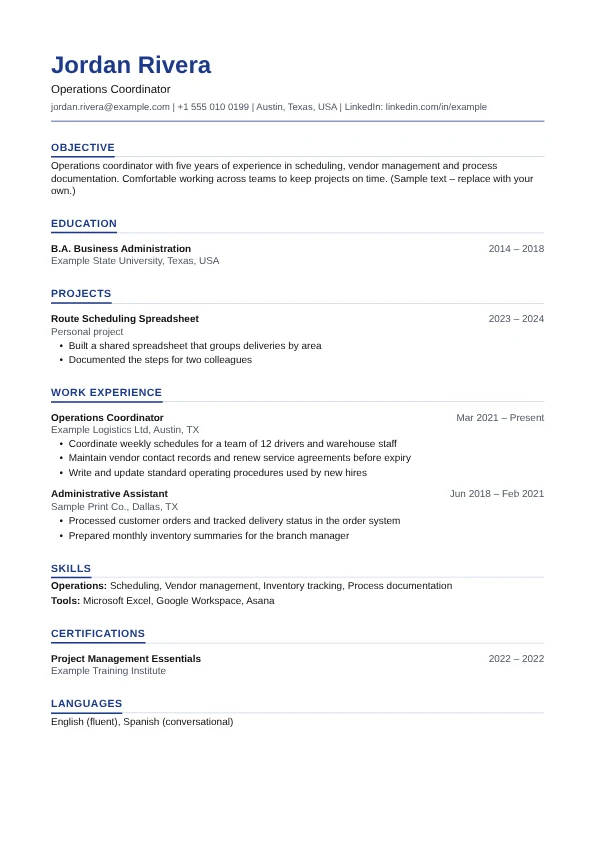
Graduate Resume
Single column

Student Resume
Single column

ATS Classic
Single column
General guidance for job seekers, not legal or immigration advice. Employers and applicant tracking systems differ, so always follow the instructions in the job advert. Spotted a mistake? Email support@jobb.ae.
Ready to build your resume?
Start with a sample or a blank page. No sign-up needed. Free to edit; US$1.00 only if you download a PDF.