
CV Guidance by Country
United States CV and resume guidance – Page 3
Do I need a separate "Skills" section on a US resume?
Yes, a short skills section is standard on US resumes. It helps recruiters and applicant tracking systems see your tools and technical skills quickly. Keep it focused and grouped.
Example:
"Skills
Software: Excel (pivot tables, XLOOKUP), QuickBooks, Salesforce
Languages: English, Spanish (fluent)
Certifications: Lean Six Sigma Green Belt"
Tips:
- Mirror relevant terms from the job description where they are true for you.
- Avoid rating bars or percentage graphics.
- Prove key skills in your experience bullets too.
Can I send a European-style CV to US employers?
It is better not to. A European-style CV, with photo, date of birth, nationality and several pages, does not match US expectations. Convert it to a US resume: one or two pages, no personal details or photo, achievement-focused bullets and US Letter size.
Changes to make:
- Remove photo, birth date, nationality, marital status.
- Shorten to the most relevant 10 to 15 years.
- Replace duty lists with achievements.
- Use American spelling.
- Translate qualifications and grades into understandable terms.
How should a career changer write a US resume?
Lead with a summary that names your new target role and the transferable skills you bring, then show relevant training and projects before or alongside your work history. US recruiters respond to clear direction and evidence.
Structure:
- Summary: "Former restaurant manager moving into HR, with experience hiring and training teams of 30 and a SHRM-CP in progress."
- Relevant skills or projects.
- Work experience, with bullets chosen for transferable results.
- Education and certifications.
The CareerOneStop resume guide also covers changing careers and other special circumstances.
Sources
- Resume Guide (CareerOneStop, sponsored by the U.S. Department of Labor)
How do I convert metric units and foreign currency on a US resume?
Convert currency to US dollars or describe results without amounts, and give imperial units where they help a US reader, keeping metric where your field uses it. Hiring managers should be able to understand your results without converting them.
Tips:
- For money, use rounded US dollar equivalents or relative results, such as "the company's largest account".
- Engineering, science and medicine often use metric in the US too; keep metric there.
- For construction, logistics and real estate, US readers often think in feet, square feet, miles and pounds.
Example: "Managed a 20,000 sq ft warehouse" instead of square metres for a US logistics role.
How should a doctor trained abroad present a CV for US medical roles?
Use a medical CV format with education, training, licensing and examination status, clinical experience, research and publications, and present everything accurately with its country and dates. US medical recruitment and residency applications use their own systems and requirements, so check those official instructions for what is required.
General tips:
- List medical school, internship and residency with dates and locations.
- State your US licensing exam or certification progress accurately, as reported by the official body.
- Include clinical rotations or observerships in the US, if any.
- List research and publications.
Do not claim US licensure or eligibility you do not have.
Templates to try
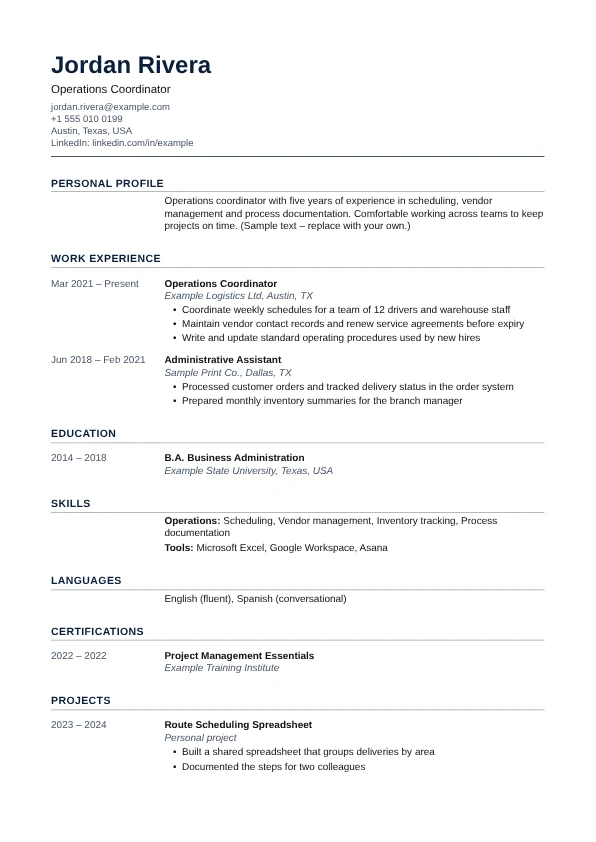
Free to edit and preview. Single-column layouts are the safest choice for applicant tracking systems.
International CV
Two-column entries (more complex)

ATS Classic
Single column

ATS Professional
Single column
General guidance for job seekers, not legal or immigration advice. Employers and applicant tracking systems differ, so always follow the instructions in the job advert. Spotted a mistake? Email support@jobb.ae.
Ready to build your resume?
Start with a sample or a blank page. No sign-up needed. Free to edit; US$1.00 only if you download a PDF.